IRS IRIS System Replacing FIRE: What CPA Firms Need to Know for 2027
Summary
The IRS is transitioning from the legacy FIRE (Filing Information Returns Electronically) system to the modernised IRIS (Information Returns Intake System), with FIRE scheduled for full decommission by January 2028.
IRS IRIS System Replacing FIRE: What CPA Firms Need to Know for 2027
Key Takeaways
• The IRS is transitioning from the legacy FIRE (Filing Information Returns Electronically) system to the modernised IRIS (Information Returns Intake System). FIRE is scheduled for full decommission by January 2028.
• IRIS is a cloud-based, browser-accessible platform supporting 1099 electronic filing through a web portal or API — eliminating the fixed-width file formats and batch processing delays that made FIRE frustrating for CPA firms.
• CPA firms must update workflows, train staff, test IRIS access, and verify that their tax software (CCH Axcess, UltraTax, Lacerte, Drake) integrates with the new system. Do this before the transition deadline to avoid filing disruptions.
• The transition creates a short-term compliance workload surge — the kind of operational work that offshore teams absorb efficiently. That frees your partners and managers for client advisory.
• Firms that prepare now gain a competitive advantage over those scrambling at deadline — and adding dedicated offshore capacity ensures the transition doesn’t overwhelm your existing team.
The IRS doesn’t change its core technology infrastructure very often — so when it does, every CPA firm that files information returns needs to pay attention. The transition from FIRE to IRIS is one of the most significant operational changes the IRS has made in decades. It directly affects your firm’s 1099 filing workflow, your staff’s processes, and your technology stack.
FIRE — Filing Information Returns Electronically — has been the backbone of information return filing since the 1990s. It uses fixed-width file formats, batch processing, and an interface that predates the modern internet. It works, but its age shows: limited error feedback, no real-time processing, and an enrollment process unchanged in twenty years.
IRIS — the Information Returns Intake System — is the modernised replacement. Built on cloud architecture, IRIS offers browser-based direct filing, API integration for tax software vendors, and real-time validation. It also supports a growing range of information return types. The IRS has been running IRIS in parallel since 2023 and confirmed FIRE’s full decommission by January 2028.
For CPA firms handling outsourced tax preparation and information return filing for hundreds of clients, this transition isn’t optional. The AICPA has urged practitioners to begin migration planning now. This guide covers what IRIS is, how it differs from FIRE, the practical timeline, and what your firm needs to do. It also covers how offshore teams can absorb the transition workload so your domestic staff stays focused on clients.
What Is the IRIS System?
IRIS is the IRS’s next-generation platform for electronically filing information returns. It was developed as part of the broader IRS modernisation initiative funded partly by the Inflation Reduction Act. It replaces FIRE with modern cloud-based technology designed for today’s API-driven, real-time data processing environment.
IRIS operates through two primary channels. The Taxpayer Portal is a browser-based interface where filers manually enter, review, and submit information returns directly through a web application — no proprietary software installation required, no special file formats to generate. This is useful for small firms or businesses filing limited returns. The Application-to-Application (A2A) channel is an API-based integration. It allows tax software vendors and large-volume filers to transmit returns electronically through automated systems. This is how most CPA firms will interact with IRIS — through their existing software (CCH Axcess, UltraTax CS, Lacerte, Drake), which connects to IRIS via API rather than FIRE’s legacy protocol.
Key improvements over FIRE include real-time validation with immediate error feedback during filing (versus FIRE’s hours-long batch rejection cycle), and streamlined correction workflows through the same interface as original filings. Add a modernised dashboard with real-time filing status tracking, enhanced security with multi-factor authentication, and support for a growing list of information return types. The IRS has confirmed IRIS will eventually support all forms currently filed through FIRE — all 1099 variants (1099-NEC, 1099-MISC, 1099-INT, 1099-DIV, 1099-R, 1099-S, 1099-B), W-2G, 1098, 3921, 3922, and others — with the most common forms already fully supported.
For firms managing high-volume bookkeeping outsourcing that generates the underlying data for 1099 filings, IRIS’s real-time validation alone represents a significant workflow improvement. Errors caught during submission, rather than days late, will eliminate the costly reject-fix-resubmit cycle that consumes preparer hours under FIRE.
How IRIS Differs from FIRE
Understanding the specific differences between FIRE and IRIS is essential for planning your firm’s transition strategy and updating your standard operating procedures.
On the technical architecture, FIRE uses fixed-width flat file formats requiring exact character-by-character alignment — technology from the early 1990s. Any formatting error, even a single misplaced character, causes the entire batch to be rejected with minimal diagnostic information. Debugging FIRE rejections often requires manually inspecting raw text files character by character. IRIS uses modern data formats (XML/JSON through the API, structured web forms through the portal) with field-level validation and specific, actionable error messages. These identify exactly which data element has an issue.
On processing speed, FIRE operates as batch processing — submit a file, wait hours or days, receive a status report. IRIS processes near-real-time for portal submissions and provides rapid feedback for API transmissions. This eliminates the submit-reject-fix-resubmit cycle that Accounting Today has repeatedly cited as one of the most frustrating aspects of information return filing for practitioners.
On enrollment, FIRE requires a Transmitter Control Code (TCC) obtained through a paper-based application process taking weeks. IRIS uses the IRS’s modernised identity platform with ID.me verification and mandatory multi-factor authentication. Each authorised user needs individual identity verification rather than sharing a firm-wide TCC — a security improvement that creates an enrollment planning requirement.
On corrections, FIRE required separate correction files with formatting requirements different from original filings — a common error source. IRIS streamlines corrections through the same interface. The system automatically tracks the relationship between original and corrected returns. For firms processing sales tax compliance and information returns simultaneously, this workflow simplification is meaningful.
On direct filing capability, IRIS supports filing through the web portal without requiring tax software. This provides a useful backup channel during software outages and a practical option for ad hoc filings outside normal workflows — flexibility that FIRE never offered.
Timeline: When Your Firm Needs to Transition
The IRS has published a phased transition timeline that every CPA firm should incorporate into its operational planning calendar. Waiting until the deadline creates unnecessary risk and stress.
IRIS has been available for voluntary use since January 2023 for Forms 1099. The IRS has encouraged filers to begin using IRIS alongside FIRE to familiarise teams with the new system. Most major tax software vendors — including Wolters Kluwer (CCH), Thomson Reuters (UltraTax), and Intuit (Lacerte) — now support IRIS filing for common 1099 types, though integration depth varies by vendor and version.
Through 2026, the IRS is expanding IRIS capabilities and adding form type support while beginning to reduce FIRE functionality. The AICPA has published guidance urging practitioners to begin testing IRIS during non-peak months. That is when there’s time to troubleshoot without deadline pressure. Firms that haven’t tested IRIS should do so now — not during the January-February information return filing crunch.
By January 2027, FIRE enters a formal “sunset” period with reduced support, no new features, and no new TCC applications. New filers are directed exclusively to IRIS. Existing FIRE filers receive increasingly direct migration communications from the IRS.
By January 2028, FIRE is fully decommissioned. All information return electronic filing goes through IRIS exclusively. Firms that haven’t migrated will be unable to file electronically — creating compliance violations for firms exceeding the IRS electronic filing thresholds.
The practical advice: start testing now. File a small batch of 1099s through IRIS this year. Verify software integration. Train staff on the new interface. Update SOPs. Firms that test now will be fully ready when FIRE goes dark. Firms that wait will face overwhelmed IRS support queues, software vendor scrambles, and stressed staff learning a new system during peak season.
What CPA Firms Need to Do Now
Here’s the action plan for CPA firms preparing for the IRIS transition, broken down into concrete steps your team can begin executing immediately.
Verify your software vendor’s IRIS readiness. Contact your tax software vendor and confirm their current version supports IRIS filing for your form types. Ask about their A2A API integration status, their timeline for forms not yet supported, and whether you need a software update. Thomson Reuters and Wolters Kluwer have published IRIS readiness guides for their respective platforms — review them.
Enrol your team in IRIS. Each person who will submit information returns needs an IRIS account through IRS identity verification. This requires ID.me verification with a government-issued photo ID — typically 15–30 minutes per person, but processing times spike during peak periods. Enrol early. This includes your offshore team members who prepare information returns — they access IRIS through your firm’s VPN and need individual verification.
Conduct a test filing. Before your next filing deadline, file a small batch of returns through IRIS. Document differences from your FIRE workflow, identify issues, and update procedures. This test filing is your firm’s insurance policy against transition surprises during production season.
Update your SOPs. Your standard operating procedures need revision for IRIS’s different error handling, correction workflows, filing confirmations, and user authentication. Staff trained exclusively on FIRE need updated step-by-step guides. Share updated SOPs with your offshore team so everyone operates from the same playbook.
Plan for the workload surge. The transition creates operational work — enrollment, testing, SOP updates, training, and vendor coordination. This pulls partners away from billable advisory work. This is precisely where offshore capacity through Acculink CPA provides maximum value. Your offshore team handles the increased compliance workload at $8–$35/hour while your domestic team manages the migration and serves clients.
Technology Requirements and Access
IRIS’s technology requirements are fundamentally different from FIRE’s legacy setup — and generally simpler for end users, which is good news for firms with diverse team setups.
For portal access, IRIS works through any modern web browser — Chrome, Firefox, Edge, Safari. No proprietary software, no Java applets, no browser plugins. Each user needs an IRS account verified through ID.me with a government-issued photo ID and selfie-based verification. Multi-factor authentication is mandatory.
For A2A access, your tax software vendor handles the API integration transparently. The vendor connects to IRIS using OAuth 2.0 authentication and transmits return data in XML/JSON format. This is invisible to end users working within their software — but verify with your vendor that the integration is configured and tested.
Internet requirements are straightforward — stable broadband over standard HTTPS connections. Unlike FIRE, which had compatibility issues with specific ISP configurations and firewalls, IRIS works through virtually any modern network setup.
The per-user enrollment model is the biggest operational change. FIRE’s shared TCC meant anyone with the code could submit. IRIS requires individual identity verification for each authorised submitter — a security improvement that eliminates shared credential risks but requires enrollment planning. Each team member — whether in your domestic office or through your offshore staffing provider — needs to complete the verification process individually.
For firms with offshore teams, IRIS is browser-accessible from any location with internet access. Offshore professionals access IRIS through your firm’s VPN infrastructure. It is the same secure connection they use for your tax software and document management systems. Acculink CPA’s IT and data security framework ensures all data transmission meets the encrypted VPN standards that both IRS requirements and IRS §7216 compliance demand.
Impact on Tax Season Workflow
The IRIS transition changes several aspects of your information return filing workflow. Understanding these changes in advance prevents surprises during production season.
The biggest positive change is real-time error feedback. Under FIRE, you’d submit a batch, wait hours or days, then receive a rejection with cryptic error codes requiring research to interpret. Under IRIS, validation happens during submission — you know immediately whether there’s an issue and receive specific descriptions of what needs fixing. This eliminates the rejection cycle and should reduce total filing time for firms that frequently deal with FIRE rejections.
The correction process improvement is equally significant. FIRE corrections required separate file formats with different specifications than original filings — a notorious error source that the Journal of Accountancy has documented as one of practitioners’ top frustrations. IRIS allows corrections through the same interface as original filings, with automatic correction linkage. This simplifies one of the most error-prone parts of information return compliance.
Filing status tracking gets a major upgrade. IRIS provides a real-time dashboard showing all filed returns, acceptance status, pending corrections, and filing history. For firms managing 1099 filings for hundreds of bookkeeping clients, this visibility is transformative compared to FIRE’s delayed status reports.
For high-volume filers processing hundreds or thousands of 1099s during January-February, expect a temporary productivity dip. Staff need time to adjust to new interfaces and procedures. This is normal for any system transition. It is precisely where having additional offshore capacity matters — maintaining your filing pace while your onshore team adapts.
The bottom line: IRIS is better than FIRE in every meaningful way once your team is proficient. But transitions involve learning curves. Firms that start early experience the smoothest adjustment with the least client-service disruption.
How Offshore Teams Help with the Transition
The IRIS transition creates three categories of additional work where offshore teams from providers like Acculink CPA deliver measurable value to CPA firms managing the migration.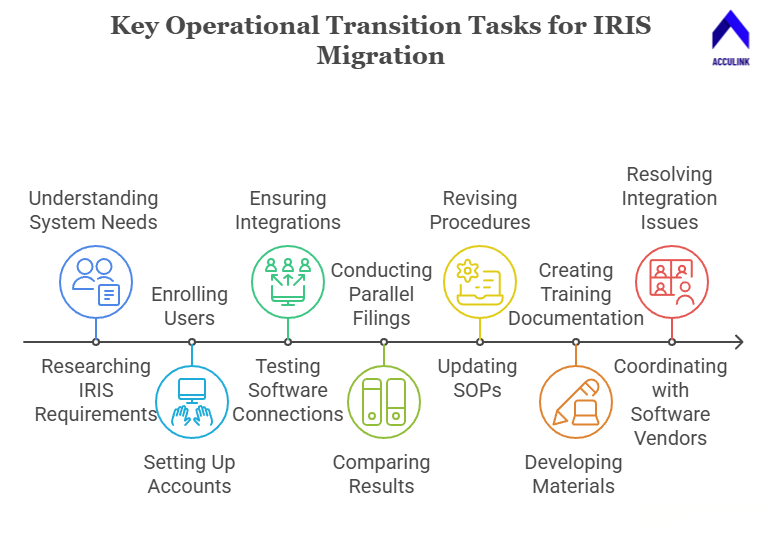 First, the operational transition work itself: researching IRIS requirements, enrolling users, testing software connections, conducting parallel filings comparing FIRE and IRIS results, and updating SOPs. Add creating training documentation and coordinating with software vendors on integration issues. This is detail-oriented, documentation-heavy work that requires accuracy but not partner-level judgment. An offshore professional trained on your systems handles the research, documentation, testing, and SOP revision under your supervision — freeing your domestic team for client-facing work.
Second, maintaining ongoing compliance throughput during the transition. Your firm doesn’t pause information return filing while switching systems. 1099s still need preparation, review, and filing on schedule. Payroll-related information returns are still generated. Corrections still need processing. Offshore capacity ensures the transition doesn’t create compliance bottlenecks that delay client deliverables or miss filing deadlines.
Third, post-transition optimisation. Once your firm is operational on IRIS, there are opportunities to improve workflows and leverage real-time validation to reduce error rates. You can also build more efficient correction processes. Offshore team members who participated in the transition contribute to identifying efficiencies. They have firsthand experience with the system’s capabilities and limitations.
Acculink CPA provides dedicated professionals who function as genuine team extensions. They’re trained on CCH Axcess, UltraTax CS, Lacerte, Drake, and other major platforms. They adapt to system changes alongside your domestic staff because they work in your systems daily. With flexible engagement models starting at $8/hour, a 40-hour free trial, and no long-term contracts, the barrier is low. Adding offshore capacity for the IRIS transition is a low-risk, high-return investment in operational continuity.
For firms already filing large volumes of information returns, the IRIS transition is also an opportunity to evaluate whether your staffing model is optimised. If your domestic team is stretched thin during the 1099 season under the current system, take note. The additional transition workload is a clear signal that you need more capacity — and offshore staffing remains the most cost-effective way to add it. Learn more about why 80+ CPA firms trust Acculink for exactly this type of capacity challenge.
Frequently Asked Questions
When will FIRE be fully shut down?
The IRS has scheduled FIRE for full decommission by January 2028, with a sunset period beginning January 2027. Firms should begin migrating to IRIS now to avoid last-minute complications.
Do I need new software for IRIS?
Most major platforms — CCH Axcess, UltraTax CS, Lacerte, Drake — already support IRIS filing through A2A API integration. Confirm with your vendor that your current version includes IRIS support.
Can my offshore team access IRIS?
Yes. IRIS is browser-based and accessible from any location with internet. Offshore team members at Acculink CPA access IRIS through your firm’s encrypted VPN, provided they’ve completed IRS identity verification.
What forms does IRIS currently support?
IRIS supports most 1099 types (1099-NEC, MISC, INT, DIV, R, S, B), W-2G, and additional forms being added regularly. Check the IRS IRIS portal for the current complete list.
How long does IRIS enrollment take?
Individual enrollment takes 15–30 minutes per user via ID.me. Processing times increase during peak periods. Enrol early — don’t wait until January when every practitioner in the country is trying to access the system.
Will IRIS change the state information return filing?
IRIS is a federal system. State requirements vary by jurisdiction. States participating in the Combined Federal/State Filing program are expected to align processes with IRIS over time. Check your state’s specific guidance.
References
IRS IRIS Information Returns Intake System — IRS — e-file Forms 1099 with IRIS
IRS FIRE System Information — IRS FIRE system (information returns)
IRS Strategic Operating Plan — IRS Strategic Plan
American Institute of CPAs (AICPA) — American Institute of CPAs (AICPA)
Thomson Reuters Tax & Accounting — Thomson Reuters Tax & Accounting
Wolters Kluwer — Wolters Kluwer
IRS Section 7216 Information Centre — IRS Section 7216 Information Center
Journal of Accountancy — Journal of Accountancy
About Acculink CPA
Acculink CPA is a premier offshore staffing and outsourcing company purpose-built for CPA firms, accounting firms, and tax firms in the United States, Canada, and the UAE. With a team of 300+ qualified professionals — including CPAs, Chartered Accountants, Enrolled Agents, and Big 4-trained staff — Acculink provides dedicated offshore accountants, bookkeepers, tax preparers, auditors, virtual CFOs, and virtual assistants at $8–$35/hr, delivering up to 75% cost savings compared to domestic hiring. The company is ISO 27001 certified, SOC 2 Type II aligned, IRS §7216 compliant, and GDPR compliant, with zero security breaches in 5+ years of operations. Acculink offers a 40-hour free trial with no setup fees, no recruitment charges, and no long-term contracts. Over 80 CPA firms across the United States trust Acculink to deliver quality, security, and scalability.
Website: Acculink CPA | Schedule a Call: book a 45-minute call | Email: Info@acculinkcpa.com | Phone: +1 (203) 997-0224
Tags:
About the Author

Related Posts

Hire Offshore Accountants for CPA & Accounting Firms – Why Outsourced Accounting Works
How to hire an offshore accountant for your CPA firm — month-end close, GL, GAAP reporting, in your software —…

Accounting Outsourcing Services for CPA & Accounting Firms – Why Outsourcing Works
Accounting outsourcing lets CPA firms add capacity without adding headcount. Why outsourced accounting service…

Business Formation Outsourcing for CPA & Accounting Firms – Why Outsource Entity Setup
How outsourcing business-formation support helps CPA firms — entity selection, EIN, S-election (2553), Delawar…