IRS Budget Cuts and Workforce Reductions: What CPA Firms Should Know

Summary
The IRS has experienced unprecedented leadership instability in 2025–2026, with seven acting commissioners in eight months, creating organisational uncertainty that affects every practitioner\\\\\\\\\\\\\\\\\\\\\\\\\\\\\\\'s interaction with the agency.
Key Takeaways
• The IRS has experienced unprecedented leadership instability in 2025–2026, with seven acting commissioners in eight months. That creates organisational uncertainty that affects every practitioner's interaction with the agency.
• Budget cuts and workforce reductions have decreased IRS staffing by thousands of positions. The result is longer processing times, reduced phone accessibility, and slower audit resolution that directly increases CPA firm workload.
• CPA firms are absorbing the burden of IRS inefficiency through increased client communication, proactive filing strategies, extended follow-up cycles, and more power of attorney representation work.
• Offshore teams help CPA firms absorb the additional compliance workload created by IRS delays at $8–$35/hour. That frees domestic professionals for the judgment-intensive client advisory that IRS disruptions demand.
• The IRS situation is unlikely to stabilise quickly, regardless of political outcomes. That makes additional firm capacity a strategic necessity rather than a temporary measure.
Imagine running a business where your primary regulatory partner — the agency you interact with daily, the one that processes your clients’ returns, the one that answers your compliance questions — has had seven different leaders in eight months. That’s not the plot of a satirical comedy like Veep. That’s the actual IRS in 2025–2026.
The Internal Revenue Service has been through a period of institutional disruption unlike anything in its modern history. Leadership turnover at the commissioner level. Budget cuts are reducing headcount by thousands. Processing backlogs that make already-slow timelines even slower. Phone lines where the concept of “hold time” has been redefined from “inconvenient” to “might as well make lunch.”
The AICPA has raised alarms repeatedly. The National Taxpayer Advocate has published reports documenting the deterioration in taxpayer services. Accounting Today has covered the operational impacts extensively. And CPA firm partners across the country are living the consequences every day — spending more time on IRS follow-ups, fielding more client calls about delays, and absorbing workload that the IRS would normally handle.
Here’s what nobody in Washington seems to understand: when the IRS doesn’t work, CPA firms do the work instead. Every delayed refund is a client call your team handles. Every unprocessed amended return is a follow-up that your staff tracks. Every unanswered IRS phone line is an hour your partner spends on hold instead of advising clients.
This blog examines what’s happened at the IRS, how it affects your firm, and what your firm can do about it. It also covers how offshore capacity through Acculink CPA helps you absorb the additional workload without burning out your domestic team.
The IRS in 2026: What’s Changed
The IRS has experienced a perfect storm of institutional disruption that has degraded its ability to serve taxpayers and practitioners. The Government Accountability Office and Congressional Research Service have documented the changes in detail.
Leadership instability has been the most visible symptom. Seven acting IRS commissioners in approximately eight months created a vacuum of consistent strategic direction. Each leadership change brings new priorities, reorganisation discussions, and uncertainty about ongoing initiatives. The Inflation Reduction Act funding that was supposed to modernize the agency has been partially redirected. That creates budget uncertainty on top of leadership turnover.
Budget cuts have reduced the IRS workforce by thousands of positions across multiple functions. Taxpayer service representatives, correspondence processors, examination agents, and IT staff have all been affected. The National Taxpayer Advocate has documented how these reductions directly translate to longer processing times, fewer phones answered, and slower resolution of taxpayer issues.
The IRS Strategic Operating Plan, which outlined a multi-year modernisation roadmap funded by the Inflation Reduction Act, has been partially disrupted by the funding and leadership changes. Technology modernisation projects that were expected to improve processing efficiency have been delayed or scaled back. That means the efficiency gains that were supposed to offset staffing reductions haven’t materialised.
For CPA firms, this institutional disruption means every interaction with the IRS takes longer, requires more follow-up, and produces less predictable outcomes. It’s like trying to play a game where the referee keeps changing the rules mid-quarter and then doesn’t show up for the second half. You still have to play — your clients still need their returns filed, their refunds processed, and their issues resolved — but the system you depend on is operating at diminished capacity.
Impact on CPA Firms and Their Clients
The IRS’s reduced capacity doesn’t reduce the work CPA firms do — it increases it. Every function the IRS performs less effectively is a function that shifts to CPA firms. They are the intermediary between taxpayers and the agency.
Return processing delays mean more client inquiries. When the IRS takes 8–12 weeks to process a return that used to take 3–4 weeks, clients call their CPA firm asking what’s happening. Your tax preparation team prepared and filed the return correctly and on time — the delay is entirely on the IRS side — but you’re the one fielding the calls, checking status online, and reassuring anxious clients.
Correspondence processing backlogs create extended follow-up cycles. If your client receives a CP2000 notice and you respond within the deadline, the response may sit unprocessed at the IRS for months. Meanwhile, the system may generate follow-up notices assuming no response was received. Your team tracks these items, coordinates with clients, and sometimes files additional responses — all unplanned work driven by IRS inefficiency.
Audit resolution timelines have stretched significantly. Examinations that would normally conclude in 3–6 months may extend to 9–12 months or longer. Each additional month means more communication with the client, more tracking of outstanding items, and more preparation of additional documentation as the IRS makes piecemeal requests.
The Practitioner Priority Service phone line — the CPA’s direct connection to IRS operations — has become nearly unusable during peak periods. Wait times of 2–4 hours are common. Disconnections are frequent. Some practitioners report spending entire mornings trying to reach a single IRS representative to resolve one client issue. That’s senior professional time being consumed by a broken system rather than being deployed on client advisory or tax planning.
The cumulative effect: every CPA firm in America is doing more work — unpaid work, in many cases — because the IRS is doing less. Firms that were already at capacity before the IRS disruptions are now stretched past their limits. The additional strain is showing up in partner burnout, staff turnover, and missed deadlines.
How Firms Are Adapting
Forward-thinking CPA firms are adapting to the IRS reality rather than waiting for it to improve. The Journal of Accountancy has profiled several adaptation strategies that practitioners are implementing.
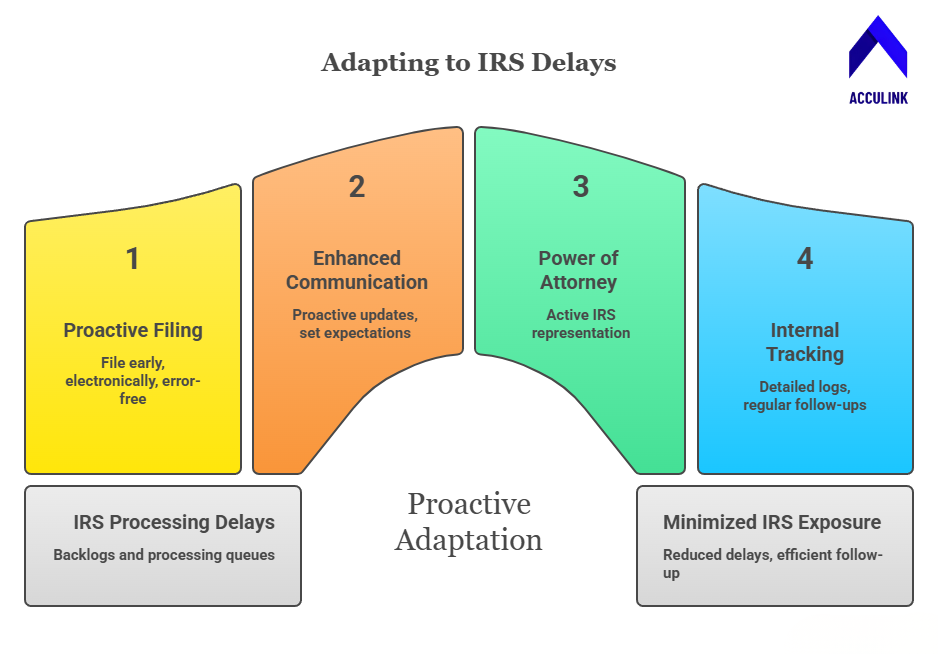
Proactive filing strategies minimise exposure to IRS backlogs. Filing electronically with direct deposit (obvious but worth emphasising), filing early in the season before processing queues build up, and preparing complete, error-free returns that don’t trigger correspondence — all reduce the likelihood of getting caught in IRS processing delays. This is where quality in preparation pays dividends: a return that doesn’t generate a CP2000 notice saves hours of follow-up work.
Enhanced client communication has become essential. Firms are sending proactive updates about IRS processing timelines, setting expectations during engagement conversations about potential delays beyond the firm’s control. They also provide clients with tools to check their own refund status through IRS.gov. The AICPA has published communication templates that firms can adapt.
Power of attorney (Form 2848) filings are increasing as firms take more active roles in IRS representation. When the IRS can’t serve taxpayers directly, CPA firms step in as representatives — which requires both the legal authority (POA) and the staffing capacity to execute.
Internal tracking systems for IRS-pending items have become more sophisticated. Firms are maintaining detailed logs of every item awaiting IRS action — filed returns pending processing, correspondence awaiting response, audits in examination, refunds in transit — and building regular follow-up cadences. This tracking work is operational overhead that offshore team members can handle efficiently. They maintain the database, running follow-up schedules, and flagging items that need partner attention.
Offshore Teams Help Absorb the IRS Workload
The additional work created by IRS disruptions falls into two categories: work that requires partner-level judgment and IRS interaction (representation, strategy, complex correspondence). The second is work that requires capacity, accuracy, and consistency (tracking, documentation, preparation, routine follow-up). Offshore teams through Acculink CPA handle the second category. That frees your domestic professionals for the first.
Specifically, offshore professionals can maintain your firm’s IRS tracking database. They monitor the status of every pending item per client and flagging items that require domestic follow-up. They can prepare response drafts for routine IRS correspondence (CP2000 responses, information document requests, penalty abatement requests) that your domestic reviewers finalise and submit. They can handle the increased tax preparation workload that the IRS situation creates — because every minute your partners spend on IRS phone hold is a minute not spent reviewing returns.
They can also compile the additional documentation that IRS delays generate. When an audit extends from 3 months to 9 months, the IRS makes additional requests. When correspondence goes unanswered, follow-up submissions require additional documentation. When clients have questions, you need updated status reports. Your offshore bookkeeping team can compile client financial data, your offshore tax preparers can draft response documents. Your domestic professionals can review, finalise, and submit.
The economic logic is straightforward: partner time on IRS phone hold costs your firm $300–$500/hour in foregone advisory billing. Offshore capacity handling the preparation work that frees up those partner hours costs $8–$35/hour. The ROI on offshore staffing during a period of IRS disruption is among the highest of any investment your firm can make.
Explore Acculink’s engagement models to see how firms structure their offshore teams for maximum flexibility, or read about why 80+ CPA firms trust Acculink for their staffing needs.
Frequently Asked Questions
How long will IRS processing delays last?
There’s no definitive timeline for IRS operational recovery. The National Taxpayer Advocate has indicated that processing capacity remains below pre-cut levels. CPA firms should plan for continued delays through at least 2027 and build offshore capacity accordingly.
What should I tell clients about delayed refunds?
Communicate proactively that IRS processing times have extended beyond historical norms due to staffing changes. Set realistic expectations during engagement, and provide the IRS Where’s My Refund tool link so clients can self-serve basic status checks.
Can offshore teams help with IRS correspondence?
Yes. Offshore professionals at Acculink CPA can draft response letters, compile supporting documentation, maintain tracking databases, and prepare routine correspondence for domestic reviewer sign-off — handling the bulk of the work while your licensed professionals handle strategy and submission.
Is the IRS leadership situation going to stabilize?
The commissioner position and budget situation remain subject to political dynamics. The GAO has recommended structural reforms, but implementation timelines are uncertain. Build your firm’s capacity model assuming continued IRS instability rather than hoping for rapid improvement.
How can I reduce my firm’s exposure to IRS delays?
File electronically with direct deposit, prepare error-free returns that don’t trigger correspondence, and maintain robust tracking systems for pending items. Then add offshore capacity to handle the increased workload that IRS delays create.
References
IRS — Internal Revenue Service (IRS)
Government Accountability Office — U.S. Government Accountability Office
National Taxpayer Advocate — IRS Taxpayer Advocate Service
Congressional Research Service — Congressional Research Service reports
AICPA — American Institute of CPAs (AICPA)
Accounting Today — Accounting Today
Journal of Accountancy — Journal of Accountancy
IRS Strategic Operating Plan — IRS Strategic Plan
About Acculink CPA
Acculink CPA is a premier offshore staffing and outsourcing company purpose-built for CPA firms, accounting firms, and tax firms in the United States, Canada, and the UAE. With a team of 300+ qualified professionals — including CPAs, Chartered Accountants, Enrolled Agents, and Big 4-trained staff — Acculink provides dedicated offshore accountants, bookkeepers, tax preparers, auditors, virtual CFOs, and virtual assistants at $8–$35/hr, delivering up to 75% cost savings compared to domestic hiring. The company is ISO 27001 certified, SOC 2 Type II aligned, IRS §7216 compliant, and GDPR compliant, with zero security breaches in 5+ years of operations. Acculink offers a 40-hour free trial with no setup fees, no recruitment charges, and no long-term contracts. Over 80 CPA firms across the United States trust Acculink to deliver quality, security, and scalability.
Website: Acculink CPA | Schedule a Call: book a 45-minute call | Email: Info@acculinkcpa.com | Phone: +1 (203) 997-0224
Tags:
About the Author

Related Posts

Hire Offshore Accountants for CPA & Accounting Firms – Why Outsourced Accounting Works
How to hire an offshore accountant for your CPA firm — month-end close, GL, GAAP reporting, in your software —…

Accounting Outsourcing Services for CPA & Accounting Firms – Why Outsourcing Works
Accounting outsourcing lets CPA firms add capacity without adding headcount. Why outsourced accounting service…

Outsourced Tax Preparation: The Ultimate Guide for U.S. Accounting Firms
Discover how outsourced tax preparation helps accounting firms reduce costs, improve efficiency, and scale tax…