How to Price Advisory Services at Your CPA Firm: A Practical Guide


Summary
Advisory pricing is ultimately about confidence. The confidence to charge what your services are worth, the confidence to walk away from clients who do not value advisory, and the confidence to invest in building an advisory practice even when the short-term economics require patience. Offshore deli
Advisory pricing is ultimately about confidence. The confidence to charge what your services are worth, the confidence to walk away from clients who do not value advisory, and the confidence to invest in building an advisory practice even when the short-term economics require patience. Offshore delivery through Acculink CPA provides the economic foundation that supports this confidence. When your delivery costs are 60 to 75 percent lower than domestic alternatives, you have the margin cushion to experiment with pricing, invest in client acquisition, and build your advisory reputation without the financial pressure that forces premature discounting or scope reduction.
The most profitable advisory practices were not built overnight. They were built by firms that priced with discipline, delivered with consistency, and invested in the team and tools needed to scale. Start with one advisory service, price it correctly, deliver it professionally using your offshore team, and let the results speak for themselves. Your clients will tell other business owners. Your reputation will grow. And your advisory revenue will compound year over year into the most profitable and fulfilling part of your practice.
Whether you choose hourly, fixed-fee, value-based, or subscription pricing, the fundamental principle remains the same: your advisory services deliver strategic value that far exceeds the fee. Price with confidence, deliver with excellence through your combined domestic and offshore team, and let the results build your reputation. The CPA firms that master advisory pricing in 2026 will be the firms that define the next decade of the profession. The firms that remain stuck in compliance-only pricing will find themselves competing on a shrinking playing field with declining margins and increasing commoditization pressure.
Pricing Models in Practice: Real-World Examples
To make advisory pricing concrete, here are three real-world examples showing how different pricing models work in practice.
Example 1: Monthly Financial Review for a 3 million dollar revenue services company. The engagement includes monthly financial statement review, 10 custom KPIs tracked in Fathom, variance analysis with written commentary, and a 30-minute monthly advisory call with the owner. Pricing: 1,200 dollars per month on a fixed-fee basis. Delivery cost with offshore support: approximately 400 dollars per month including 6 hours of offshore analyst time and 1 hour of partner time. Margin: 67 percent. The client receives professional monthly insights that previously cost them nothing because no one was providing them, and the value in improved financial decision-making far exceeds the 14,400 dollar annual fee.
Example 2: Virtual CFO engagement for a 12 million dollar revenue manufacturing company. The scope includes weekly cash flow management and 13-week forecasting, monthly financial close review with executive summary, quarterly board reporting package, annual budgeting with monthly reforecast, ad hoc strategic analysis as needed up to 8 hours per month, and biweekly advisory calls. Pricing: 5,500 dollars per month on a subscription model. Delivery cost: approximately 2,200 dollars per month including 25 hours of offshore virtual CFO time, 5 hours of partner time, and advisory tool subscriptions. Margin: 60 percent. The client gets a dedicated financial advisor at a fraction of the cost of hiring a full-time CFO at 200,000 to 300,000 dollars per year.
Example 3: FP&A project for a startup raising Series A funding. The scope includes a 3-year financial model with revenue projections, unit economics analysis, investor-ready financial projections deck, scenario modeling for three growth cases, and cap table analysis. Pricing: 15,000 dollars as a fixed-fee project with 2 revision rounds. Delivery cost: approximately 4,500 dollars including 40 hours of offshore analyst time and 10 hours of partner time. Margin: 70 percent. The startup gets institutional-quality financial modeling that strengthens their fundraising position.
In each example, the offshore delivery model through Acculink CPA is what makes the engagement profitable at market rates. Without offshore support, the same engagements would require domestic staff at 3 to 4 times the hourly cost, compressing margins to 20 to 30 percent and making it difficult to justify the partner time investment. Offshore delivery is the economic engine that makes advisory practices viable and profitable for firms of every size.
Building Advisory Pricing Confidence Over Time
Start with What You Know
If you have never priced advisory before, start with a fixed-fee model based on estimated hours. Track actual time for the first three to six months. This gives you real data to calibrate future pricing. Most firms discover initial pricing is too low because they underestimate client value and overestimate delivery time once processes are standardized.
Raise Prices Annually
Advisory pricing should increase annually. A 5 to 10 percent annual increase is standard and expected by clients receiving genuine value. Frame increases around expanded scope, new deliverables, or enhanced reporting. Offshore delivery through Acculink CPA gives you margin headroom to absorb cost increases while still improving profitability.
Use Engagement Letters That Protect Scope
Scope creep is the number one margin killer in advisory. Your engagement letter must define what is included, what is excluded, and the process for adding scope with fee adjustments. Common triggers include ad hoc client requests, additional entity reporting, and unplanned strategic projects. Build a change order process into every engagement from day one.
Create a Pricing Committee
For firms with multiple partners, establish a pricing committee that reviews advisory proposals before they reach clients. This ensures consistency, prevents underpricing, and builds institutional knowledge about market rates. Review actual profitability against quoted prices quarterly and adjust your framework accordingly.
Transitioning Compliance Clients to Advisory
Many firms struggle with introducing advisory to existing compliance clients. Start with a value demonstration. Prepare a sample KPI dashboard or cash flow forecast using the client existing data. Present it as a complimentary preview. When clients see their business performance visualized and interpreted professionally, the conversation shifts from whether they need advisory to which level they want.
Your offshore team plays a critical role. Have your Acculink FP&A analyst prepare 3 to 5 sample deliverables for your best compliance clients. The cost is minimal since data already exists. Conversion rates on these demonstrations typically reach 30 to 50 percent because clients see immediate tangible value.
Price the transition conservatively. A client paying 5,000 dollars per year for compliance might initially resist 3,000 dollars per month for advisory. Start with a 1,000 dollar per month basic package and upgrade over time. The economics work because offshore delivery keeps your cost well below the fee, generating positive margin from day one. Within 6 to 12 months, most clients voluntarily upgrade to higher tiers as they experience the strategic value of ongoing advisory.
Advisory Pricing Mistakes to Avoid
Several common pricing mistakes undermine advisory profitability. First, discounting to win the first engagement. Advisory clients who start at a discount rarely accept full pricing later. Price correctly from the start and use scope adjustments rather than discounts to accommodate budget-sensitive clients. Second, bundling advisory with compliance at a single price. This obscures the value of each service and makes it impossible to demonstrate advisory ROI separately.
Third, failing to track profitability by engagement. Without engagement-level margin data, you cannot identify which advisory services are profitable and which are destroying value. Track time and cost for every advisory engagement, even under fixed-fee models, to ensure your pricing reflects reality. Fourth, pricing based on competitor rates rather than your own cost structure and value proposition. Your offshore delivery model gives you a structural cost advantage that allows you to price competitively while maintaining margins that hourly-only firms cannot achieve.
Key Takeaways
-
Pricing advisory services requires a fundamentally different approach than pricing compliance work — the value delivered is strategic, not transactional, and pricing must reflect this.
-
Four primary pricing models work for CPA firm advisory: hourly, fixed-fee, value-based, and subscription/retainer. Each has trade-offs in simplicity, profitability, and client alignment.
-
Virtual CFO engagements typically range from $1,500–$7,500/month for small-to-mid business clients, with margins of 50–70% when delivered with offshore team support.
-
Monthly financial review packages range from $500–$2,000/month, and FP&A engagements range from $2,000–$10,000/month depending on complexity.
-
Offshore staffing from Acculink CPA dramatically improves advisory margins by reducing delivery cost by 60–75% while maintaining the same client-facing quality.
You’ve decided to build an advisory practice at your CPA firm. You’ve identified the services — virtual CFO, FP&A, monthly financial reviews, cash flow forecasting, KPI dashboards. You’ve selected your advisory tools. You’ve even identified the first few clients who need these services. But now comes the question that paralyzes most firm partners: How much do I charge?
Pricing advisory services is fundamentally different from pricing a tax return or an audit. A 1040 has a market price that clients understand. An advisory engagement delivers strategic value that’s harder to quantify upfront but vastly more impactful over time. Price too low and you devalue the service while destroying margins. Price too high and you lose clients to competitors or to “we’ll just figure it out ourselves.”
This guide provides a practical, numbers-driven framework for pricing every major advisory service at your CPA firm. We’ll cover the four pricing models, specific price ranges for each service type, margin analysis showing how offshore teams improve profitability, and the psychology behind advisory pricing.
Why Pricing Advisory Is Different from Compliance
Compliance work (tax returns, bookkeeping, audit) has a clear scope, a defined deliverable, and a market-established price range. Advisory work is different in every dimension.
First, the value is ongoing and compounding. A monthly virtual CFO engagement doesn’t produce a single deliverable — it produces ongoing strategic guidance that helps the client make better decisions about pricing, hiring, capital allocation, and growth. The value compounds over time as the advisor’s understanding of the business deepens.
Second, the deliverables are customized. Every advisory engagement looks different because every client’s needs are different. One client needs cash flow forecasting; another needs board reporting; a third needs pricing strategy analysis. This customization makes standardized pricing challenging.
Third, the buyer psychology is different. Clients buying compliance services think in terms of cost and obligation. Clients buying advisory services think in terms of investment and return. Your pricing must speak to the ROI, not the hours.
Four Pricing Models for Advisory Services
1. Hourly Pricing
Charge by the hour for time spent on advisory work. Partner rates typically range from $250–$500/hour; senior advisor rates from $150–$300/hour.
Pros: Simple to implement, familiar to clients and staff, flexible for variable-scope engagements.
Cons: Creates a ceiling on revenue (you can only sell so many hours), penalizes efficiency (the faster you work, the less you earn), and clients focus on hours rather than value. Most advisory experts recommend moving away from hourly as quickly as possible.
2. Fixed-Fee Pricing
Charge a predetermined fee for a defined scope of advisory work. For example, $3,000/month for a monthly financial review package that includes KPI dashboards, variance analysis, and a 30-minute advisory call.
Pros: Predictable revenue for the firm, predictable cost for the client, eliminates hour-tracking overhead, and rewards firm efficiency.
Cons: Scope creep risk if boundaries aren’t clearly defined. Requires accurate scoping and cost estimation upfront.
3. Value-Based Pricing
Price based on the value the advisory engagement delivers to the client, not the time it takes you to deliver it. If your cash flow forecasting helps a client avoid a $200,000 liquidity crisis, the value far exceeds the $2,000/month fee.
Pros: Highest potential margins, aligns firm and client incentives, positions your work as an investment rather than an expense.
Cons: Requires confidence in communicating value, harder to implement with price-sensitive clients, and requires deep understanding of each client’s business to justify the price.
4. Subscription/Retainer Pricing
Offer advisory services as monthly subscriptions with defined tiers. For example: Tier 1 ($1,500/month) includes monthly financials and KPIs. Tier 2 ($3,500/month) adds cash flow forecasting and quarterly strategy sessions. Tier 3 ($7,500/month) provides full virtual CFO with weekly advisory.
Pros: Predictable recurring revenue, easy for clients to understand and budget, natural upgrade path as client needs grow.
Cons: Requires careful tier design to avoid over- or under-delivering at each level.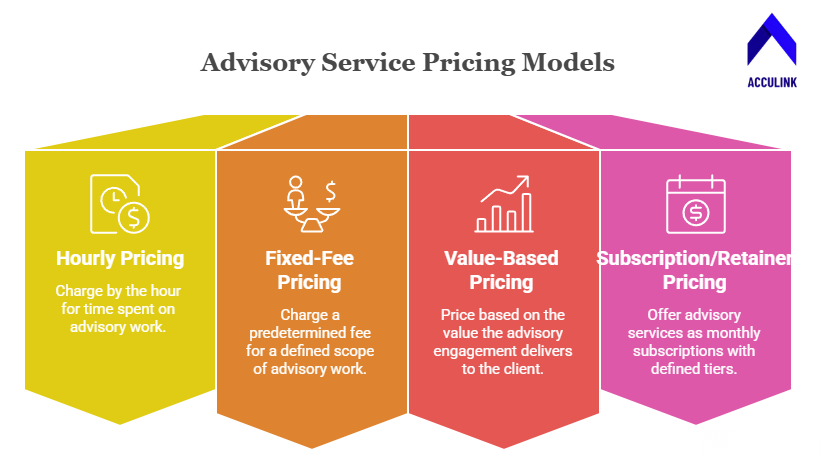
Pricing Guide by Service Type
Virtual CFO Services
Virtual CFO engagements are the premium tier of advisory. Monthly pricing typically ranges from $1,500 to $7,500 depending on client size, complexity, and scope.
-
Small business ($1–$5M revenue): $1,500–$3,000/month
-
Mid-market ($5–$25M revenue): $3,000–$5,000/month
-
Larger mid-market ($25–$100M revenue): $5,000–$7,500+/month
Scope typically includes monthly financial review, KPI dashboards, cash flow forecasting, budgeting, board/investor reporting, strategic advisory sessions, and coordination with tax and audit teams. Learn more about Acculink’s virtual CFO services.
FP&A Services
Financial Planning and Analysis engagements focus on budgets, forecasts, and scenario modeling. Pricing ranges from $2,000 to $10,000/month.
-
Annual budget preparation (one-time): $5,000–$15,000
-
Rolling forecasts (monthly updates): $2,000–$5,000/month
-
Full FP&A retainer (budgets + forecasts + scenario models): $5,000–$10,000/month
Offshore FP&A analysts from Acculink CPA can handle the modeling and analysis work, with partners providing strategic oversight and client presentation.
Monthly Financial Reviews
The most common entry point for advisory: a monthly package that includes financial statement review, KPI tracking, variance analysis, and a brief advisory call.
-
Basic (financials + KPIs): $500–$1,000/month
-
Standard (+ variance analysis + advisory call): $1,000–$2,000/month
-
Premium (+ cash flow forecast + quarterly strategy): $2,000–$3,500/month
Margin Analysis: Compliance vs. Advisory with Offshore Support
Here’s where the economics of advisory become compelling, especially when offshore teams handle the delivery.
A typical compliance engagement (tax return) might generate $3,000 in fees with $2,100 in delivery cost (domestic preparer time, review, admin), yielding a 30% margin. A virtual CFO engagement at $3,000/month generates $36,000 annually. With an offshore virtual CFO handling 80% of the work at $20–$30/hr, the annual delivery cost is roughly $12,000–$18,000, plus $3,000–5,000 in partner review and client meeting time. Total cost: $15,000–$23,000. Margin: 36–58%.
Scale that to 10 virtual CFO clients at $3,000/month average, and you have $360,000 in annual advisory revenue at 40–60% margins — delivered primarily by offshore professionals. This is how advisory practices become the most profitable service line at CPA firms.
Advisory Pricing Psychology: How to Present Fees with Confidence
Anchor to Value, Not Hours
Never present advisory fees in terms of hours. Present them in terms of what the client gets: “For $3,000/month, you get a dedicated financial advisor who ensures your cash flow is planned 13 weeks ahead, your financial statements are reviewed within 10 days of month-end, and you have a quarterly strategy session to align your financial decisions with your business goals.”
Use Tiered Proposals
Present three tiers (basic, standard, premium) in every advisory proposal. Research consistently shows that clients gravitate toward the middle option. Design your middle tier to be your ideal engagement scope and pricing.
Quantify the ROI
Help clients understand the financial impact of advisory. A $3,000/month virtual CFO engagement costs $36,000/year. If the advisory helps the client improve cash flow by $100,000, reduce tax liability by $25,000, and avoid a $50,000 bad hiring decision, the ROI is clear. Make this math explicit in your proposal.
Frequently Asked Questions
How much should I charge for virtual CFO services?
$1,500–$7,500/month depending on client size and scope. Small businesses ($1–$5M revenue) typically pay $1,500–$3,000/month; mid-market clients pay $3,000–$7,500/month.
What pricing model works best for CPA firm advisory?
Fixed-fee or subscription pricing works best for most firms. It creates predictable revenue, rewards efficiency, and aligns with client expectations for ongoing advisory relationships.
How do offshore teams improve advisory margins?
Offshore professionals handle 60–80% of advisory delivery work (dashboard updates, forecast models, variance analysis) at $8–$35/hr. Partners focus on client-facing advisory. This reduces delivery cost by 60–75% while maintaining the same client-facing quality.
Can I start advisory without raising prices on existing clients?
Yes. Start with new advisory-only engagements, or offer advisory as an add-on service to existing compliance clients. As you build confidence and results, expand advisory to your full client base.
References
AICPA CAS Resources — https://www.aicpa.org/
Accounting Today — https://www.accountingtoday.com/
About Acculink CPA
Acculink CPA is a premier offshore staffing and outsourcing company purpose-built for CPA firms, accounting firms, and tax firms in the United States, Canada, and the UAE. With a team of 300+ qualified professionals — including CPAs, Chartered Accountants, Enrolled Agents, and Big 4-trained staff — Acculink provides dedicated offshore accountants, bookkeepers, tax preparers, auditors, virtual CFOs, and virtual assistants at $8–$35/hr, delivering up to 75% cost savings compared to domestic hiring. The company is ISO 27001 certified, SOC 2 Type II aligned, IRS §7216 compliant, and GDPR compliant, with zero security breaches in 5+ years of operations. Acculink offers a 40-hour free trial with no setup fees, no recruitment charges, and no long-term contracts. Over 80 CPA firms across the United States trust Acculink to deliver quality, security, and scalability.
Website: Acculink CPA | Schedule a Call: book a 45-minute call | Email: Info@acculinkcpa.com | Phone: +1 (203) 997-0224
Tags:
About the Author

Related Posts

Hire Offshore Virtual CFOs for CPA & Accounting Firms – Why CFO Outsourcing Delivers Strategic Value
How hiring an offshore virtual CFO lets your CPA firm offer profitable advisory/CAS — forecasts, KPI dashboard…

Virtual Accounting Services for CPA & Accounting Firms – Offshore Accounting Support
How virtual accounting gives CPA firms a managed, cloud-based accounting team — bookkeeping to reporting — wit…

Hire Offshore Real Estate Virtual Assistants for CPA & Accounting Firms – Why Property Firms Outsource Support
Hire an offshore real estate VA for property admin + accounting — rent rolls, owner statements, CAM, AppFolio/…