How the 2026 Tariffs Are Changing CPA Firm Advisory for Supply Chain & Costs

Summary
How the 2026 Tariffs Are Changing the Way CPA Firms Advise Clients on Supply Chain & Costs
How the 2026 Tariffs Are Changing the Way CPA Firms Advise Clients on Supply Chain & Costs
The tariff environment in 2026 is creating advisory demand that most CPA firms are not yet equipped to serve. The firms that step up, building the analytical capabilities, the client communication skills, and the operational capacity to deliver tariff advisory at scale, will capture significant revenue. Clients are actively seeking this guidance. Offshore teams from Acculink CPA provide the analytical backbone that makes tariff advisory economically viable. They build the models, run the numbers, and prepare the deliverables that power every advisory conversation. The opportunity is real, the demand is immediate. The firms that act first will establish positions that competitors will struggle to displace.
Tariff Advisory as a Revenue Growth Strategy
Many CPA firms view tariff advisory as a one-time project: help the client understand the impact, adjust the books, and move on. But the smartest firms recognise that tariff advisory is an ongoing engagement opportunity. Trade policy is not static. Tariff rates change, new countries are targeted, retaliatory measures escalate, and supply chains continue to evolve. Clients with significant tariff exposure need continuous monitoring, periodic financial model updates, and regular advisory conversations about evolving strategies.
Structure your tariff advisory as a recurring engagement rather than a one-time project. Offer a monthly retainer that includes tariff landscape monitoring, and quarterly financial model updates reflecting the latest tariff changes. Add semi-annual supply chain cost reviews, and ad hoc advisory calls when significant policy changes occur. A monthly retainer of 1,500 to 3,000 dollars per client is appropriate for mid-size businesses with significant import or export exposure. With offshore delivery handling the analytical work at 8 to 35 dollars per hour, margins on these engagements are highly attractive.
The clients who need tariff advisory today will need it for years to come. The geopolitical dynamics driving tariff policy, including U.S.-China competition, reshoring incentives, and supply chain diversification, are structural trends. They are not temporary disruptions. CPA firms that build tariff advisory capabilities now are investing in a service line that will generate recurring revenue for the foreseeable future.
Key Takeaways
-
The 2026 tariff environment — driven by IEEPA executive orders, Section 232 duties, and retaliatory measures — is creating urgent advisory demand from CPA firm clients across manufacturing, retail, agriculture, and construction.
-
CPA firms that position themselves as tariff advisory resources will capture high-value engagements: scenario modelling, supply chain cost analysis, pricing strategy, and HTS code optimisation.
-
The accounting treatment of tariffs involves ASC 330 (inventory costing), ASC 450 (contingencies), and ASC 606 (revenue recognition for contract modifications) — areas where professional judgment is essential.
-
Offshore teams from Acculink CPA handle the analytical workload: landed cost calculations, scenario models, inventory revaluations, and financial projections that power advisory conversations.
If you’re advising business clients in 2026, tariffs are not an optional topic. They’re a daily conversation. Your manufacturing clients are calling about surging raw material costs. Your retail clients are asking whether to absorb duty increases or pass them through to consumers. Your agricultural clients are watching export markets shrink under retaliatory tariffs. Every industry with import or export exposure is affected.
This isn’t a temporary disruption. The tariff landscape in 2026 reflects a structural shift in U.S. trade policy that has been building for years. IEEPA-based tariffs on Chinese goods, expanded Section 232 duties on steel and aluminium, Section 122 emergency measures, and retaliatory tariffs from trading partners all stack up. They have created a complex, multi-layered duty environment that clients cannot navigate without professional guidance.
For CPA firms, this is a significant advisory opportunity. The firms that can help clients quantify the impact, model scenarios, optimise costs, and adjust their financial projections will differentiate themselves from compliance-only competitors. They will capture premium advisory fees.
Note: For comprehensive coverage of the 2026 tariff landscape, the accounting treatment of tariff costs, and industry-by-industry impact analysis, see our pillar blog on how tariffs and trade wars are impacting accounting firms. This topical blog focuses specifically on the advisory strategies CPA firms should deploy right now.
The 2026 Tariff Landscape: Quick Summary
The current tariff environment includes IEEPA-based tariffs on Chinese imports across broad product categories. Cumulative effective rates exceed 50% on many goods when layered with existing Section 301 tariffs. Section 232 tariffs on steel at 25% and aluminum at 10% have been expanded to additional countries and products. Section 122 emergency tariffs on specific categories create time-limited but disruptive duties. And retaliatory tariffs from Canada, the EU, and other trading partners reduce U.S. export competitiveness.
Advisory Opportunities for CPA Firms
Scenario Modeling
Clients need to understand how different tariff scenarios affect their bottom line. Build financial models showing the impact of tariff increases, decreases, exemptions, and retaliatory measures on client profitability, cash flow, and competitive position. This is classic virtual CFO and FP&A work that offshore analysts can prepare for partner review and client presentation.
Effective scenario models include a base case reflecting current tariff levels, a worst case assuming escalation in specific product categories, and a better case assuming partial rollbacks or exemptions. Add a restructuring case showing the impact of supply chain changes to non-tariffed sources. Each scenario should show the impact on gross margin, operating income, cash flow, and key profitability ratios.
Supply Chain Cost Analysis
Help clients map their supply chains and quantify the total landed cost of inputs. Include direct duties, freight changes, currency effects, and indirect supply chain disruption costs. Compare the total landed cost of current suppliers against alternatives in countries not subject to the same tariff treatment. This analysis often reveals that supply chain restructuring can permanently reduce costs even if tariffs are eventually reduced.
Pricing Strategy Advisory
Work with clients to model pricing strategies under tariff pressure. The core decision is whether to absorb tariff costs and accept lower margins, or pass costs through to customers and risk volume declines. Other options: selectively reprice products based on tariff exposure and price elasticity, or restructure product offerings to shift demand toward less tariff-exposed items. Each strategy has different margins, volumes, and competitive implications. These need to be quantified before making decisions.
HTS Code Optimisation
The Harmonised Tariff Schedule classification of imported products determines the duty rate. Products can often be legitimately classified under alternative HTS codes with lower duty rates. Working with customs brokers, CPA firms can review client product classifications and identify savings opportunities that flow directly to the bottom line.
Tariff Mitigation Strategies
Advise clients on structural mitigation options. These include Foreign Trade Zones that allow duty deferral or elimination on re-exported goods, duty drawback programs that provide refunds on duties paid for goods that are subsequently exported, and bonded warehouses for temporary storage without duty payment. Add first-sale valuation that uses the first sale in a series of transactions as the dutiable value rather than the final transaction price.
How Offshore Teams Power Tariff Advisory
Tariff advisory is analytically intensive. The models, calculations, and financial projections require skilled professionals spending significant hours on each client engagement. This is where offshore teams from Acculink CPA become essential.
Offshore accountants and FP&A analysts handle landed cost recalculations. They update inventory costing models with new tariff rates across all product lines. They build scenario models in Excel showing the impact of various tariff outcomes on client financials. They prepare inventory revaluation workpapers under ASC 330 for tariff-impacted inventory. They produce management reports and dashboards showing tariff impact that partners present to clients.
The model is straightforward: offshore professionals handle the analytical work overnight. By morning, partners have scenario models, revaluation workpapers, and updated financials ready for client advisory meetings. Partners focus on interpretation, strategy, and client relationships — the activities clients value most.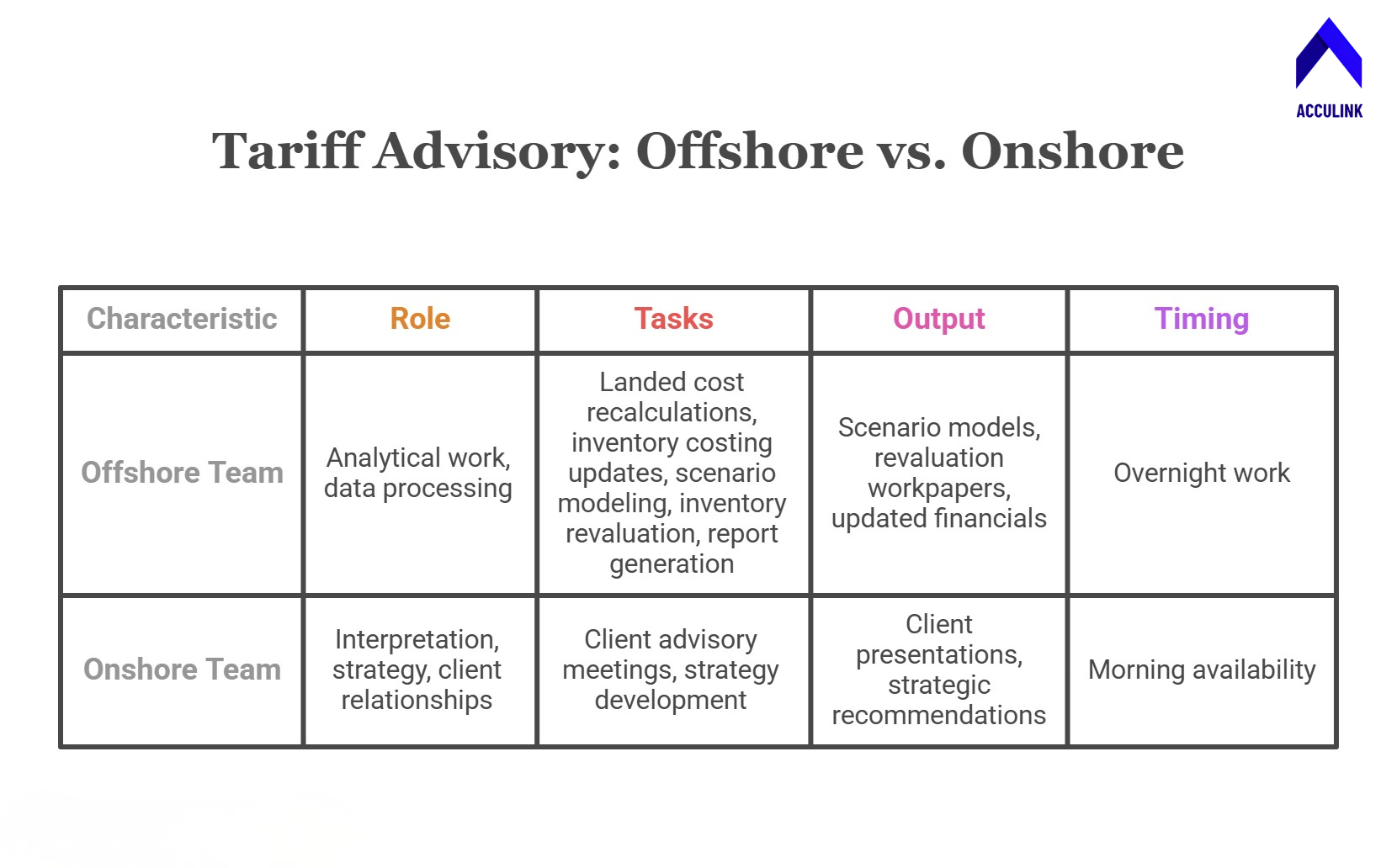
What CPA Firms Should Do This Week
-
Identify tariff-exposed clients: Review your client base for import-dependent supply chains, export exposure, and raw material costs tied to tariffed commodities.
-
Proactively reach out: Contact exposed clients offering a tariff impact assessment. The firms that reach out first capture the advisory engagement.
-
Build capacity: If your team is stretched, add offshore capacity through Acculink CPA. Pre-vetted professionals can ramp within 2–3 weeks.
-
Develop templates: Create standardised templates for landed cost analysis, scenario modelling, and pricing impact assessment.
-
Monitor developments: Assign someone to track tariff policy changes from the USTR and CBP and update clients proactively.
Frequently Asked Questions
How should CPA firms advise clients on tariffs?
Provide scenario modelling showing tariff impacts on profitability, supply chain cost analysis comparing sourcing alternatives, pricing strategy advisory, HTS code optimisation, and guidance on mitigation strategies like Foreign Trade Zones and duty drawback programs.
What accounting standards apply to tariff costs?
ASC 330 (Inventory) for landed cost and NRV analysis, ASC 450 (Contingencies) for uncertain tariff outcomes, and ASC 606 (Revenue) for contract modifications triggered by cost changes.
How can offshore teams help with tariff advisory?
Offshore professionals handle the analytical workload: landed cost calculations, scenario models, inventory revaluations, and management reports. Partners focus on client advisory conversations.
References
Office of the U.S. Trade Representative — https://ustr.gov/
U.S. Customs and Border Protection — https://www.cbp.gov/
About Acculink CPA
Acculink CPA is a premier offshore staffing and outsourcing company purpose-built for CPA firms, accounting firms, and tax firms in the United States, Canada, and the UAE. With a team of 300+ qualified professionals — including CPAs, Chartered Accountants, Enrolled Agents, and Big 4-trained staff — Acculink provides dedicated offshore accountants, bookkeepers, tax preparers, auditors, virtual CFOs, and virtual assistants at $8–$35/hr, delivering up to 75% cost savings compared to domestic hiring. The company is ISO 27001 certified, SOC 2 Type II aligned, IRS §7216 compliant, and GDPR compliant, with zero security breaches in 5+ years of operations. Acculink offers a 40-hour free trial with no setup fees, no recruitment charges, and no long-term contracts. Over 80 CPA firms across the United States trust Acculink to deliver quality, security, and scalability.
Website: Acculink CPA | Schedule a Call: book a 45-minute call | Email: Info@acculinkcpa.com | Phone: +1 (203) 997-0224
Tags:
About the Author

Related Posts

Payroll Outsourcing Services for CPA & Accounting Firms – Your Guide to Payroll & Compliance
How payroll outsourcing keeps CPA firms' clients compliant — 941/940 and multi-state filings, W-2/1099, on a 2…
Sales Tax Compliance Outsourcing for CPA & Accounting Firms – Why It Works
How outsourcing sales tax compliance handles nexus, multi-state filings, and exemption certificates for CPA fi…