How the 2025–2026 Government Shutdowns Are Impacting CPA Firms, IRS Operations & Tax Season

Summary
The 2025–2026 federal government shutdowns disrupted IRS operations during critical filing periods, creating processing backlogs, delayed refunds, and reduced taxpayer services that directly impacted CPA firms and their clients.
Key Takeaways
• The 2025–2026 federal government shutdowns disrupted IRS operations during critical filing periods, creating processing backlogs, delayed refunds, and reduced taxpayer services that directly impacted CPA firms and their clients.
• IRS staffing reductions during shutdowns meant fewer phone lines answered, slower correspondence processing, and delayed resolution of pending audits and amended returns — increasing workload on CPA firms serving as the de facto communication bridge.
• CPA firms that maintained proactive client communication, adjusted filing strategies, and had adequate staffing capacity weathered the shutdowns far better than firms operating at maximum stretch with no surge capacity.
• Offshore teams provide shutdown-proof capacity — India-based operations are completely unaffected by U.S. federal government closures, maintaining full productivity while domestic operations face disruption.
• The lesson for every CPA firm: build your capacity before the crisis hits, not during it. Acculink CPA’s offshore professionals operate independently of the U.S. government stability at $8–$35/hour.
You know that feeling when you’re watching a disaster movie — maybe The Day After Tomorrow or Don’t Look Up — and the characters keep ignoring all the warning signs until it’s too late? That’s basically what it feels like running a CPA firm during a government shutdown.
You can see the shutdown coming weeks in advance. You know it’s going to mess up IRS operations. You know your clients are going to start calling in a panic about delayed refunds. You know your team is going to spend hours fielding questions you can’t answer because the IRS literally isn’t picking up the phone. And yet, when it actually hits, it still manages to be worse than you expected.
The 2025–2026 government shutdowns weren’t the first to disrupt tax season, and they won’t be the last. The Government Accountability Office has documented the pattern: political brinksmanship leads to funding lapses, which lead to IRS furloughs, which lead to processing delays, which land squarely on the desks of CPA firms already operating at capacity.
The AICPA responded to the shutdowns by demanding that the IRS maintain full operations during filing season. Accounting Today covered the fallout extensively. But demands and coverage don’t process returns, and CPA firms were left managing the chaos with their existing resources.
This blog examines what happened during the 2025–2026 shutdowns, how the IRS was affected, what it meant for CPA firms and their clients, and — most importantly — how firms can build contingency capacity through offshore staffing that operates completely independently of U.S. government stability.
What Happened: The 2025–2026 Shutdown Timeline
The 2025–2026 fiscal year brought multiple funding crises that disrupted federal operations at the worst possible times for CPA firms and their clients. The Congressional Research Service has documented the timeline and operational impacts in detail.
The first shutdown occurred in late January 2026, lasting several days as Congress struggled to pass spending legislation. While shorter than some historical shutdowns, its timing during the early filing season created immediate disruption at the IRS. A partial shutdown followed in mid-February, affecting the Department of Homeland Security and creating cascading uncertainty about whether a broader government closure would follow.
The IRS invoked emergency authority under the Inflation Reduction Act to keep some operations running during the initial shutdown, avoiding the full-scale furloughs that characterised earlier shutdowns like the 35-day closure in 2018–2019. But “some operations” is not “full operations,” and the reduced capacity hit CPA firms in predictable ways: fewer phone lines staffed, slower correspondence processing, delayed audit resolution, and uncertainty about whether e-filing systems would remain fully operational.
For CPA firms, the timing was brutal. January and February are when tax preparation volume ramps up sharply, when clients send in their documents, and when early filers expect quick turnaround and fast refunds. A shutdown during this window is like losing your starting lineup right before the playoffs — except the opponents keep coming regardless.
The AICPA issued strongly worded statements demanding that Congress ensure full IRS operations during filing season. The National Taxpayer Advocate similarly warned of the downstream consequences. But political dynamics don’t operate on a tax season schedule, and CPA firms were left managing the practical fallout.
How the IRS Was Affected
When the government shuts down, the IRS operates under a contingency plan that designates certain functions as “excepted” (essential and continuing) and others as “non-excepted” (furloughed). The practical impact depends on the shutdown’s duration, timing, and which specific appropriations are affected.
During the 2025–2026 shutdowns, the IRS maintained e-filing system operations, processing of electronic returns, and some enforcement activities. However, taxpayer services were significantly curtailed. The Practitioner Priority Service line — the dedicated phone line CPA firms use to resolve client issues — operated at reduced capacity, with wait times stretching from the normal 30–60 minutes to several hours. Some firms reported simply being unable to get through at all during shutdown periods.
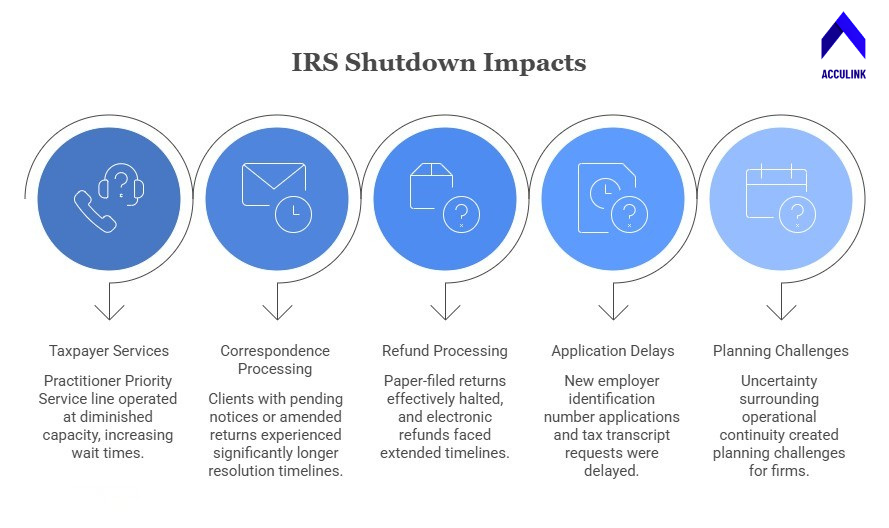
Correspondence processing slowed dramatically. If you had a client with a pending CP2000 notice, an amended return in process, or an audit at the examination stage, resolution timelines stretched from weeks to months. The Government Accountability Office documented similar delays in previous shutdowns and warned that the cumulative effect of repeated shutdowns compounds processing backlogs.
Refund processing for paper-filed returns effectively stopped during shutdown periods, and even electronic refund timelines were extended. Clients expecting 21-day refund turnarounds saw 30–45 days or longer, generating a wave of phone calls to CPA firms asking “where’s my money?” — calls your team had to handle even though the answer was “it’s sitting in an IRS processing queue because Congress couldn’t agree on a budget.”
New employer identification number applications were delayed. Tax transcript requests faced longer processing times. And the general uncertainty about whether operations would continue or expand created planning challenges for firms trying to manage their filing calendar and client expectations.
For firms handling outsourced tax review work, the shutdowns created a downstream timing problem: returns prepared and reviewed on schedule couldn’t always be filed or resolved on schedule, creating a queue management headache that added operational complexity.
Impact on CPA Firms and Their Clients
The shutdown impact on CPA firms goes beyond just IRS delays — it creates a cascade of additional work, client anxiety, and operational strain that tests every firm’s capacity and communication systems.
Client communication volume surges immediately when shutdown news breaks. Clients want to know: Will my refund be delayed? Should I wait to file? Is my audit on hold? Can I still make estimated payments? Will penalties be waived? Each question requires a thoughtful, client-specific answer — and during tax season, your partners and managers are already working at capacity. Adding a wave of shutdown-related inquiries on top of normal seasonal workload is like asking someone already carrying two armloads of groceries to also grab the dog’s leash.
The advisory opportunity is real but requires bandwidth. Proactive firms use shutdowns as a trigger for value-added client communication — sending updates about IRS status, recommending filing timing adjustments, advising on estimated payment strategies, and helping clients navigate the specific impacts on their situations. The Journal of Accountancy has documented how firms that communicate proactively during disruptions strengthen client relationships and differentiate themselves from competitors who go silent. But creating, personalising, and delivering these communications takes time your team may not have.
Filing strategy adjustments require operational coordination. Some firms accelerate filing to beat potential processing backlogs. Others delay certain filings until IRS systems stabilise. Amended returns and responses to IRS notices may be held because there’s no one at the IRS to receive and process them. Each strategic adjustment requires coordination between your preparers, reviewers, and offshore team members to ensure everyone is operating from the same playbook.
Extended resolution timelines strain client patience. If a client’s partnership return amendment has been sitting at the IRS for three months and a shutdown adds another month of delay, that client is calling you — not the IRS. Your team absorbs the frustration that rightfully belongs to Congress, and your billable hours get consumed by hand-holding instead of productive work.
The firms that navigate shutdowns best are the ones with capacity to spare — teams that can absorb the additional communication and coordination work without dropping the ball on routine preparation and filing. And the most cost-effective way to build that capacity is through offshore staffing that operates completely independently of U.S. government stability.
Contingency Planning for CPA Firms
Government shutdowns are becoming a recurring feature of U.S. fiscal policy, not a rare exception. The Congressional Budget Office and Brookings Institution have both noted that funding disputes are increasingly normalised in the political process. CPA firms should treat shutdown contingency planning as a standard part of their operational playbook, not an emergency response.
Communication templates should be prepared in advance. Draft shutdown client communications before the shutdown happens — update letters, FAQs, and email templates that can be customised and deployed within hours of a shutdown announcement. Have your offshore team compile client-specific data (pending IRS items, expected refunds, open audit matters) so your partners can deliver personalised guidance quickly.
Filing strategy protocols should be documented for different shutdown scenarios. Short shutdown (under a week): file normally, expect minor delays. Medium shutdown (1–3 weeks): prioritise e-filing, defer paper submissions, and monitor IRS system status daily. Extended shutdown (over 3 weeks): implement alternative filing calendars, proactively extend deadlines where possible, and increase client communication frequency.
Staffing contingency is the most critical element. A shutdown doesn’t reduce your work — it increases it by adding client communication, strategy adjustments, and resolution follow-ups on top of normal seasonal volume. You need more capacity during disruptions, not less. Offshore teams through Acculink CPA provide that capacity because they’re unaffected by U.S. government operations. Your India-based preparers keep preparing returns. Your offshore bookkeeping team keeps reconciling accounts. Your review queue stays full regardless of what’s happening on Capitol Hill.
As Peter Drucker wrote, “The best way to predict the future is to create it.” CPA firms that build their contingency capacity before the next shutdown will navigate it from a position of strength. Firms that wait will scramble from a position of weakness — again.
Frequently Asked Questions
How do government shutdowns affect tax filing?
The IRS reduces staffing and services during shutdowns. E-filing typically continues, but refund processing slows, taxpayer service phone lines have extreme wait times, and correspondence processing backlogs. CPA firms absorb the impact through increased client communication.
Will my clients’ refunds be delayed during a shutdown?
Electronic refunds may experience modest delays (days to weeks). Paper-filed refund processing effectively stops. Advise clients to file electronically with direct deposit to minimise the impact. The IRS Where’s My Refund tool continues operating during most shutdowns.
Should I adjust my filing strategy during a shutdown?
Yes. Prioritise electronic filing, defer paper submissions, and proactively communicate with clients about potential delays. Your offshore team can maintain preparation throughput while your domestic team adjusts strategy and manages client communications.
How can I prepare for future shutdowns?
Build offshore capacity that operates independently of U.S. government stability. Prepare communication templates in advance. Document filing strategy protocols for different shutdown durations. Maintain a list of pending IRS items per client for quick reference.
Are offshore operations affected by U.S. shutdowns?
No. India-based operations through Acculink CPA are completely unaffected by U.S. government closures. Your offshore team continues working normally, maintaining preparation throughput while domestic disruptions are managed by your onshore team.
How quickly can I add capacity before a shutdown?
Through Acculink CPA, pre-vetted professionals can start within 5–7 days. If a shutdown appears likely, engaging offshore capacity in advance is the smartest contingency investment your firm can make.
References
IRS — Operations During Government Shutdowns — Internal Revenue Service (IRS)
Government Accountability Office (GAO) — U.S. Government Accountability Office
Congressional Research Service — Congressional Research Service reports
Congressional Budget Office — Congressional Budget Office
American Institute of CPAs (AICPA) — American Institute of CPAs (AICPA)
National Taxpayer Advocate — IRS Taxpayer Advocate Service
Journal of Accountancy — Journal of Accountancy
Brookings Institution — Brookings Institution
About Acculink CPA
Acculink CPA is a premier offshore staffing and outsourcing company purpose-built for CPA firms, accounting firms, and tax firms in the United States, Canada, and the UAE. With a team of 300+ qualified professionals — including CPAs, Chartered Accountants, Enrolled Agents, and Big 4-trained staff — Acculink provides dedicated offshore accountants, bookkeepers, tax preparers, auditors, virtual CFOs, and virtual assistants at $8–$35/hr, delivering up to 75% cost savings compared to domestic hiring. The company is ISO 27001 certified, SOC 2 Type II aligned, IRS §7216 compliant, and GDPR compliant, with zero security breaches in 5+ years of operations. Acculink offers a 40-hour free trial with no setup fees, no recruitment charges, and no long-term contracts. Over 80 CPA firms across the United States trust Acculink to deliver quality, security, and scalability.
Website: Acculink CPA | Schedule a Call: book a 45-minute call | Email: Info@acculinkcpa.com | Phone: +1 (203) 997-0224
Tags:
About the Author

Related Posts

Hire Offshore Tax Preparers for CPA & Accounting Firms – Why Outsourced Tax Preparation Works Best.
How to hire an offshore tax preparer for your CPA firm — 1040/1065/1120/1120-S, CCH/UltraTax/Drake, IRS §7216-…

Sales Tax Compliance Outsourcing for CPA & Accounting Firms – Why It Works
How outsourcing sales tax compliance handles nexus, multi-state filings, and exemption certificates for CPA fi…

S Corporation Tax Return Outsourcing for CPA & Accounting Firms – Why It Works
How outsourcing Form 1120-S prep gives CPA firms expert S-corp returns — K-1s, basis, AAA, reasonable comp, QB…