Geopolitical Risks and Offshore Outsourcing: Mitigation Strategies for CPA Firms

Summary
Geopolitical risk is a legitimate concern for CPA firms considering offshore outsourcing, but it is manageable through proper provider selection, contractual protections, business continuity planning, and geographic risk assessment.
Key Takeaways
• Geopolitical risk is a legitimate concern for CPA firms considering offshore outsourcing. But it is manageable through proper provider selection, contractual protections, business continuity planning, and geographic risk assessment.
• India — the primary offshore destination for accounting services — maintains strong political stability, robust democratic institutions, diversified trade relationships, and consistent GDP growth rated favourably by the World Bank.
• Provider-level business continuity planning — redundant infrastructure, disaster recovery, backup power, and multi-site operations — is the primary defence against operational disruptions regardless of cause.
• Acculink CPA maintains ISO 27001 certification, SOC 2 alignment, backup power systems, encrypted VPN, disaster recovery protocols, and zero security breaches in 5+ years.
• The geopolitical risk of not outsourcing — chronic understaffing, capacity constraints, margin compression — often exceeds the risk of a well-managed offshore partnership with a proven provider.
Every CPA firm owner who considers offshore outsourcing eventually asks: “What happens if something goes wrong geopolitically?” It’s a fair question that deserves a thorough, honest answer addressing the concern head-on rather than dismissing it.
The 2026 geopolitical landscape is undeniably complex. The Middle East conflict continues to affect oil prices and global trade routes. U.S.-China tensions remain elevated. Russia-Ukraine conflict impacts European energy markets. Government shutdowns disrupt domestic IRS operations. CPA firms operate in a world where disruption is the baseline, not the exception.
But here’s the critical perspective most risk conversations miss: geopolitical risk isn’t unique to offshore outsourcing. It affects all business operations globally — including your domestic operations. The relevant question isn’t “is there any risk?” but rather “is the risk material, manageable, and outweighed by the benefits?”
The AICPA has addressed third-party risk management in its professional standards, and firms are expected to conduct due diligence on any service provider relationship. This blog applies that discipline to the geopolitical dimension. It examines the current risk landscape, evaluating India’s specific stability profile, detailing the business continuity measures that reputable providers maintain, and providing a practical mitigation framework. We’ll also address the often-overlooked risk of not outsourcing — which, for many CPA firms in 2026, is a more immediate threat to firm viability than any realistic geopolitical scenario.
The Current Geopolitical Landscape
Understanding the global risk environment helps CPA firms contextualise offshore outsourcing risks proportionally rather than reactively. The Council on Foreign Relations and the World Economic Forum both publish annual risk assessments that provide useful frameworks.
The Middle East continues experiencing instability, with ongoing conflict involving Israel, Iran, and regional proxies. Oil price volatility from Strait of Hormuz disruption concerns creates ripple effects on global inflation. However, these conflicts are geographically distant from India and have no direct operational impact on Indian offshore operations — only the same macro-economic energy price effects that every global business experiences.
U.S.-China tensions remain elevated with trade restrictions, technology controls, and diplomatic friction. This is relevant for CPA firm clients needing advisory on tariff compliance and supply chain accounting. But it does not affect India-based operations. India has benefited from global diversification away from China. It is attracting increased outsourcing investment as companies seek alternatives — a trend the World Bank has documented in India’s favour.
Russia-Ukraine conflict effects continue to impact European energy and agricultural markets. The direct effect on Indian operations is minimal. India has maintained diplomatic relationships across multiple geopolitical alignments. That strategy insulates its economy from bilateral tensions with any single partner.
U.S. domestic political volatility — federal spending debates, government shutdowns disrupting IRS operations, and policy shifts on trade and immigration — creates its own form of operational risk that affects domestic hiring, regulatory stability, and IRS processing times. This domestic uncertainty often has a more direct impact on CPA firm operations than any offshore-related geopolitical development.
The essential point: risk exists everywhere in 2026. The question is whether your offshore destination and provider have the stability, infrastructure, and planning to maintain operations through disruptions. India, as we’ll examine, scores exceptionally well on every relevant dimension.
India’s Stability as an Offshore Destination
India’s suitability as an offshore destination rests on multiple pillars of stability. Together they make it the lowest-risk major outsourcing location available to CPA firms. The World Bank’s economic assessments and IMF country reports consistently rate India’s economic fundamentals as strong.
Political stability is anchored in India’s democratic institutions. India is the world’s largest democracy with a well-established constitutional framework, an independent judiciary, regular elections, peaceful power transfers, and a robust rule of law. The institutional infrastructure supporting business operations — contract enforcement, property rights, regulatory frameworks — remains stable regardless of which party holds power.
Economic resilience is demonstrated by India’s diversified economic base. India’s GDP is not dependent on any single sector, commodity, or trading partner — spanning IT services, manufacturing, agriculture, financial services, pharmaceuticals, and consumer markets. The Bureau of Economic Analysis tracks U.S.-India bilateral trade exceeding $200 billion. That confirms the deepening economic relationship between the two countries.
Trade diversification provides structural resilience. India’s recent free trade agreement with the EU, combined with strong bilateral relationships with the U.S., UK, UAE, Australia, Japan, and ASEAN nations. It ensures India’s economy isn’t hostage to any single trading partner. This breadth of engagement is a direct buffer against geopolitical disruptions in any region.
India’s regulatory maturity in data protection has improved markedly through the Digital Personal Data Protection Act and international commitments through trade agreements. For CPA firms concerned about IRS §7216 compliance, India’s regulatory trajectory aligns firmly with global best practices. Providers like Acculink CPA operate under ISO 27001, SOC 2, and GDPR compliance frameworks that meet the highest international standards.
Geographic advantage is often overlooked. India is not located in or adjacent to any active conflict zone. Its position in South Asia places it at a comfortable distance from the regions dominating current geopolitical concerns. Accounting Today has noted that the vast majority of U.S. CPA firms outsourcing accounting choose India. They cite this stability advantage relative to alternative destinations.
Business Continuity Planning: The Real Defence
The most effective defence against operational disruptions isn’t geographic luck — it’s systematic business continuity planning at the provider level. A well-managed offshore provider maintains operations through disruptions ranging from power outages to extreme weather events.
Reputable providers maintain multiple layers of infrastructure redundancy. Power backup systems, including diesel generators, UPS systems, and solar supplementation, ensure continuous operations during grid outages. Multiple internet service providers with automatic failover maintain connectivity. Redundant server infrastructure and cloud-based systems ensure data and work products remain accessible.
Data protection and disaster recovery protocols extend beyond basic backup. ISO 27001 certification requires documented disaster recovery plans with defined recovery time and recovery point objectives. SOC 2 Type II alignment requires evidence that these plans are tested regularly. Leading providers maintain off-site data backups, encrypted data transmission, and the ability to restore full operational capability within defined timeframes.
Multi-site operations provide geographic redundancy within India. Providers maintaining offices in multiple Indian cities enable workload redistribution if any single location is affected. This is the ultimate continuity measure — work continues from another location without client interruption.
Acculink CPA maintains a comprehensive business continuity infrastructure, including ISO 27001 certification, SOC 2 Type II alignment, and 24/7 CCTV monitoring. Add backup power systems, encrypted VPN connections, disabled USB ports, mandatory NDAs, and zero security breaches in 5+ years. These are documented, audited, and maintained as part of ongoing operations — not aspirational standards but verified controls.
The question for CPA firms isn’t “what could go wrong?” but “does my provider have the planning and infrastructure to maintain operations when something does?” With a properly vetted provider, the answer should be unequivocal, with documentation to prove it. Review our complete IT and data security framework and certifications for details.
Risk Mitigation Framework for CPA Firms
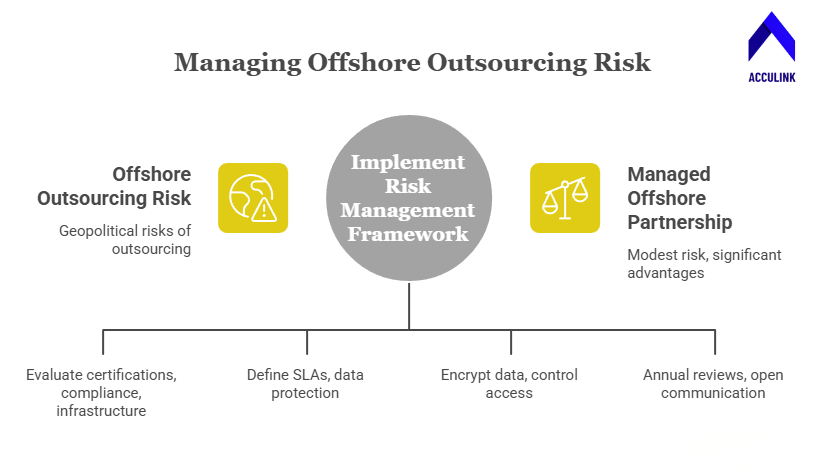
CPA firms can manage offshore outsourcing risk effectively through a practical framework. It addresses provider selection, contractual protections, operational procedures, and ongoing monitoring — the same due diligence discipline the AICPA recommends for any critical vendor relationship.
Provider due diligence is the foundation. Before engaging any offshore provider, evaluate certifications (ISO 27001, SOC 2), compliance posture (IRS §7216 for tax work, GDPR for data protection), infrastructure (power backup, internet redundancy, physical security). Check track record (years of operation, security incident history, client references), and business continuity documentation (disaster recovery plans, recovery timeframes, testing frequency).
Contractual protections should include defined service level agreements with performance metrics, data protection obligations with liability provisions, and business continuity requirements with recovery timeframes. Add termination provisions protecting your interests, including data return, and compliance obligations matching your regulatory requirements.
Operational procedures should ensure encrypted data transmission for all client information, controlled system access on a need-to-know basis, and regular performance monitoring and quality reviews. Add clear escalation procedures for disruptions, and documented handover procedures for staff changes. Acculink CPA’s engagement models build these safeguards into every client relationship.
Ongoing monitoring keeps your risk assessment current. Conduct annual reviews of your provider’s certifications, security posture, and continuity capabilities. Maintain open communication about any concerns. The firms managing offshore risk most effectively treat it as a business relationship requiring ongoing attention — not a set-and-forget arrangement.
For firms handling sensitive tax return information, audit workpapers, and financial statements, the due diligence bar should be high. But meeting that bar is entirely achievable with a provider like Acculink CPA that maintains enterprise-grade security as a core business requirement.
The Risk of Not Outsourcing
The geopolitical risk conversation typically focuses exclusively on outsourcing risks. But a complete risk assessment must also consider the risks of not outsourcing. For many CPA firms in 2026 these are more immediate and damaging than any realistic geopolitical scenario.
The domestic talent crisis is not a geopolitical risk — it’s a certainty. The AICPA and NASBA have documented the pipeline crisis extensively. CPA firms across the United States are chronically understaffed, with recruiting timelines of 3–6 months, salary demands rising 15–25% over three years, and retention rates declining. Every month your firm operates understaffed is lost revenue, declined engagements, burned-out partners, and increased competitive vulnerability.
Capacity constraints limit growth. A firm that can’t staff up can’t take on new clients, expand into advisory services, or capitalise on opportunities like OBBBA-related planning work. The opportunity cost of understaffing often exceeds the total cost of an offshore team.
Margin compression from rising domestic labour costs squeezes profitability. If revenue per return stays flat while cost per preparer increases 15–25%, margins shrink regardless of operational efficiency. Offshore staffing at $8–$35/hour directly addresses the cost structure challenge.
Competitive disadvantage versus PE-backed firms that aggressively use offshore staffing creates a widening gap. If competitors have lower costs, more capacity, faster turnaround, and better margins — all enabled by offshore teams — your market position erodes gradually but persistently.
The balanced risk assessment: a well-managed offshore partnership with a proven India-based provider carries modest, manageable geopolitical risk. It is offset by significant capacity, cost, and competitive advantages. Not outsourcing carries near-certain risks of understaffing, margin compression, and competitive decline with no offsetting benefit. For most CPA firms, the risk calculus clearly favours building offshore capacity through a vetted provider with documented security and continuity infrastructure.
Frequently Asked Questions
What happens to my offshore team if there’s a geopolitical crisis?
Reputable providers maintain business continuity plans including backup power, redundant internet, and multi-site capability. India’s distance from the current conflict zone minimises direct impact. Your provider should share documented contingency plans.
Is India affected by the Middle East conflict?
India is not directly involved and is geographically distant. The primary indirect effect is global oil prices, affecting all economies equally. Indian offshore operations continue normally regardless of Middle East developments. The World Bank rates India’s economic resilience highly.
What certifications should I look for?
ISO 27001 (information security), SOC 2 Type II (security controls), IRS §7216 compliance (for tax work), and GDPR (data protection). Acculink CPA holds all of these with zero security breaches in 5+ years.
Can I visit my offshore team’s facility?
Yes. Reputable providers welcome client visits. Seeing the physical security, infrastructure, and working environment firsthand provides confidence that documentation alone cannot. Contact Acculink CPA to arrange a facility tour.
What’s the biggest actual risk in offshore outsourcing?
Choosing a poorly managed provider without proper certifications, continuity planning, or compliance infrastructure. This risk is entirely mitigable through thorough due diligence. See our security framework and engagement models.
How do I evaluate an offshore provider’s stability?
Check ISO 27001/SOC 2 certifications, years of operation, client references, security breach history, IRS compliance, disaster recovery documentation, and financial stability. Acculink CPA provides all documentation during the evaluation process.
References
World Bank — India Economic Outlook — World Bank
International Monetary Fund (IMF) — International Monetary Fund
Council on Foreign Relations — Council on Foreign Relations
World Economic Forum — World Economic Forum
IRS Section 7216 Information Center — IRS Section 7216 Information Center
Bureau of Economic Analysis — U.S. Bureau of Economic Analysis
European Commission — Trade — European Commission trade policy
American Institute of CPAs (AICPA) — American Institute of CPAs (AICPA)
About Acculink CPA
Acculink CPA is a premier offshore staffing and outsourcing company purpose-built for CPA firms, accounting firms, and tax firms in the United States, Canada, and the UAE. With a team of 300+ qualified professionals — including CPAs, Chartered Accountants, Enrolled Agents, and Big 4-trained staff — Acculink provides dedicated offshore accountants, bookkeepers, tax preparers, auditors, virtual CFOs, and virtual assistants at $8–$35/hr, delivering up to 75% cost savings compared to domestic hiring. The company is ISO 27001 certified, SOC 2 Type II aligned, IRS §7216 compliant, and GDPR compliant, with zero security breaches in 5+ years of operations. Acculink offers a 40-hour free trial with no setup fees, no recruitment charges, and no long-term contracts. Over 80 CPA firms across the United States trust Acculink to deliver quality, security, and scalability.
Website: Acculink CPA | Schedule a Call: book a 45-minute call | Email: Info@acculinkcpa.com | Phone: +1 (203) 997-0224
Tags:
About the Author

Related Posts

Hire Offshore Bookkeepers for CPA & Accounting Firms – Blueprint for Outsourced Bookkeeping
How to hire an offshore bookkeeper for your CPA firm — what they do, how vetting and onboarding work, cost (up…

Hire Offshore Accountants for CPA & Accounting Firms – Why Outsourced Accounting Works
How to hire an offshore accountant for your CPA firm — month-end close, GL, GAAP reporting, in your software —…

15 Profitable Add-On Services CPA and Accounting Firms Can Offer Without Hiring In-House
CPA and accounting firms do not need to build every new service with another in-house hire. This guide compare…