AI-Powered Tax Preparation: What CPA Firms Need to Know Before Adopting


Summary
AI tools like ChatGPT, Copilot, and specialised tax AI can automate data extraction, categorisation, and draft preparation — but they cannot sign returns, apply professional judgment, or guarantee IRS compliance.
AI-Powered Tax Preparation: What CPA Firms Need to Know Before Adopting
Key Takeaways
• AI tools like ChatGPT, Copilot, and specialised tax AI can automate data extraction, categorisation, and draft preparation — but they cannot sign returns, apply professional judgment, or guarantee IRS compliance.
• The IRS has not issued formal guidance approving AI-prepared returns, and practitioners remain personally liable for every return filed under IRC §6694 regardless of how it was prepared.
• AI error rates in complex tax scenarios — multi-state filings, entity elections, treaty positions — remain unacceptably high for production use without qualified human review at every stage.
• The optimal model for CPA firms in 2026 is AI + offshore professionals + in-house review — combining the speed of automation, the cost efficiency of outsourced tax preparation services, and the judgment of licensed CPAs.
• Firms that start testing AI now in controlled environments will have a significant competitive advantage within 2–3 years as the technology matures alongside their offshore teams.
There’s a question bouncing around every CPA firm conference, every accounting podcast, and every partner meeting in 2026: “Should we be using AI for tax preparation?”
The short answer is yes — with enormous caveats.
Artificial intelligence is reshaping how tax work gets done. Tools powered by large language models, optical character recognition, and machine learning are automating tasks that used to consume hours of preparer time: extracting data from source documents, categorising transactions, flagging anomalies, and even drafting return workpapers. The American Institute of CPAs has acknowledged that AI will fundamentally change the profession — the question is how fast and how responsibly firms adopt it.
But here’s what the hype cycle misses: AI doesn’t prepare tax returns. People prepare tax returns. AI assists, accelerates, and automates specific sub-tasks within the preparation workflow. The difference matters — legally, practically, and professionally. A CPA firm that deploys AI without understanding its limitations is taking on risk. A firm that ignores AI entirely is leaving efficiency on the table. The firms doing it right are combining AI with qualified offshore tax professionals through providers like Acculink CPA to create a three-layer model that maximises speed, accuracy, and cost savings simultaneously.
This guide cuts through the noise. We’ll cover what AI can actually do in tax preparation today, what it can’t do, the top tools worth evaluating, the IRS’s current position, the real risks, and — most importantly — why the winning model for CPA firms isn’t AI alone but AI combined with dedicated offshore tax preparers and in-house CPA review.
What AI Can Actually Do in Tax Prep Today
Let’s start with what’s real, not what’s promised on a vendor’s landing page. In 2026, AI tools integrated into tax workflows can reliably perform several categories of tasks that deliver measurable productivity improvements.
First, document extraction and data entry. AI-powered OCR tools can read W-2s, 1099s, K-1s, and other source documents, extract relevant data fields, and populate them into tax software. This alone saves hours per return for firms processing high volumes. Tools like SurePrep and Intuit’s built-in AI extraction handle this with increasing accuracy — typically 90–95% on standard forms, though accuracy drops significantly on handwritten or poorly scanned documents.
Second, transaction categorisation. For firms that also handle bookkeeping outsourcing services, AI categorises bank and credit card transactions to improve precision. QuickBooks Online, Xero, and Sage all use machine learning to auto-categorise, learning from corrections over time. This feeds cleaner data into the tax preparation process and reduces the reconciliation burden.
Third, anomaly detection and error flagging. AI can compare current-year return data against prior-year returns and flag significant variances — a sudden drop in rental income, an unusually high deduction ratio, or a missing schedule. This functions as a preliminary quality check before human review, catching issues that might otherwise slip through to the tax review stage.
Fourth, draft workpaper generation. Some emerging tools can generate draft tax workpapers based on source data, essentially creating a first pass of the return that a preparer then reviews and refines. This is still early-stage but advancing rapidly with each software update cycle.
Fifth, research assistance. Large language models like ChatGPT, Claude, and Microsoft Copilot can answer tax research questions, summarise IRC sections, explain regulatory changes, and draft client communication — saving preparers from manual research time. However, these tools hallucinate, and every research output must be verified against primary sources before being relied upon.
The common thread: AI handles repetitive, data-intensive, pattern-recognition tasks. It does not handle judgment, elections, client-specific strategy, or the thousand small decisions a skilled tax preparer makes on every return. This is precisely why firms need qualified human preparers — whether onshore or through offshore staffing providers — to bridge the gap between AI output and client-ready deliverables.
What AI Can’t Do (Yet)
Understanding AI’s limitations is more important than understanding its capabilities — because the limitations are where professional and legal risk lives.
AI cannot apply professional judgment. Tax preparation is not just data entry. It involves choosing between filing positions, evaluating whether a deduction is supportable, determining the optimal entity election, and weighing the risk-reward of aggressive positions. These require understanding the client’s full financial picture, their risk tolerance, and the current enforcement environment. No AI tool in 2026 can do this reliably. This is why experienced offshore tax preparers with CA and EA credentials remain indispensable — they bring the judgment that AI lacks.
AI cannot sign a return. Under IRC §6694, the tax return preparer — a human — bears personal liability for every position taken on a return. AI is a tool, not a preparer. The IRS holds the signing CPA responsible, regardless of how the return was prepared. This legal reality hasn’t changed and won’t change soon.
AI cannot handle complex entity structures reliably. Multi-entity returns involving partnership and LLC filings, S corporations, trusts, and their interrelated K-1 schedules require an understanding of basis calculations, at-risk limitations, passive activity rules, and allocation methodologies that AI handles inconsistently. Errors in these areas can result in material misstatements and IRS penalties.
AI cannot manage multi-state compliance. State tax rules vary enormously — apportionment formulas, nexus standards, conformity to federal law, and state-specific credits and deductions. AI tools trained primarily on federal rules perform poorly on state-specific nuances, especially for less common states. Firms handling multi-state returns need professionals trained specifically in sales tax compliance and state filing requirements.
AI cannot guarantee data security. Tax return data is governed by IRS §7216, which imposes criminal penalties for unauthorised disclosure. Many AI tools process data through cloud servers, and firms must evaluate whether their AI vendor’s data handling complies with §7216 requirements. Acculink CPA addresses this through its ISO 27001-certified IT and data security framework — a level of compliance most AI vendors cannot match.
AI cannot replace the client relationship. Clients don’t want to talk to a chatbot about their tax situation. They want a CPA who knows their business, understands their goals, and provides advice they trust. AI can free up time for these conversations, but it cannot have them.
Top AI Tools for Tax Preparation in 2026
The market is flooded with AI tax tools, but only a handful are production-ready for CPA firms. Here’s what’s worth evaluating based on current capabilities and market adoption.
SurePrep TaxCaddy and 1040SCAN use AI-powered document extraction to automate the data gathering process. Source documents uploaded by clients are read, extracted, and mapped to the appropriate lines in the return. This is the most mature AI application in tax and delivers measurable time savings — firms report a 30–50% reduction in data entry time for individual returns.
Intuit’s AI features within Lacerte and ProConnect offer smart categorisation, anomaly detection, and guided workflows. These are improving with each release but remain most effective for straightforward individual and small business returns.
Thomson Reuters ONESOURCE uses AI for tax provision calculations, transfer pricing analysis, and indirect tax compliance. This is enterprise-grade and most relevant for larger firms handling complex corporate clients.
Wolters Kluwer CCH Axcess has integrated AI-assisted research and workflow automation features, including smart review checklists and automated workpaper references. Useful as a productivity layer on top of existing workflows.
ChatGPT, Claude, and Microsoft Copilot serve as general-purpose AI assistants for research, drafting, and analysis. CPA firms are using these for client letters, memo drafting, tax research questions, and internal training materials. They are not tax preparation tools — they are productivity tools that happen to be useful in tax contexts.
The critical evaluation question for any AI tool is not “What can it do?” but “What happens when it’s wrong?” Every AI tool has an error rate, and in tax preparation, errors have consequences — penalties, interest, malpractice exposure, and client trust erosion.
AI + Offshore: The Optimal Model for CPA Firms
Here’s the framework that’s actually working for forward-thinking CPA firms in 2026: it’s not AI versus humans, it’s AI plus humans in the right configuration. The three-layer model is emerging as the gold standard for firms that want to maximise efficiency without sacrificing quality.
Layer 1: AI automation for data extraction, categorisation, and preliminary quality checks. This layer handles the repetitive, high-volume tasks that consume preparer time without requiring professional judgment. AI reduces the time required for these sub-tasks by 30–50%, creating capacity that flows to the human layers.
Layer 2: Qualified offshore professionals for return preparation and first-pass technical review. This is where providers like Acculink CPA deliver transformative value. U.S.-trained tax preparers with CA, EA, and CPA-equivalent qualifications take the AI-accelerated data and prepare complete, accurate returns using your firm’s software (CCH Axcess, UltraTax CS, Lacerte, Drake), your processes, and your quality standards. They bring the technical expertise, software proficiency, and attention to detail that AI lacks — at $8–$35/hour versus $55,000–$80,000+ for domestic hires.
Layer 3: In-house CPA review for judgment calls, client strategy, and final sign-off. Your onshore partners and managers focus exclusively on high-value work: complex positions, client advisory, strategic decisions, and the relationship-building that clients pay premium rates for.
The economics are compelling across every metric. AI reduces data entry time by 30–50%. Offshore professionals handle preparation at a fraction of domestic cost. Partners reclaim hours previously spent on preparation to focus on virtual CFO advisory work billed at $300–$500/hour. The combined savings — technology plus offshore plus redeployed partner time — can transform a firm’s profitability.
Firms using this model report clearing 40–60% more returns per season without adding domestic headcount, while improving quality because each layer serves as a check on the others. The offshore team catches AI errors. The onshore reviewer catches offshore oversights. The result is a multi-layer quality control process that’s more robust than any single-layer approach.
The firms that will struggle are those that try to replace human preparers with AI entirely — they’ll face quality issues, compliance risks, and client dissatisfaction. The firms that will thrive are those that use AI to amplify their human talent, both onshore and offshore, creating a system where each component handles what it does best.
Risk: AI Errors in Tax Returns
Let’s be direct about the risks, because the AI vendor marketing materials won’t be. Understanding these risks is essential for any firm integrating AI into its tax workflow.
Data extraction errors occur in 5–10% of documents, depending on quality. A misread digit on a W-2 can cascade through the entire return. Handwritten documents, non-standard formats, and multi-page K-1s have significantly higher error rates. The National Institute of Standards and Technology has documented that OCR accuracy varies dramatically based on document quality, and tax source documents are notoriously inconsistent.
Hallucination in research outputs is well-documented across all major language models. ChatGPT, Claude, and Copilot all confidently generate incorrect tax citations, fabricate IRC sections, and misstate regulations. A preparer who relies on AI research without verifying against primary sources — the Internal Revenue Code, Treasury Regulations, and IRS guidance — is taking a professional risk that could result in penalties, malpractice claims, and license jeopardy.
Over-reliance on AI categorisation leads to misclassified deductions, missed income items, and incorrect Schedule assignments. AI categorises based on patterns; it doesn’t understand the taxpayer’s intent or the legal character of a transaction. A qualified human preparer — whether through your domestic team or through an offshore tax preparation provider — understands context that AI cannot infer.
Version and update lag is a real concern. Tax law changes constantly — new legislation like the One Big Beautiful Bill Act, updated thresholds, revised forms. AI tools may not reflect the latest changes immediately, and firms using AI during the gap between a law change and a software update risk preparing returns under outdated rules.
The mitigation strategy is straightforward: never let AI be the last set of eyes on a return. AI is Layer 1. A qualified human preparer is Layer 2. A licensed CPA reviewer is Layer 3. For firms looking to build robust quality control frameworks, Acculink CPA’s approach to multi-layer review provides a proven model that integrates seamlessly with AI-augmented workflows.
IRS Position on AI-Prepared Returns
As of March 2026, the IRS has not issued formal guidance specifically addressing AI-prepared tax returns. This regulatory gap doesn’t mean the IRS doesn’t care — it means the regulatory framework hasn’t caught up with the technology.
What we know from existing authority: The IRS holds the tax return preparer responsible under IRC §6694 and §6695 regardless of the tools used to prepare the return. Whether a return is prepared by hand, by software, or with AI assistance, the preparer who signs bears full liability for accuracy and compliance. There is no “AI defence” to prepare penalties.
The IRS has signalled increased scrutiny of returns with error patterns consistent with automated preparation — unusual rounding, repeated categorisation errors, and missing context-dependent elections. The IRS Strategic Operating Plan emphasises enforcement modernisation, and firms should expect that AI-assisted returns will receive the same or greater scrutiny as traditionally prepared returns.
The AICPA has published guidance emphasising that AI tools do not change a CPA’s professional responsibilities. Due diligence, reasonable care, and professional judgment remain the standard — AI or not. The practitioner must understand and be able to defend every position on every return, regardless of how that position was initially identified or drafted.
The National Association of State Boards of Accountancy (NASBA) has similarly indicated that the use of AI tools does not alter the professional standards governing CPA practice, including continuing education requirements, supervision standards, and ethical obligations.
Practically, this means: use AI to prepare, but review as if AI weren’t involved. The review standard doesn’t change because the preparation method changed. This is precisely why qualified human reviewers — both offshore tax reviewers and onshore CPAs — remain absolutely indispensable in any AI-augmented workflow.
How to Test AI in Your Firm: A Practical Approach
For firms ready to start experimenting with AI, here’s a low-risk, high-learning approach that builds institutional knowledge while protecting client quality and compliance.
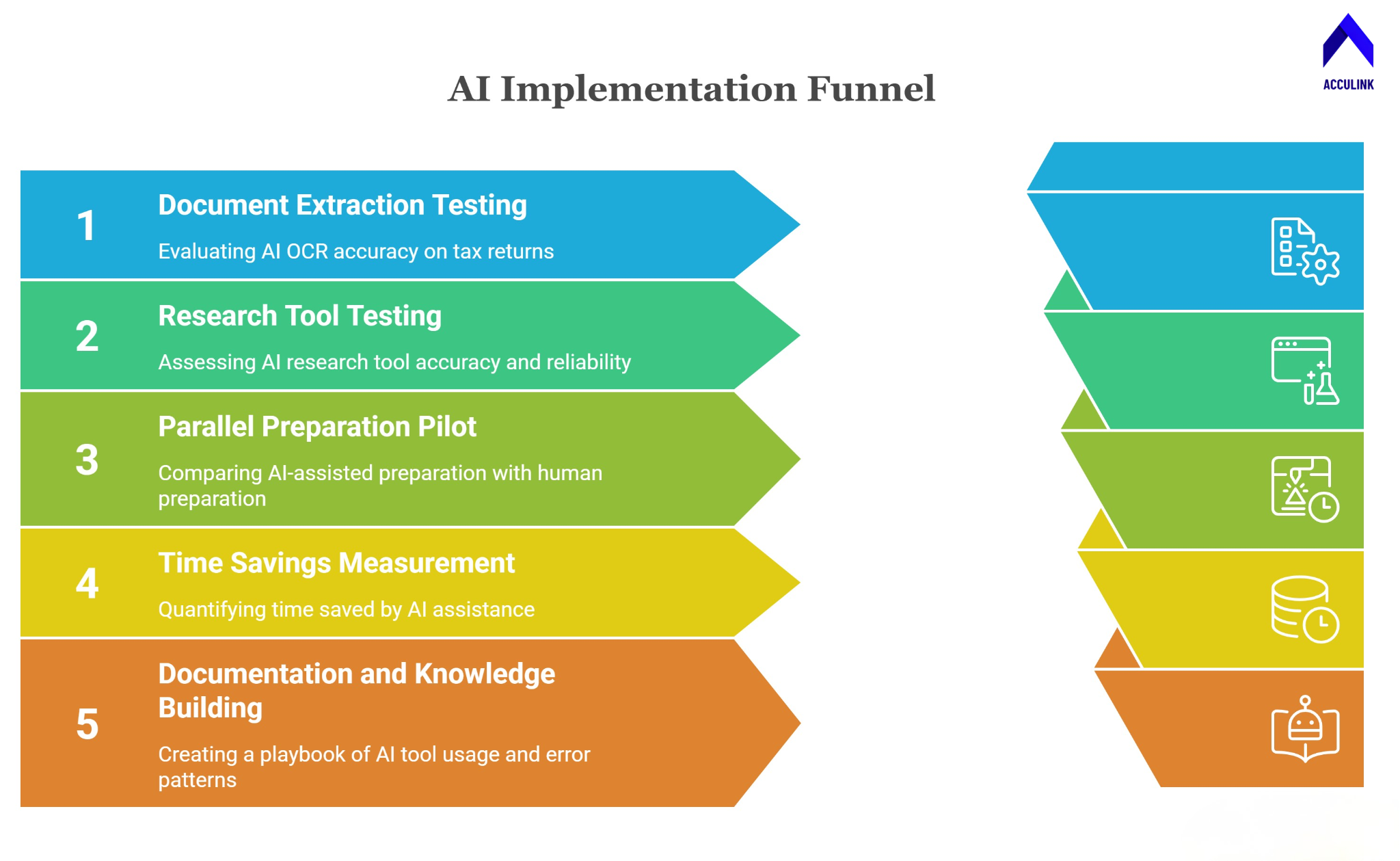
Start with document extraction. This is the most mature, lowest-risk AI application in tax preparation. Test an AI-powered OCR tool on 20–30 returns from last season. Compare the extracted data against the actual returns filed. Measure the accuracy rate by field type. If accuracy exceeds 95% on standard forms like W-2s and 1099-INT, it’s ready for limited production use with mandatory human verification on every extracted data point.
Test research tools on known questions. Give ChatGPT, Claude, or Copilot 10 tax research questions where you already know the correct answer. Evaluate accuracy, citation quality, and whether the tools flag uncertainty appropriately. Use this controlled testing to calibrate your team’s trust level — you’ll quickly learn which question types the tools handle well and which they consistently botch.
Run a parallel preparation pilot. For 5–10 straightforward returns, have AI assist with preparation while your regular preparer (onshore or through your offshore accounting team) prepares the same returns independently. Compare results field by field. This reveals where AI adds genuine value and where it introduces errors in your specific workflow with your specific client types.
Measure time savings rigorously, not just accuracy. The ROI of AI isn’t just about getting things right — it’s about getting things right faster. Track preparer hours per return with and without AI assistance. If AI saves 30 minutes per 1040 and your firm files 2,000 individual returns, that’s 1,000 hours recovered — equivalent to a half-time staff member, or roughly $15,000–$20,000 in offshore preparer costs.
Document everything systematically. Build an internal playbook of which AI tools work for which tasks, what the error patterns are, and what the review requirements are for each tool. This institutional knowledge becomes a competitive advantage that compounds over time as your team gains experience.
Scale gradually and deliberately. Once you’ve validated AI on simple returns, expand to more complex scenarios — but always with qualified human review at every stage. The goal is augmentation, not replacement. The firms getting the best results are those that add AI as a productivity layer on top of their existing offshore staffing model, not those that try to substitute AI for qualified professionals.
The Future: Human Review Will Always Be Needed
Every technology cycle produces predictions that machines will replace professionals. It hasn’t happened in medicine, law, or engineering — and it won’t happen in tax preparation, at least not in any timeline that matters for your firm’s strategic decisions today.
Here’s why: Tax preparation isn’t a data problem. It’s a judgment problem wrapped in a data problem. The data part — extracting numbers, populating forms, running calculations — is increasingly automatable. The judgment part — should the client elect S Corp status, is this home office deduction defensible, how should we structure the sale of this rental property, what’s the optimal distribution strategy for this trust return — requires understanding context, relationships, risk tolerance, and strategy. AI doesn’t understand these things. It pattern-matches.
What will change is the composition of tax work within every CPA firm. The mechanical, repetitive tasks will be handled by AI. The preparation and technical work will increasingly be handled by qualified offshore professionals who cost a fraction of domestic hires and bring rigorous qualifications like the Indian CA credential (administered by ICAI with a 10–15% pass rate) and U.S. Enrolled Agent certification. The advisory, strategic, and client-facing work will remain with onshore partners and managers — and this is the work that clients value most and pay the highest rates for.
The firms that win will be those that build the three-layer model now: AI for automation, offshore professionals for preparation, and onshore CPAs for judgment and advisory. This model is faster, cheaper, higher-quality, and more scalable than any single-layer approach — pure AI, pure domestic, or pure offshore.
Acculink CPA provides the critical middle layer: pre-vetted, U.S.-trained offshore tax professionals who work with your software, your processes, and your quality standards. They’re the human intelligence that bridges AI automation and partner-level judgment — and they cost $8–$35/hour with a 40-hour free trial to evaluate completely risk-free. No setup fees, no recruitment charges, and no long-term contracts.
Frequently Asked Questions
Will AI replace tax preparers?
Not in any meaningful timeline. AI will automate data extraction and categorisation tasks, but return preparation, judgment calls, and client advisory require human expertise. The optimal model is AI + offshore tax preparers + in-house CPA review.
Is it safe to use ChatGPT for tax research?
ChatGPT and similar tools are useful starting points for tax research, but they hallucinate regularly. Every AI-generated research output must be verified against primary sources — the IRC, Treasury Regulations, and IRS guidance. Never cite AI research directly in a client work product.
Does the IRS allow AI-prepared returns?
The IRS has not issued specific guidance on AI-prepared returns. The signing preparer remains fully liable under IRC §6694 regardless of preparation method. Use AI as a tool, not a substitute for professional review.
How much can AI reduce tax preparation costs?
AI can reduce data entry and categorisation time by 30–50%. Combined with offshore tax preparation at $8–$35/hour, the total cost reduction reaches 60–75% compared to fully domestic staffing models.
What’s the best way to start with AI in my firm?
Start with document extraction tools on a small batch of returns. Measure accuracy, time savings, and error patterns. Scale gradually with human review at every stage. Consider adding offshore capacity to handle the preparation work that AI accelerates but cannot complete independently.
Can offshore tax preparers work with AI tools?
Yes. Offshore professionals at Acculink CPA are trained on the same software and tools your firm uses, including AI-augmented platforms like CCH Axcess, UltraTax CS, Lacerte, and Drake. They adapt to your workflow, AI-assisted or traditional. Learn more about why firms choose Acculink.
References
American Institute of CPAs (AICPA) — American Institute of CPAs (AICPA)
IRS Section 7216 Information Centre — IRS Section 7216 Information Center
IRC §6694 — Preparer Liability — IRC §6694 — preparer penalty rules
National Association of State Boards of Accountancy (NASBA) — National Association of State Boards of Accountancy (NASBA)
Institute of Chartered Accountants of India (ICAI) — Institute of Chartered Accountants of India (ICAI)
National Institute of Standards and Technology (NIST) — National Institute of Standards and Technology (NIST)
IRS Strategic Operating Plan — IRS Strategic Plan
Internal Revenue Code — Cornell Law — Internal Revenue Code (26 U.S. Code)
About Acculink CPA
Acculink CPA is a premier offshore staffing and outsourcing company purpose-built for CPA firms, accounting firms, and tax firms in the United States, Canada, and the UAE. With a team of 300+ qualified professionals — including CPAs, Chartered Accountants, Enrolled Agents, and Big 4-trained staff — Acculink provides dedicated offshore accountants, bookkeepers, tax preparers, auditors, virtual CFOs, and virtual assistants at $8–$35/hr, delivering up to 75% cost savings compared to domestic hiring. The company is ISO 27001 certified, SOC 2 Type II aligned, IRS §7216 compliant, and GDPR compliant, with zero security breaches in 5+ years of operations. Acculink offers a 40-hour free trial with no setup fees, no recruitment charges, and no long-term contracts. Over 80 CPA firms across the United States trust Acculink to deliver quality, security, and scalability.
Website: Acculink CPA | Schedule a Call: book a 45-minute call | Email: Info@acculinkcpa.com | Phone: +1 (203) 997-0224
Tags:
About the Author

Related Posts

Hire Offshore Tax Preparers for CPA & Accounting Firms – Why Outsourced Tax Preparation Works Best.
How to hire an offshore tax preparer for your CPA firm — 1040/1065/1120/1120-S, CCH/UltraTax/Drake, IRS §7216-…
Sales Tax Compliance Outsourcing for CPA & Accounting Firms – Why It Works
How outsourcing sales tax compliance handles nexus, multi-state filings, and exemption certificates for CPA fi…
S Corporation Tax Return Outsourcing for CPA & Accounting Firms – Why It Works
How outsourcing Form 1120-S prep gives CPA firms expert S-corp returns — K-1s, basis, AAA, reasonable comp, QB…