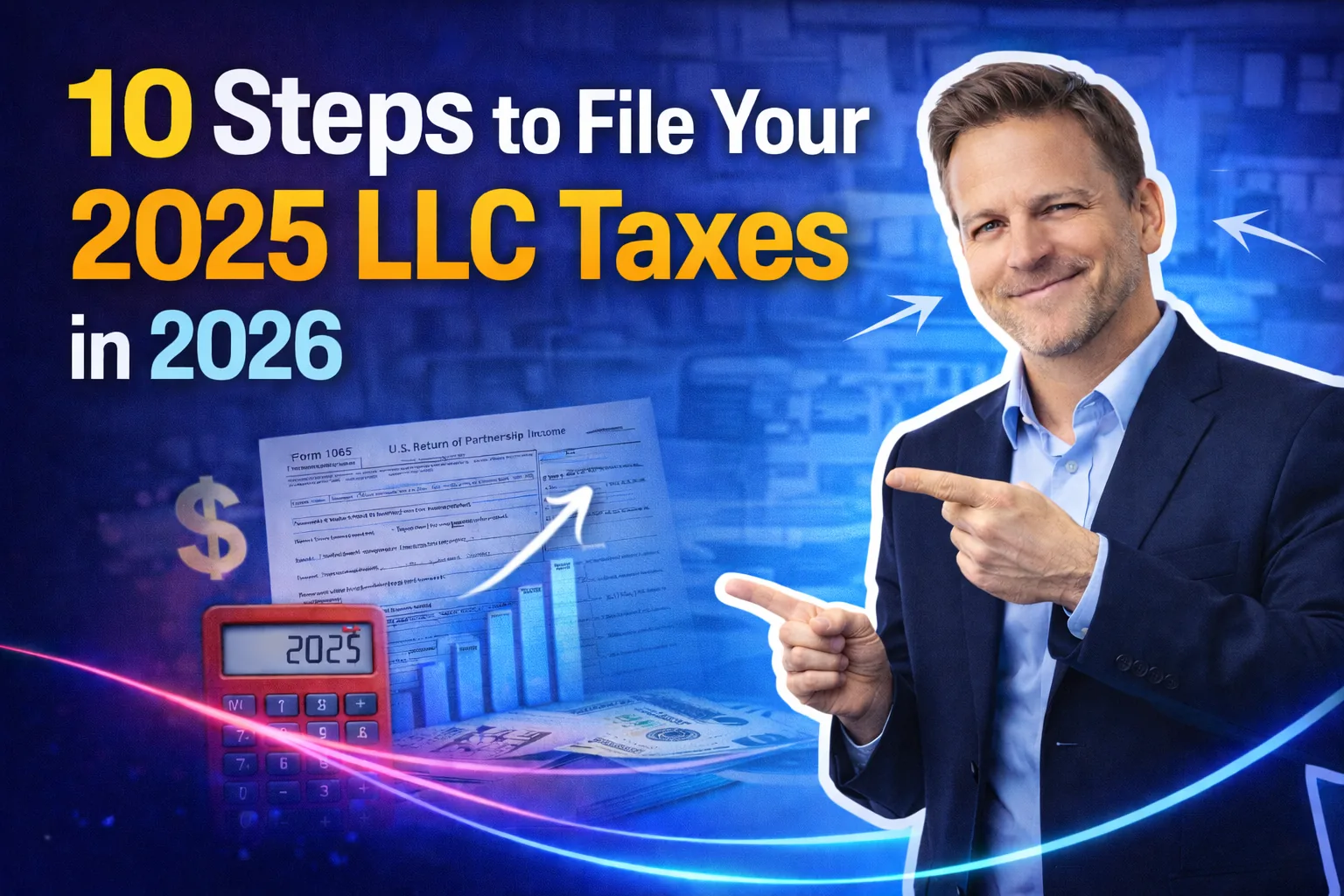
10 Steps to File Your 2025 LLC Taxes in 2026

Summary
Learn the complete step-by-step process to file your 2025 LLC taxes in 2026. From choosing the correct tax classification to meeting IRS deadlines and maximising deductions, this guide helps you stay compliant and avoid costly mistakes.
10 Steps to File Your 2025 LLC Taxes in 2026
Filing taxes for your LLC is not just a compliance requirement. It is a critical financial responsibility that impacts your profitability, cash flow, and long-term business stability. As we move through 2026, business owners across the United States are preparing to file returns for the 2025 tax year.
Whether you operate a single-member LLC, manage a multi-member partnership, or elect corporate taxation, understanding the correct filing process is essential. The rules differ based on structure, revenue size, and state location. Missing key steps can result in penalties, delayed refunds, or unnecessary tax liabilities.
This guide outlines ten structured steps to help you confidently prepare and file your 2025 LLC taxes in 2026.
Why Proper LLC Tax Filing Matters for Business Growth
Many business owners treat tax filing as a once-a-year obligation. In reality, it reflects your financial systems, record-keeping discipline, and strategic planning.
Strong Compliance Protects Your Business
Accurate tax filing helps you:
- Maintain good standing with the Internal Revenue Service
- Avoid penalties and interest
- Strengthen financial credibility with lenders
- Prepare for future expansion
- Reduce audit risk
Professional preparation ensures your return reflects accurate income, expenses, and deductions.
Step 1: Confirm Your LLC Tax Classification
Before preparing any forms, verify how your LLC is taxed for federal purposes.
- Single-member LLCs are treated as sole proprietorships
- Multi-member LLCs are treated as partnerships
- Some LLCs elect S Corporation or C Corporation taxation
Your classification determines which forms you must file and how income is reported. Review prior year returns or confirm your election status before proceeding.
If you are unsure whether an S Corporation election is beneficial, reviewing insights from S Corporation Election Strategy: Is It Still Worth It can provide valuable direction.
Step 2: Organise All Financial Records for 2025
Accurate bookkeeping simplifies the entire tax filing process.
Gather Income Documentation
Collect:
- Bank statements
- Payment processor summaries
- Sales reports
- 1099 forms received
- Loan documentation, if applicable
Compile Expense Records
Include:
- Rent and utilities
- Software subscriptions
- Professional fees
- Marketing expenses
- Travel and vehicle costs
- Payroll reports
If your books are not fully reconciled, consider professional support through Accounting and Bookkeeping Services to ensure clean financial data before filing.
Step 3: Identify the Correct Federal Tax Forms
Your filing requirements depend on your tax classification. Single-member LLC files Schedule C with Form 1040
- Multi-member LLC files Form 1065
- S Corporation files Form 1120S
- C Corporation files Form 1120
Filing Deadlines
- Partnerships and S Corporations generally file by March 15
- Sole proprietors and C Corporations typically file by April 15
Always verify deadlines directly with the Internal Revenue Service to ensure compliance.
Step 4: Calculate Net Business Income Accurately
Your taxable income is determined by subtracting eligible business expenses from total revenue.
Understand Deductible Expenses
Common deductions include:
- Operating expenses
- Business insurance
- Office expenses
- Equipment purchases
- Professional services
- Education and training
Reviewing Essential Facts to Know About FICA Tax Rates can also help you understand payroll-related obligations that impact your overall liability.
Accurate expense classification prevents underreporting of income or overstating deductions.
Step 5: Evaluate Self-Employment Tax Obligations
If your LLC is taxed as a sole proprietorship or partnership, you are responsible for self-employment tax. This covers Social Security and Medicare contributions.
Many new business owners underestimate this portion of their tax bill. Careful calculation and proper estimated payments reduce the risk of penalties.
Strategic planning support through Tax Planning Services can help optimise your overall liability.
Step 6: Review State and Local Tax Requirements
Federal compliance is only part of the process.
Depending on where your LLC operates, you may need to file:
- State income tax returns
- Franchise tax reports
- Sales tax returns
- Annual business reports
States such as California impose franchise taxes even if the business reports minimal profit.
Ensure compliance in every state where you have nexus to avoid penalties.
Step 7: Prepare Contractor and Payroll Filings
If your LLC paid independent contractors in 2025, you may need to issue Form 1099 NEC. If you have employees, W 2 forms and payroll tax filings are required.
Accurate payroll reporting is critical. Errors in classification or reporting can trigger audits or penalties.
Businesses that use Payroll Processing Services often reduce compliance risk and improve reporting accuracy.
Step 8: Review Available Tax Credits and Incentives
Tax credits directly reduce your tax liability and can significantly impact your final amount owed.
Common Credits for Small Businesses
- Research and development credits
- Work opportunity tax credits
- Energy efficiency incentives
Eligibility varies by industry and activity. Proactive planning ensures you do not miss valuable opportunities.
The U.S. Small Business Administration provides additional guidance for small business compliance and support resources.
Step 9: Reconcile Estimated Tax Payments
Most LLC owners are required to make quarterly estimated tax payments.
Before filing, reconcile:
- Quarterly payments made
- Withholding if applicable
- Refund expectations or outstanding balances
Underpayment may result in penalties, while overpayment can be applied to the next tax year.
Strategic forecasting through Virtual CFO Services helps business owners align estimated payments with actual profitability.
Step 10: File on Time and Maintain Proper Records
Meeting deadlines protects your business from unnecessary penalties.
If additional time is needed, you may file an extension. However, remember that an extension applies to filing, not payment.
Maintain Proper Documentation
Keep copies of:
- Filed returns
- Payment confirmations
- Supporting financial records
- Depreciation schedules
- Payroll filings
Well-organised records protect your LLC in case of future inquiries.
Common Filing Mistakes LLC Owners Should Avoid
Even established businesses make preventable mistakes such as:
- Mixing personal and business expenses
- Failing to reconcile bank accounts
- Incorrectly classifying workers
- Missing state compliance requirements
- Ignoring estimated tax payments
Professional review reduces these risks and strengthens financial accuracy.
Strategic Tax Planning Beyond Compliance
Tax filing is not only about reporting past income. It is about preparing for future growth.
Long-Term Benefits of Proactive Planning
- Optimised entity structure
- Improved cash flow forecasting
- Reduced tax liability
- Better financial visibility
- Stronger lender confidence
Businesses that treat tax planning as a year-round activity often experience stronger financial performance.
How Acculink CPA Supports US-Based LLC Owners
Acculink CPA works with entrepreneurs, consultants, service providers, and growing companies across the United States. Our team focuses on structured compliance, accurate reporting, and strategic tax planning tailored to your specific industry and business model.
From complete tax preparation and bookkeeping to advanced advisory and multi-state compliance support, we help LLC owners file accurately while positioning their business for long term success.
If you are preparing to file your 2025 LLC taxes in 2026 and want clarity, compliance, and professional guidance, Acculink CPA is ready to support your business every step of the way.
About the Author

Related Posts
Accounting Busy Season 2027: A Capacity Plan for CPA and Accounting Firms
Accounting busy season becomes manageable when a CPA firm forecasts preparation, review, and administrative wo…
Top Tax Outsourcing Companies for CPA and Accounting Firms (2026 Rankings)
The top tax outsourcing companies for CPA firms in 2026 are Acculink CPA, QX Accounting Services, CapActix, Da…
Tax Preparation Outsourcing for CPA Firms: How It Works, What It Costs, and Where to Start (2026)
Tax preparation outsourcing lets a CPA firm hand routine return preparation to an external team, usually offsh…