Year-End Accounting Services for CPA & Accounting Firms – Why Outsourcing Helps


Summary
How outsourcing year-end accounting helps CPA firms clear the close — trial balances, depreciation, W-2/1099, clean workpapers — before tax season. When to start.
Year-end accounting work is the most predictable production crunch in a CPA firm's calendar — and the one most likely to overwhelm in-house capacity. Every client with a December 31 fiscal year-end needs a year-end close, an adjusted trial balance, and the documentation package that feeds into tax preparation. For CPA firms carrying 30–60 clients through a January–March cycle, that production load either gets handled efficiently or it creates a quality crisis.
Year-end accounting services — outsourced to an offshore accounting team — let CPA firms absorb the production load without carrying excess headcount year-round. This guide explains what year-end accounting services cover, which tasks outsource cleanly, and how to structure the offshore engagement for the year-end cycle.
What "Year-End Accounting" Actually Covers
The term "year-end accounting" means different things in different contexts. For CPA firm purposes, the tasks in scope are:
Year-end close entries Closing entries that zero out revenue and expense accounts into retained earnings, reset temporary accounts, and bring the books to a "true" beginning balance for the new year. In a double-entry system, these are mechanical — but they require the correct prior-year data and trial balance to start from.
Adjusting journal entries (AJEs) AJEs that the CPA firm identifies during the year-end review: depreciation, amortization, accrued liabilities, prepaid expenses, inventory adjustments, accrued payroll, deferred revenue. Most year-end adjustments follow predictable patterns and can be prepared by an offshore team working from the CPA's adjustment schedule.
Bank and account reconciliations Year-end reconciliations are more thorough than monthly — they may include clearing out reconciling items that have been carried for months, reconciling loan balances to lender statements, and confirming that all accounts are properly stated. The offshore team prepares the reconciliation workpapers; the CPA reviews.
Accounts receivable and payable cleanups Identifying and writing off uncollectible AR, clearing out long-outstanding AP items, and reconciling subsidiary ledgers to control accounts. Year-end is when clients most often discover that their AR ledger doesn't agree with what they think they're owed.
Fixed asset and depreciation schedule updates Adding capital expenditures made during the year, computing current-year depreciation, identifying and removing fully-depreciated or disposed assets. The updated depreciation schedule feeds directly into the tax return.
Year-end financial statement preparation Preparing the year-end income statement, balance sheet, and cash flow statement from the adjusted trial balance. The CPA reviews and delivers.
Workpaper organization for tax preparation Packaging the year-end close workpapers in a format that feeds efficiently into the tax return: trial balance, prior-year comparison, AJE summary, depreciation schedule, any supporting schedules (payroll summary, contract revenue by client, etc.). Disorganized workpapers are one of the primary causes of tax preparation delays.
Why Year-End Accounting Is a Capacity Problem
The year-end crunch for CPA firms is structural, not accidental. Every client with a December 31 year-end needs the same work done in the same 8–10 week window (January through mid-March). The volume doesn't smooth itself.
For a firm with 40 December year-end clients: - 40 year-end closes to prepare - 40 adjusted trial balances to review - 40 sets of workpapers to organize - 40 potential catch-up bookkeeping situations (clients who let reconciliations slide in November and December)
If each year-end close takes 6–10 hours of production time, the aggregate is 240–400 hours of production work — in addition to all other work the firm carries in Q1.
Most CPA firms handle this with a combination of: extended hours for existing staff, delayed delivery to some clients, or high-priced temporary staffing. Offshore year-end accounting services are a fourth option that addresses the capacity constraint at a lower unit cost than domestic temporary staff.
The Catch-Up Problem: January Books That Aren't Closed
A consistent challenge in year-end accounting is clients who arrive in January with October or November not yet closed — sometimes with the full year unreconciled. The year-end can't proceed until the underlying books are caught up.
Catch-up bookkeeping is one of the highest-fit tasks for offshore accounting teams: high volume, rule-based transaction processing that requires accuracy more than CPA-level judgment. An offshore team can clear a 3–4 month backlog while the US partner focuses on clients whose books are clean.
Firms that use offshore accounting support for year-end work typically establish a two-track process: - Clean clients: Offshore team begins year-end close preparation directly - Catch-up clients: Offshore team clears the backlog first, then proceeds to year-end close
Both tracks run simultaneously, allowing the US partners to review completed packages rather than waiting in queue.
How to Structure an Offshore Year-End Accounting Engagement
October/November: Establish the engagement scope with the offshore provider. Identify which clients will use offshore support for year-end. Provision the offshore team with software access for those clients.
December (pre-close): Offshore team completes any ongoing bookkeeping through November, prepares preliminary December entries as transactions come in.
January (year-end close preparation): As clients submit their December bank statements and last-quarter transaction data, the offshore team processes the December close, prepares year-end reconciliations, and drafts AJE schedules for CPA review.
February (workpaper organization): Offshore team packages the adjusted trial balance, AJEs, and supporting schedules in the firm's standard tax workpaper format.
February–March (CPA review and tax preparation): CPA partner reviews the year-end package, makes final adjustments, and hands off to tax preparation (which may also be offshore-supported, or handled in-house).
The critical path is: client submits December data → offshore close and reconciliation (target: 5 business days) → CPA review → finalized workpapers → tax preparation.
Common Year-End Issues That Get Caught During Offshore Processing
Offshore accounting teams working through year-end closes regularly surface issues the client and CPA firm weren't aware of:
- Old unpaid invoices in AP — vendors paid via ACH but invoices never matched in the system, leaving an overstatement of AP
- Undeposited funds — payments received but not deposited correctly, floating in the accounting system
- Payroll liabilities that don't match the year-end payroll tax returns
- Loan balances that don't agree with lender statements
- Fixed assets on the books that were sold or scrapped but never removed
- Revenue recorded in the wrong period — invoice dates vs. delivery dates
These findings come through the year-end close workpaper review. When the offshore team flags them, the CPA can address them before the tax return is prepared — rather than discovering them mid-preparation when they become timeline problems.
What Stays With the CPA Firm
- Adjusting entry decisions — what to accrue, what to defer, materiality thresholds
- Client advisory — year-end tax planning conversations happen with the partner, not the offshore team
- Tax position analysis — depreciation elections, accounting method changes, inventory method elections
- Final review and sign-off on year-end financial statements
- Extension decisions where the year-end close will push past the filing deadline
Acculink provides year-end accounting services for CPA firms: year-end close preparation, catch-up bookkeeping, adjusting journal entry drafts, depreciation schedule updates, and workpaper packaging for tax preparation. We operate as a production extension of your team through the January–March crunch. See our full accounting outsourcing services. Contact us.
Tags:
About the Author

Related Posts
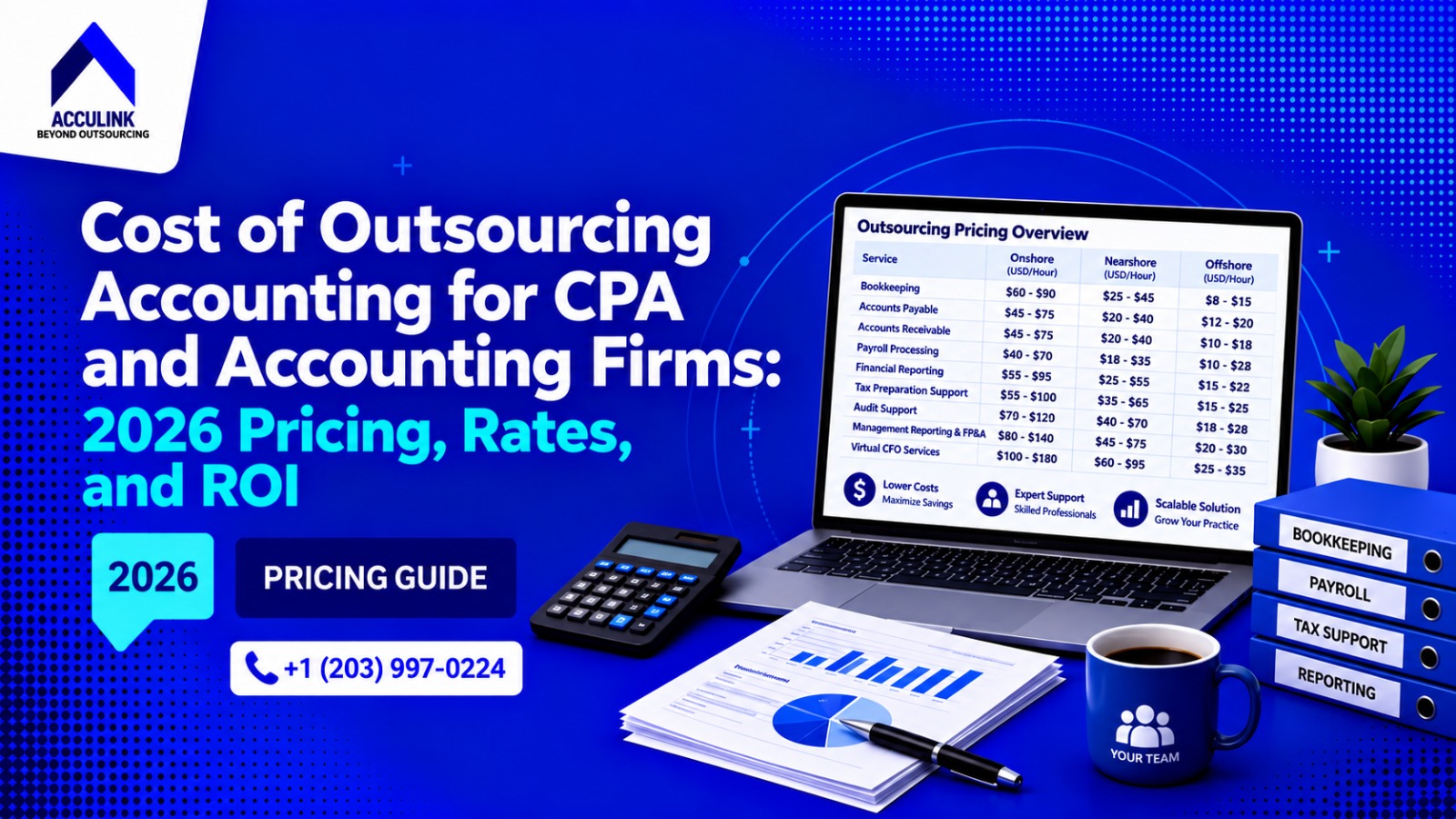
Cost of Outsourcing Accounting for CPA and Accounting Firms: 2026 Pricing, Rates, and ROI
The cost to outsource accounting typically ranges from $8 to $35 per hour, depending on the service, experienc…
15 Profitable Add-On Services CPA and Accounting Firms Can Offer Without Hiring In-House
CPA and accounting firms do not need to build every new service with another in-house hire. This guide compare…
Top 10 Payroll Outsourcing Companies for CPA and Accounting Firms (2026)
This guide compares ten payroll outsourcing companies for U.S. CPA and accounting firms. It separates processi…