Succession Planning for CPA Firms: How to Plan Your Exit Without Losing Your Practice

Summary
Succession Planning for CPA Firms: How to Plan Your Exit Without Losing Your Practice
Succession planning is ultimately about building a firm that is bigger than any one person. The paradox of successful CPA firm ownership is that the qualities that make you indispensable to clients are the same qualities that make the firm hard to transfer. Solving this paradox requires deliberate, sustained effort over years to shift the firm's value from your personal relationships and institutional knowledge to documented systems, trained teams, and scalable processes.
Offshore staffing through Acculink CPA accelerates this shift because it forces the documentation and systemisation that succession requires. When you hire an offshore professional, you must create SOPs, define workflows, establish review processes, and build technology infrastructure that works independently of any single person. These investments, made for operational reasons, are exactly what make your firm transferable, valuable, and attractive to successors, whether they come from inside or outside the organisation.
Start your succession planning today regardless of how far you are from retirement. The earlier you begin, the more options you create, the higher the value you build, and the smoother the eventual transition will be for your clients, your staff, and yourself. The firms that plan deliberately will exit on their terms with maximum value. The firms that procrastinate will face limited options and discounted outcomes. The choice is yours, and the time to act is now.
Whether your exit is 3 years away or 15, every dollar invested in building transferable operations through technology, offshore staffing, advisory development, and documented systems compounds into higher firm value and easier transition. A firm that starts building these capabilities today will be demonstrably more valuable in every future year than one that continues operating on the personal knowledge and individual relationships of its founding partner.
Common Succession Planning Mistakes
Starting Too Late
The single biggest mistake is waiting until the retiring partner is ready to leave before starting the planning process. Succession planning requires 3 to 5 years minimum to execute well. Starting one year before retirement leaves no time to build transferable systems, develop successor talent, or transition client relationships. The result is either a fire-sale transaction at a discounted valuation or a messy transition that damages client relationships and staff morale.
Overvaluing the Practice
Many firm owners have an inflated sense of their practice value because they anchor to revenue multiples they have heard at conferences without accounting for the factors that discount value: key-person dependence, concentrated client base, lack of documented systems, or declining growth trajectory. Get a professional valuation early and use it as a baseline for improvement, not as an argument for what you think the firm is worth.
Not Investing in Systems Before Selling
Buyers pay a premium for firms with documented, systemised operations because they know the firm can function without the founder. Firms that operate on institutional knowledge in the founding partner head receive discounted offers because the buyer knows they are taking on transition risk. Investing in SOPs, offshore teams, and technology in the years before a planned exit increases the eventual sale price by far more than the investment cost.
Ignoring Cultural Fit in Successor Selection
Whether you choose internal or external succession, cultural fit matters enormously. A successor who is technically competent but culturally misaligned will drive away staff and clients. Involve key staff and long-tenured clients in the successor evaluation process, at least informally, to ensure the transition preserves what makes your firm special.
Valuation Factors That Buyers Care About Most
When a prospective buyer evaluates your CPA firm, they analyse dozens of factors. But a handful drive the majority of the valuation: client retention rate is the most important single factor because it determines whether the revenue transfers with the firm. Retention above 90 per cent commands premium valuations. Revenue mix matters because advisory revenue is valued more highly than compliance revenue due to higher margins and stronger client stickiness. Client concentration risk is evaluated because buyers discount heavily when the top 5 or 10 clients represent more than 40 per cent of revenue.
Operational maturity is increasingly a differentiator. Buyers look for documented SOPs, standardised workflows, technology infrastructure that does not depend on individual configurations, and a team structure that can operate without the founding partner. Firms with established offshore teams through Acculink CPA score highly on operational maturity because the offshore engagement inherently requires all of these elements. The SOPs exist because the offshore team needs them. The technology is standardised because the VPN and cloud infrastructure require it. The team structure is defined because roles must be clearly allocated between domestic and offshore staff.
Growth trajectory is the final major factor. Buyers pay more for firms that are growing because growth means the investment will appreciate. A firm with flat or declining revenue is less attractive even at a lower multiple. The combination of offshore-enabled capacity expansion and advisory service development creates a growth trajectory that maximises valuation at exit. Firms that invested in these strategies 2 to 3 years before selling typically achieve valuations 20 to 40 per cent higher than comparable firms that did not.
The Emotional Side of Succession
Succession planning is not purely a financial and operational exercise. For many firm owners, the practice is deeply personal. They built it from nothing, nurtured client relationships for decades, and mentored staff who became family. Letting go is emotionally complex, ex even when the financial terms are favourable.
Acknowledge this emotional dimension rather than pretending it does not exist. Talk to other firm owners who have successfully transitioned. Work with a coach or advisor who understands the personal side of business exits. Define what your post-firm life will look like before you finalise the transition so you are moving toward something, not just leaving something behind. Many retired partners report that the transition was harder than expected because they did not plan for the identity shift from firm leader to private individual.
Key Takeaways
-
75% of CPAs reached retirement eligibility by 2020, yet fewer than 30% of CPA firms have a documented succession plan. This gap threatens firm continuity, client relationships, and partner retirement value.
-
Succession planning should start 3–5 years before the desired exit date. Earlier is always better — the more time you have, the more options you create.
-
This guide covers a 5-stage succession framework: valuation, internal vs external succession, building transferable systems, reducing key-person dependence, and executing the transition.
-
Offshore staffing makes your firm more sellable by creating documented, systemised, and scalable operations that are not dependent on any single individual.
-
Whether you pursue internal succession, external sale, or merger, a firm with offshore-enabled operations commands a higher valuation and smoother transition.
For many CPA firm partners, the firm is their largest financial asset. They’ve spent 20, 30, or 40 years building client relationships, developing staff, and growing revenue. Yet when it comes time to exit, most discover they have no plan. The clients are loyal to them personally. The systems exist in their heads. The staff depend on their daily involvement. The firm, as currently structured, is not transferable.
This is the succession planning paradox: the very qualities that make a partner successful — deep client relationships, personal involvement, institutional knowledge — are the same qualities that make the firm hard to sell or transition. Solving this paradox requires deliberate, years-in-advance planning that systematises what is currently personal and documents what is currently institutional.
This guide provides a complete succession planning framework for CPA firm owners. Whether you’re five years from retirement or twenty, the time to start planning is now. And as we’ll show, offshore staffing from Acculink CPA is one of the most powerful tools for making your firm transferable, scalable, and valuable to a successor.
Why Succession Planning Matters Now
The demographics are undeniable. The AICPA reports that 75% of its membership reached retirement eligibility by 2020. This means tens of thousands of CPA firms will transition ownership in the coming decade. Firms without succession plans face three possible outcomes: fire-sale mergers at discounted valuations, gradual client attrition as partners wind down without replacements, or practice dissolution that destroys decades of built equity.
A structured succession plan avoids all three outcomes. It preserves client relationships, ensures staff continuity, maximises the financial return to retiring partners, and positions the firm for growth under new leadership. The earlier you start, the better the outcome.
The 5-Stage Succession Framework
Stage 1: Valuation — What Is Your Firm Worth?
Before planning your exit, you need to know what you’re working with. CPA firm valuations typically use one of three methods: revenue multiples (typically 0.75x–1.5x annual revenue for compliance-focused firms, higher for advisory-heavy practices), earnings multiples (3x–6x normalised owner earnings), or discounted cash flow analysis (projected future cash flows discounted to present value).
Several factors increase firm value: recurring revenue with high retention rates, diversified client base without concentration risk, documented systems and SOPs, a trained staff that can operate without the founding partner, advisory revenue commanding premium margins, and a scalable operating model that includes offshore capacity.
Stage 2: Choose Your Path — Internal vs External Succession
Internal succession means transitioning ownership to existing partners, senior managers, or staff. This preserves culture, maintains client relationships, and rewards loyalty. The challenge is funding: internal successors often cannot afford to buy the firm at fair market value without structured payment plans over 5–10 years.
External succession means selling to an outside buyer: another CPA firm, a PE-backed platform, or a strategic acquirer. External buyers typically pay higher upfront valuations, but the cultural integration risk is higher. Many founding partners stay involved for 2–3 years post-sale to ensure client retention, which limits the clean break that some partners seek.
Stage 3: Build Transferable Systems
This is the most important stage and the one that directly involves offshore staffing. A transferable firm has documented SOPs for every engagement type, standardised review processes, technology systems that are not dependent on any individual’s personal setup, and a team structure where work is assigned by role, not by name.
Offshore staffing accelerates system-building because it forces documentation. When you hire an offshore professional from Acculink CPA, you must create written SOPs, standardised templates, and clear review processes for them to follow. This documentation, created out of operational necessity, is exactly what makes your firm transferable to a successor.
Stage 4: Reduce Key-Person Dependence
The biggest value destroyer in CPA firm succession is key-person dependence — when clients are loyal to a specific partner rather than to the firm. Reducing this dependence requires introducing clients to junior partners or senior managers who will remain post-transition, transitioning direct client communication from the retiring partner to the successor over 1–2 years, and building an offshore team that handles preparation and compliance work independently.
When your firm’s operations run through documented systems and an offshore team that continues regardless of which partner is managing, the firm becomes genuinely transferable. The successor inherits a functioning operation, not a relationship rolodex.
Stage 5: Execute the Transition
The actual transition typically takes 1–3 years, depending on the complexity of the firm and the succession path. Key steps include legal and financial structuring (buy-sell agreement, payment terms, non-compete provisions), client communication (transparent, reassuring, focused on continuity), staff communication (early, honest, focused on opportunity), operational handoff (systematic transfer of responsibilities with defined milestones), and post-transition support (retiring partner available for consultation during the transition period).
How Offshore Teams Make Your Firm More Sellable
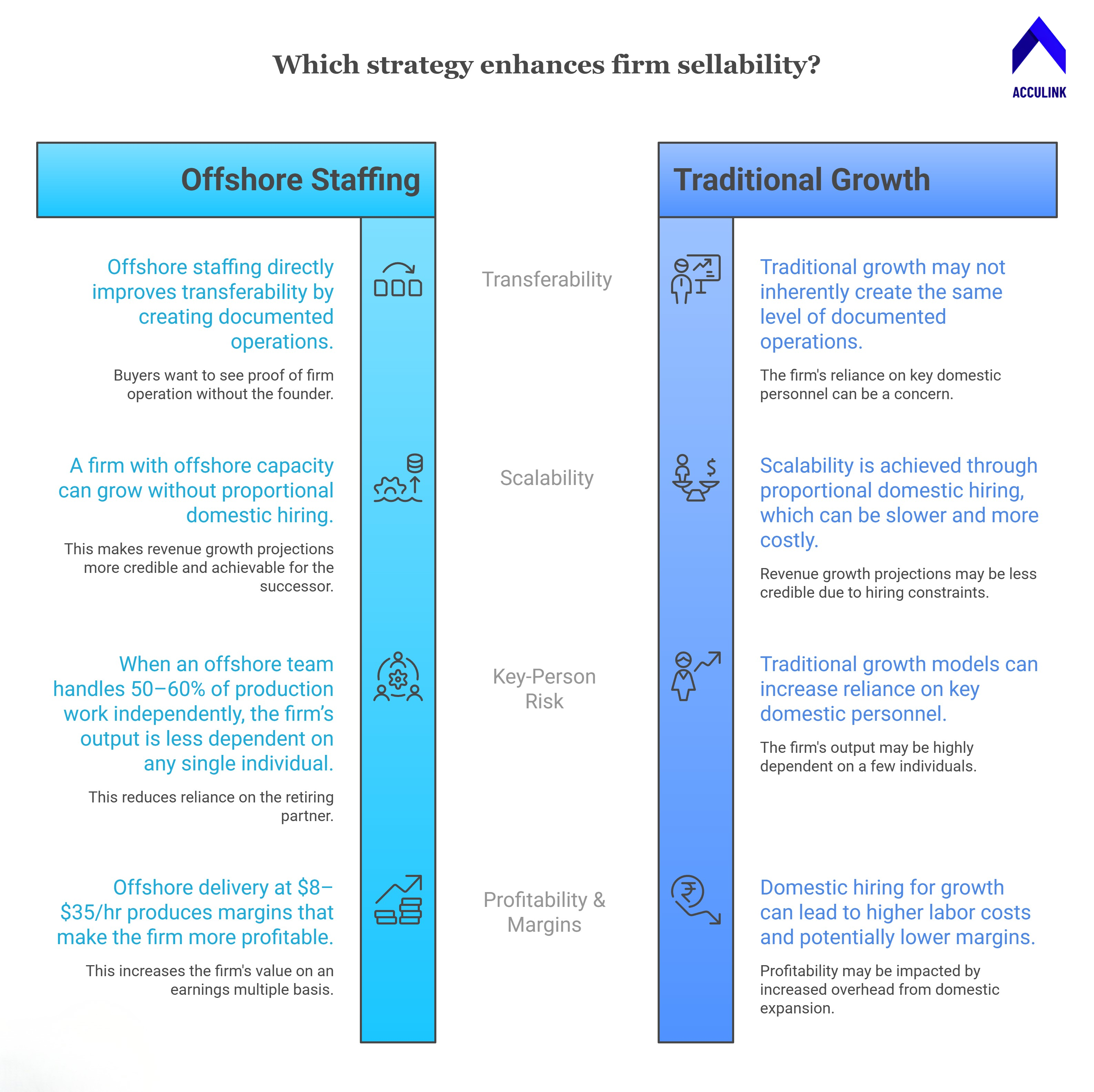
Buyers and successors evaluate CPA firms on transferability and scalability. Offshore staffing directly improves both.
-
Documented operations: Offshore teams require SOPs that document every process. This documentation is exactly what buyers want to see — proof that the firm can operate without the founder.
-
Scalable capacity: A firm with offshore capacity can grow without proportional domestic hiring. This makes revenue growth projections more credible and achievable for the successor.
-
Higher margins: Offshore delivery at $8–$35/hr produces margins that make the firm more profitable and therefore more valuable on an earnings multiple basis.
-
Reduced key-person risk: When an offshore team handles 50–60% of production work independently, the firm’s output is less dependent on any single individual — including the retiring partner.
-
Continuity: Your offshore team through Acculink CPA continues seamlessly through the transition. They don’t leave when the partner leaves — they work for the firm, not the individual.
Timeline: The 3-Year Succession Plan
Year 1: Foundation
Document all SOPs and systems. Add offshore capacity for key service lines. Begin transitioning client relationships to junior partners. Obtain a professional valuation. Decide on internal vs external succession path. If internal, begin identifying and developing successor candidates.
Year 2: Transition
Successor takes increasing operational responsibility. Retiring partner steps back from day-to-day preparation and focuses on client advisory and relationship management. The offshore team handles a growing share of production work. Financial and legal structuring of the transaction is completed.
Year 3: Execution
Formal transition of ownership. Client communications sent. Retiring partner moves to advisory or consulting role. Successor assumes full management. The offshore team continues without disruption. Post-transition support period begins.
Frequently Asked Questions
When should I start succession planning?
3–5 years before your desired exit date is the minimum. 5–10 years is ideal. The earlier you start, the more options you have and the higher the value you can achieve.
How much is my CPA firm worth?
Typically 0.75x–1.5x annual revenue or 3x–6x normalised earnings, depending on client retention, revenue mix, growth trajectory, and operational maturity. Advisory-heavy firms with offshore-enabled operations command premiums.
Does offshore staffing increase my firm’s value?
Yes. Offshore staffing creates documented operations, scalable capacity, higher margins, and reduced key-person dependence — all factors that increase firm valuation and attractiveness to buyers.
Should I tell clients about my succession plan?
Yes, but with careful timing and framing. Communicate when the successor is identified and the transition is underway. Focus on continuity: same team, same quality, same service. Most clients care more about continuity than about who owns the firm.
References
AICPA Succession Planning Resources — https://www.aicpa.org/
Accounting Today — Succession and M&A — https://www.accountingtoday.com/
About Acculink CPA
Acculink CPA is a premier offshore staffing and outsourcing company purpose-built for CPA firms, accounting firms, and tax firms in the United States, Canada, and the UAE. With a team of 300+ qualified professionals — including CPAs, Chartered Accountants, Enrolled Agents, and Big 4-trained staff — Acculink provides dedicated offshore accountants, bookkeepers, tax preparers, auditors, virtual CFOs, and virtual assistants at $8–$35/hr, delivering up to 75% cost savings compared to domestic hiring. The company is ISO 27001 certified, SOC 2 Type II aligned, IRS §7216 compliant, and GDPR compliant, with zero security breaches in 5+ years of operations. Acculink offers a 40-hour free trial with no setup fees, no recruitment charges, and no long-term contracts. Over 80 CPA firms across the United States trust Acculink to deliver quality, security, and scalability.
Website: Acculink CPA | Schedule a Call: book a 45-minute call | Email: Info@acculinkcpa.com | Phone: +1 (203) 997-0224
Tags:
About the Author

Related Posts

Hire Offshore Bookkeepers for CPA & Accounting Firms – Blueprint for Outsourced Bookkeeping
How to hire an offshore bookkeeper for your CPA firm — what they do, how vetting and onboarding work, cost (up…

Hire Offshore Accountants for CPA & Accounting Firms – Why Outsourced Accounting Works
How to hire an offshore accountant for your CPA firm — month-end close, GL, GAAP reporting, in your software —…
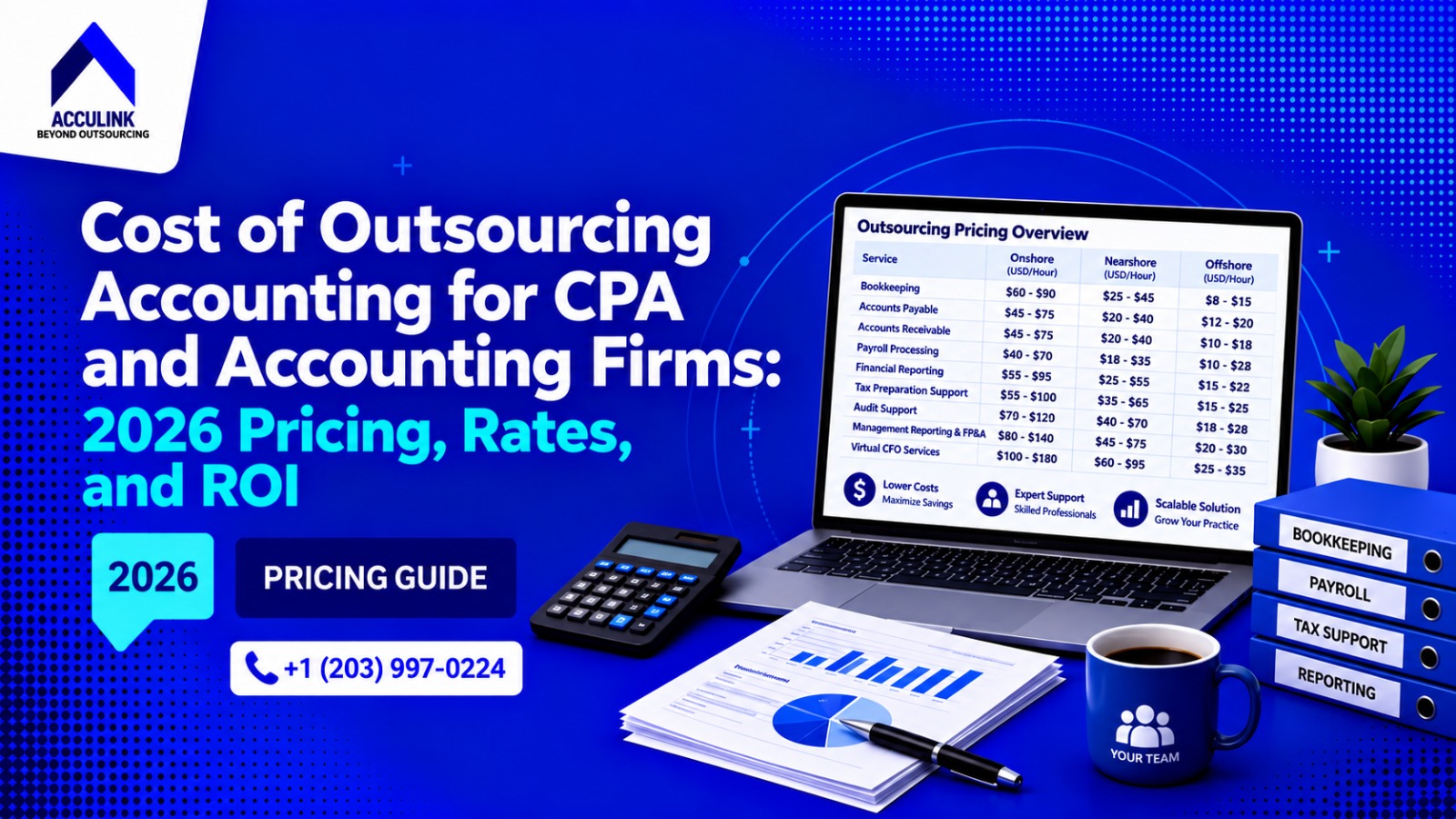
Cost of Outsourcing Accounting for CPA and Accounting Firms: 2026 Pricing, Rates, and ROI
The cost to outsource accounting typically ranges from $8 to $35 per hour, depending on the service, experienc…