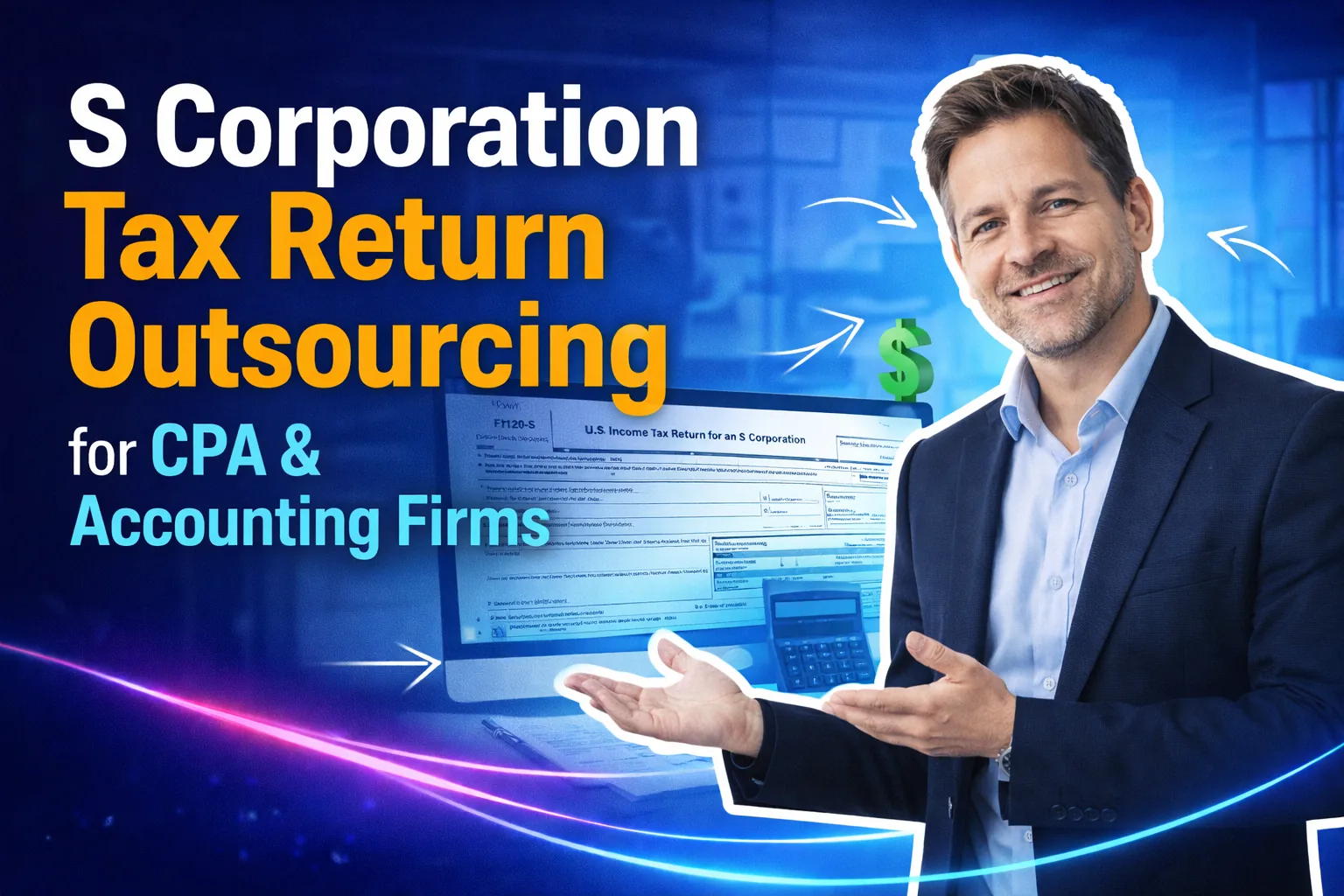
S Corporation Tax Return Outsourcing for CPA & Accounting Firms – Why It Works
Summary
How outsourcing Form 1120-S prep gives CPA firms expert S-corp returns — K-1s, basis, AAA, reasonable comp, QBI, multi-state — by March 15. What's covered and how to start.
S corporation returns are among the most complex individual-entity returns in a CPA firm's seasonal workload. Form 1120-S with its associated K-1 packages, AAA tracking, reasonable compensation analysis, passive activity rules, and QBI deduction calculations creates a substantial production burden — particularly for firms with large S Corp client bases.
Outsourcing S Corp tax return preparation offshore — through our outsourced tax preparation services — allows CPA firms to absorb higher seasonal volume without proportionally expanding domestic staffing. This guide explains the mechanics of S Corp return outsourcing, what the offshore team handles, what the CPA firm retains, and how to structure the review workflow.
What Makes S Corp Returns Labor-Intensive
The Form 1120-S requires more detail than a simple Schedule C or even a C Corp return for most small-to-mid-sized clients. The specific elements that generate production hours:
Balance sheet and Schedule L Unlike sole proprietors or single-member LLCs, S Corps must maintain a corporate balance sheet. The Schedule L requires a beginning-of-year and end-of-year balance sheet that ties to the income statement and M-1 reconciliation. For clients with disorganized books, reconstruction work is a significant pre-preparation task.
Schedule M-1 (or M-3) The reconciliation between book income and taxable income. Every significant book-to-tax difference must be identified and explained: depreciation differences, meals/entertainment disallowances, officer life insurance, guaranteed payments (if any), and one-time items.
Accumulated Adjustments Account (AAA) tracking The AAA is required for S Corps with prior C Corp history and for distributions made when E&P exists. Maintaining the AAA from year to year requires continuity of records — the offshore team needs access to the prior-year file or the AAA reconciliation.
Shareholder K-1 packages Each shareholder receives a K-1 reflecting their share of income, deductions, credits, and basis information. Multiple shareholders multiply the production work. K-1 packages with special allocations or multiple shareholder classes add complexity.
Basis tracking Shareholder basis is not calculated by the S Corp — it is calculated at the shareholder level, usually by the CPA preparing the individual return. However, the S Corp return must provide the information needed for basis calculations (distributions, loans, guaranteed payments). This information must be accurate and complete.
Reasonable compensation analysis For owner-employees, the IRS expects reasonable compensation — a documented analysis of what the shareholder's services are worth as an employee. Some firms document this annually; others do it when examining compensation for reasonableness. The documentation is a CPA judgment function but requires data the bookkeeping/accounting team provides.
QBI deduction (Section 199A) For S Corps eligible for the QBI deduction, the return must report qualified business income, W-2 wages, and unadjusted basis in depreciable property. The calculation depends on the client's specific situation and often requires the CPA's judgment on which rules apply.
What the Offshore Team Handles in S Corp Return Outsourcing
Trial balance review and cleanup Before preparation begins, the offshore team reviews the client's trial balance for obvious issues: accounts that need reclassification, unusual balances, or transactions that need CPA input before the return proceeds. A pre-preparation checklist ensures the CPA firm is alerted to issues before they delay the return.
Schedule L preparation Building the corporate balance sheet from the client's trial balance. Reconciling beginning balances to prior-year Schedule L. Identifying and flagging any balance sheet accounts that require CPA explanation (related-party balances, unusual assets, debt restructuring).
Income statement reconciliation Organizing the client's revenue and expense data into the 1120-S income section. Identifying book-to-tax differences that will populate the M-1.
Schedule M-1 preparation Preparing the book-to-tax reconciliation from the client's data and the depreciation workpapers. Flagging any adjustments that require CPA judgment (certain meals and entertainment, officer compensation analysis).
Depreciation schedules Maintaining the federal and state depreciation schedules. Applying bonus depreciation elections per the CPA's instructions. Producing the depreciation summary that feeds into the 1120-S.
K-1 package preparation Preparing K-1 worksheets for each shareholder based on ownership percentages and any special allocation agreements. Flagging any items requiring CPA review (loan basis, prior loss carryforwards, distributions that may exceed basis).
State return preparation support Many S Corp engagements require state-level filings. The offshore team can prepare state returns consistent with the federal return for states the CPA firm identifies.
Prior-year comparison workpapers Preparing the year-over-year comparison schedule that helps the CPA firm identify anomalies before reviewing the return.
What the CPA Firm Retains
- Reasonable compensation determination — the judgment call on what the owner-employee should be paid cannot be delegated
- QBI deduction analysis — determining which trade or business activities qualify and applying the phase-out rules
- Final return review and sign-off — the CPA's professional responsibility cannot be outsourced
- Client communication — particularly for clients with complex situations (debt restructuring, shareholder disputes, major asset sales)
- Basis tracking at the shareholder level — this is done on the individual return, not the S Corp return
The Review Workflow
S Corp return outsourcing works best with a structured review protocol:
Step 1: Information gathering The CPA firm collects the client's trial balance, depreciation workpapers (or prior-year file), shareholder agreement (if needed for allocations), and any transaction details from the client. This package is sent to the offshore team.
Step 2: Offshore preparation The offshore team prepares the return draft (typically within 3–5 business days for a standard S Corp engagement). The draft includes a summary of issues and questions for the CPA's review.
Step 3: CPA review The partner or manager reviews the draft. For a well-prepared return with no unusual issues, review takes 1–2 hours. For complex returns, 3–4 hours. The CPA makes any adjustments, answers the offshore team's flagged questions, and approves or requests revisions.
Step 4: Final delivery The offshore team incorporates the CPA's revisions and delivers the final return ready for e-file authorization.
For firms running 50–100 S Corp returns per season, this workflow typically reduces production time per return by 60–70%, with the partner or manager spending time on review rather than preparation.
Staffing Depth for S Corp Returns
Not every offshore accountant can prepare S Corp returns. The task requires:
- Understanding of S Corp entity structure and shareholder taxation
- Experience with Schedule L, M-1, and K-1 preparation
- Familiarity with QuickBooks or whatever the client uses for bookkeeping
- Comfort with tax preparation software (Lacerte, ProConnect, Drake, UltraTax — whatever the firm uses)
When vetting an offshore provider for S Corp return preparation, specifically ask about their team's preparation software experience and whether they have staff who have prepared 1120-S returns independently (not just as data entry).
Tax Software Access and Security
S Corp return outsourcing requires the offshore team to access the firm's tax preparation software. The two most common models:
Remote desktop / VPN access: The offshore team member logs into the CPA firm's environment and works within the firm's own installation of Lacerte, Drake, or UltraTax. The return data never leaves the firm's controlled environment.
Cloud-based tax software (ProConnect, Intuit practice management): The offshore team member is added as a user in the cloud environment with appropriate access controls. This is increasingly the preferred model for firms using cloud-native tax software.
In either model, the firm should implement a clear access control policy: offshore team members have access only to the specific client files they are assigned, not the full firm database.
Acculink provides S Corp and business tax return preparation support for CPA firms. Our teams are experienced in 1120-S preparation, Schedule L/M-1/K-1 packages, and multi-state filing support — working within the firm's own tax software environment. Contact us.
About the Author

Related Posts
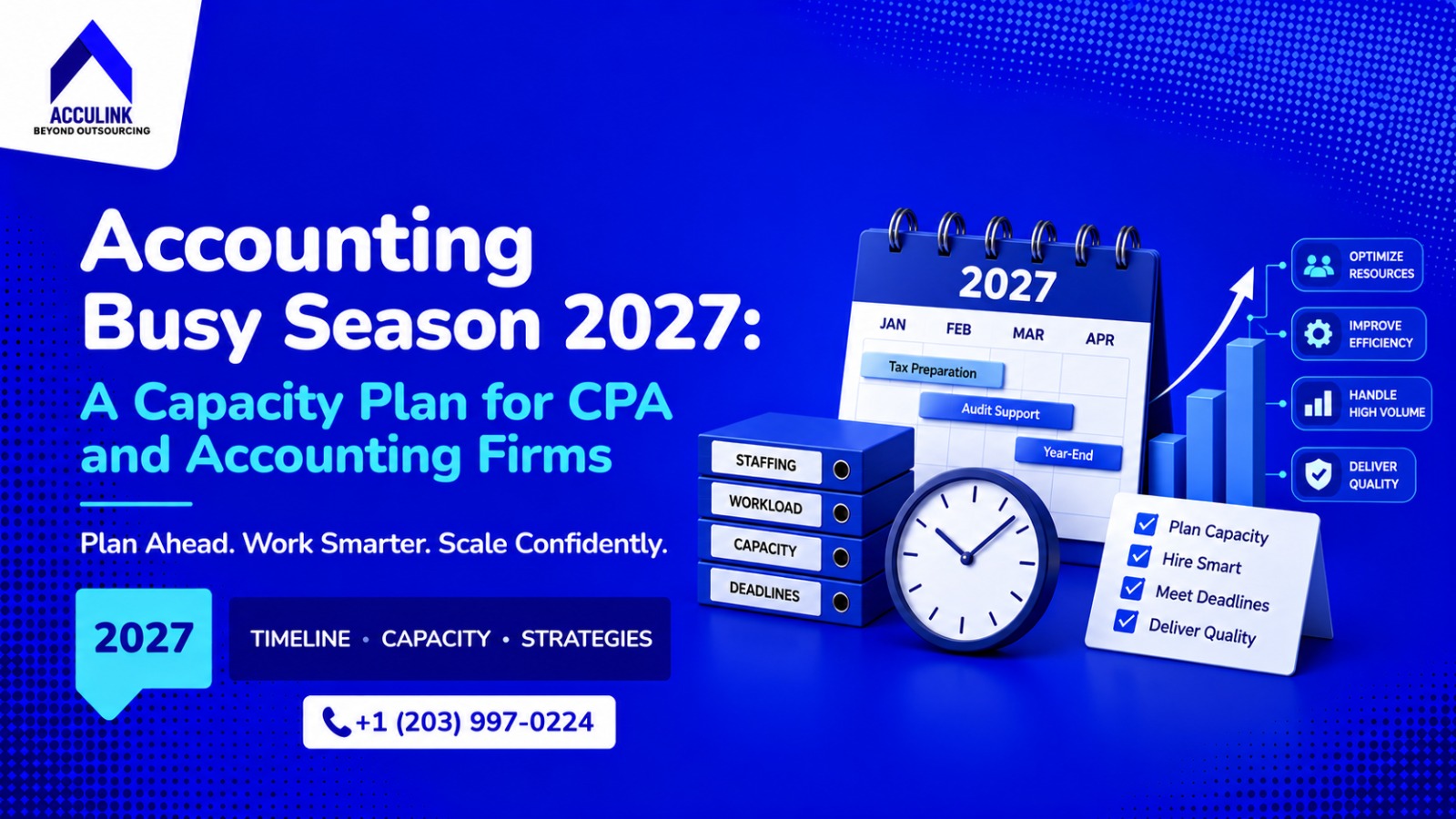
Accounting Busy Season 2027: A Capacity Plan for CPA and Accounting Firms
Accounting busy season becomes manageable when a CPA firm forecasts preparation, review, and administrative wo…
Top Tax Outsourcing Companies for CPA and Accounting Firms (2026 Rankings)
The top tax outsourcing companies for CPA firms in 2026 are Acculink CPA, QX Accounting Services, CapActix, Da…
Tax Preparation Outsourcing for CPA Firms: How It Works, What It Costs, and Where to Start (2026)
Tax preparation outsourcing lets a CPA firm hand routine return preparation to an external team, usually offsh…