Property Accounting Outsourcing for CPA & Real Estate Firms – Why Outsource Property Accounting

Summary
How outsourcing property accounting helps CPA & real estate firms — rent rolls, CAM reconciliations, MACRS depreciation, owner statements — at up to 70–75% less. What's covered.
Real estate clients are among the most complex engagements in a CPA firm's book. The accounting issues that arise — depreciation schedules across multiple properties, passive activity rules, cost segregation studies, 1031 exchange tracking, partnership allocations with multiple investors, and entity-level consolidations — require specialized knowledge. The production work, while skilled, is also voluminous.
Real estate accounting outsourcing lets CPA firms handle that volume without expanding headcount proportionally. This guide covers the specific accounting tasks that outsource well in real estate engagements, the software stack, and what to verify before engaging an offshore accounting team.
Why Real Estate Accounting Is a Production-Heavy Engagement
A real estate client with 5–10 properties isn't unusual. Each property has its own:
- Purchase and improvement cost basis (needed for depreciation calculations)
- Annual depreciation schedule (27.5 years residential, 39 years commercial — or accelerated via cost segregation)
- Mortgage tracking (principal/interest split, escrow reconciliation)
- Property income and expense statement
- Tenant ledger (if the client holds rental properties)
- CAM (Common Area Maintenance) reconciliation (for commercial tenants)
Multiply that by the number of properties, add entity-level consolidations if the client holds properties in multiple LLCs, and factor in the annual tax preparation workload, and a real estate client that looks like a mid-sized engagement generates 3–5× the production hours of a comparable non-real-estate client.
Add the specialized tax issues — cost segregation, bonus depreciation elections, 1031 exchange deferral tracking, passive activity loss limitations — and the engagement demands both production capacity and specialist knowledge.
What Real Estate Accounting Outsourcing Covers
The tasks that transfer well to offshore accounting support:
Property-level bookkeeping Monthly transaction recording for each property: rental income, property management fees, maintenance expenses, insurance, property tax, and mortgage payments. Reconciling each property's accounts against bank statements and management company reports.
Depreciation schedule maintenance Building and maintaining depreciation schedules across the property portfolio. Tracking cost basis, improvements, partial dispositions, and applying the correct depreciation method (MACRS, straight-line, or bonus depreciation election). Generating annual depreciation reports for tax preparation.
Mortgage tracking Amortizing mortgage balances using amortization schedules from the lender. Recording principal and interest splits accurately. Reconciling escrow accounts for tax and insurance payments.
Tenant receivables and rent rolls For commercial or multi-tenant residential clients: maintaining tenant ledgers, recording rent receipts, tracking late fees, and producing monthly rent roll summaries for the client's property manager and the CPA's review.
CAM reconciliation For commercial clients with triple-net or modified-gross leases: preparing annual CAM reconciliations, allocating operating expenses among tenants by square footage, and calculating the tenant's reconciliation statement.
Entity consolidations When the client holds multiple properties in separate LLCs under a parent holding entity: preparing consolidated financial statements from the entity-level trial balances.
Year-end tax workpapers Preparing the workpaper package for the CPA's tax preparation: property income and expense summaries by property, depreciation schedules, capital expenditure summaries, 1031 exchange tracking worksheets, and passive activity worksheets.
What Stays In-House
Real estate accounting involves several judgment-intensive areas where the CPA firm's professional judgment is non-delegable:
- Cost segregation analysis — identifying which components qualify for shorter MACRS lives (5-year, 7-year, 15-year vs. 39-year). The offshore team may input cost segregation study results; they don't perform the analysis.
- 1031 exchange strategy — determining timing, identification rules, and boot calculations requires tax advisory judgment.
- Passive activity loss planning — determining which clients qualify as real estate professionals for PAL purposes, and how to optimize loss recognition, is CPA-level advisory work.
- Entity structure advice — whether to hold properties in individual LLCs, series LLCs, or a master LLC structure is a legal and tax planning question, not a bookkeeping question.
- Audit or review sign-off — for clients requiring audited or reviewed financials (banks often require these for refinancing).
Software Requirements for Real Estate Accounting Outsourcing
Real estate clients use a range of software depending on their size and property type:
General accounting systems: - QuickBooks Online or Desktop (most common for smaller real estate clients) - Xero - Buildium (property management software with integrated accounting) - AppFolio (property management for larger residential portfolios) - Yardi Voyager or Genesis (commercial real estate and larger portfolios)
Depreciation software: - Fixed Asset Pro, Sage Fixed Assets, or Thomson Reuters Fixed Assets CS (used by the CPA firm; offshore team may use the firm's system)
The offshore accounting team should be fluent in QuickBooks at minimum, and should have experience with at least one property management system (Buildium or AppFolio) if the firm serves residential landlord clients.
The Seasonal Pattern of Real Estate Accounting Work
Real estate accounting has a different seasonal profile than most other CPA firm work:
Q1 (January–March): Heavy tax workpaper preparation. Depreciation schedules, entity-level income summaries, passive activity worksheets. This period compresses with general tax season.
Q2–Q3 (April–September): Lighter tax season workload. Monthly bookkeeping and quarterly reporting. Good period for catch-up work on clients with disorganized books.
Q4 (October–December): Year-end planning and projections. Some clients need bonus depreciation elections made before year-end. Property acquisition activity tends to be heavier in Q4.
The seasonal pattern means real estate accounting outsourcing has the same capacity-smoothing benefit as any other offshore arrangement: the offshore team absorbs the Q1 production surge without requiring the firm to hire year-round capacity.
Onboarding a Real Estate Client to an Offshore Arrangement
The most important onboarding step for real estate clients is establishing the chart of accounts structure at the property level. Offshore teams need to know:
- Whether the client tracks income and expenses per property (property-level P&L) or in aggregate
- What cost categories the client uses for property expenses (versus the CPA's preferred categorization for tax purposes)
- Whether the client holds properties in separate entities or all in one entity
- Which properties are residential (27.5-year depreciation) vs. commercial (39-year)
- What the acquisition cost and basis are for each property
With this information, the offshore team can set up proper accounts and begin maintaining the books correctly from the first month. Onboarding a real estate client typically takes 3–5 hours of setup versus 1–2 hours for a simpler business client.
Finding the Right Offshore Accounting Partner for Real Estate Work
Real estate accounting is a specialty. Not every offshore accounting firm has staff with the depth to handle multi-entity real estate portfolios, depreciation schedule maintenance, and CAM reconciliations accurately.
When vetting an offshore accounting provider for real estate accounting, ask:
- Do you have staff with QuickBooks + real estate client experience?
- Have you worked on clients with multiple properties in separate LLCs?
- Do you maintain depreciation schedules using MACRS methods?
- Do you have experience with property management software (Buildium, AppFolio, Yardi)?
- What is your process for tracking 1031 exchange deferrals (even if the advisory is done by the CPA)?
A provider that can answer these questions concretely has the right experience. A provider that gives vague answers about "accounting experience" probably hasn't worked in the real estate vertical.
Acculink provides real estate accounting outsourcing for CPA firms. Our teams handle property-level bookkeeping, depreciation schedules, entity consolidations, and year-end tax workpapers — operating as a production extension of your firm. See our accounting outsourcing services for the full scope. Contact us.
Looking to Hire a Qualified Property Accountant?
Get experienced staff skilled in AppFolio, Yardi, Buildium, and QuickBooks. Scale your real estate accounting team without the overhead.
Tags:
About the Author

Related Posts
15 Profitable Add-On Services CPA and Accounting Firms Can Offer Without Hiring In-House
CPA and accounting firms do not need to build every new service with another in-house hire. This guide compare…
Top 10 Payroll Outsourcing Companies for CPA and Accounting Firms (2026)
This guide compares ten payroll outsourcing companies for U.S. CPA and accounting firms. It separates processi…
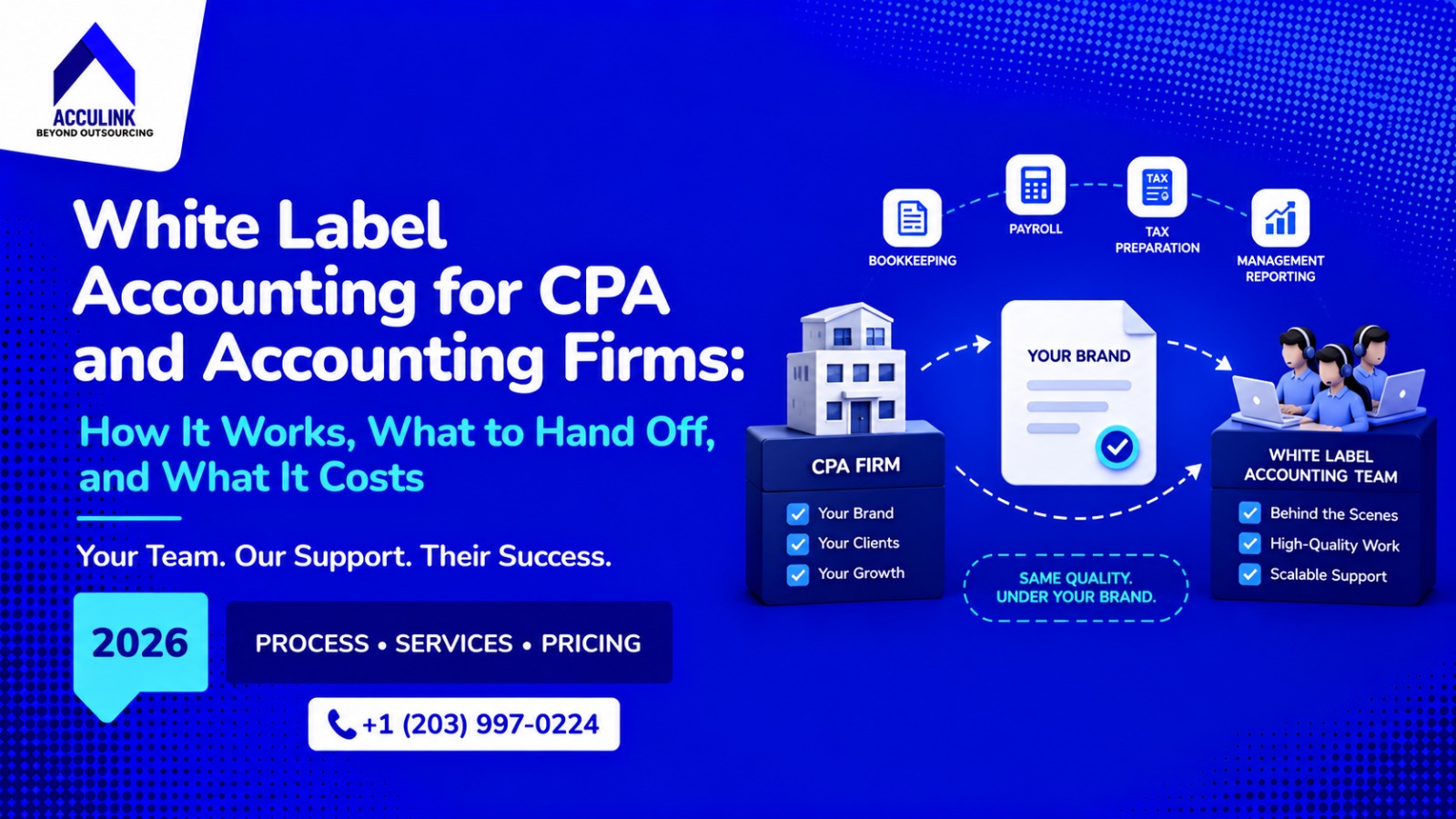
White Label Accounting for CPA and Accounting Firms: How It Works, What to Hand Off, and What It Costs
White label accounting helps CPA firms expand capacity while keeping control of their brand, client relationsh…