How to Start a CPA Firm in 2026: The Complete Startup Guide


Summary
Starting a CPA firm is one of the most rewarding career decisions an accounting professional can make. The freedom to build your own practice, choose your clients, set your own culture, and capture the full economic value of your expertise is deeply fulfilling. The practical barriers that once made
Starting a CPA firm is one of the most rewarding career decisions an accounting professional can make. The freedom to build your own practice, choose your clients, set your own culture, and capture the full economic value of your expertise is deeply fulfilling. The practical barriers that once made firm ownership accessible only to those with significant capital have been eliminated by cloud technology, remote work, and offshore staffing. Today, a licensed CPA with client relationships and professional expertise can launch a fully operational firm within weeks. It can have the capacity of a multi-person practice, at a fraction of the historical cost.
The firms that launch in 2026 with built-in offshore capacity from Acculink CPA start with an advantage that previous generations of firm owners could never have imagined. They have the staffing depth of an established practice from day one, and the cost structure of a solo operation. They keep the flexibility to scale up or down based on demand.
This combination is why the most successful new firms today reach profitability faster and grow client bases more quickly. They also achieve better work-life balance than any previous generation of firm startups.
Financial Planning for Your New Firm
Before launching, build a 12-month financial projection that includes startup costs such as firm registration, insurance, technology, and marketing. Project monthly revenue based on conservative client acquisition assumptions, accounting for the typical 3 to 6 month ramp-up period. Calculate your monthly break-even point, which is the minimum revenue needed to cover technology subscriptions, offshore staffing costs, insurance, and personal living expenses. Most new firm owners need 3 to 6 months of personal living expenses saved as a financial runway while the practice builds momentum.
Your offshore staffing costs from Acculink CPA should be part of your financial plan from day one. A full-time offshore professional at 12 to 20 dollars per hour costs roughly 2,000 to 3,200 dollars per month. This is your most important investment because it directly determines your capacity to take on clients. A solo practitioner without support might handle 20 to 30 clients. The same practitioner with one offshore team member can handle 50 to 80 clients. That generates 2 to 3 times the revenue at marginally higher cost. The math overwhelmingly favours building offshore capacity early rather than waiting until you are overwhelmed.
Track your actual financial performance against projections monthly. Adjust pricing, client acquisition efforts, and staffing levels based on real data rather than assumptions. The firms that manage by the numbers from launch build stronger, more profitable practices than those that fly blind during the critical first year.
Key Takeaways
-
Starting a CPA firm in 2026 is more accessible than ever — cloud technology, offshore staffing, and remote work have dramatically lowered the cost and complexity of launching a practice.
-
This guide covers every step: self-assessment, licensing, business structure, technology stack, initial hires vs outsourcing, pricing, client acquisition, and a 12-month startup timeline.
-
The smartest new firm owners build offshore capacity from day one through providers like Acculink CPA. That gives them the staffing depth of a 10-person firm at the cost structure of a solo practice.
-
Common startup mistakes include underpricing, over-investing in office space, trying to do everything yourself, and waiting too long to build a team.
Starting your own CPA firm is one of the most rewarding — and most daunting — career decisions you can make. The freedom to choose your clients, set your own schedule, build your own culture, and capture the full economic value of your work is deeply appealing. But the practical questions can feel overwhelming: How do I get licensed? What business structure should I choose? What technology do I need? How do I get clients? And, critically, how do I deliver quality work without a team?
The good news is that starting a CPA firm in 2026 is fundamentally easier than it was even five years ago. Cloud accounting platforms eliminate the need for expensive server infrastructure. Practice management tools are available at monthly subscription prices. Remote work means you can start from your home office. And offshore staffing through providers like Acculink CPA means you can have a full-time, dedicated team member from day one at $8–$35/hr — without the $75,000+ salary, benefits, and overhead of a domestic hire.
This guide walks you through every step of starting a CPA firm, from the initial decision to your first year of operations. Whether you’re leaving a large firm, a mid-size practice, or corporate accounting, this is your blueprint.
Is Starting a CPA Firm Right for You?
Before diving into logistics, take an honest self-assessment. Starting a firm requires skills beyond technical accounting: client development (business development and sales are now your responsibility). It needs operations management (you’re running a business, not just practising accounting), financial risk tolerance (irregular cash flow in the early months is normal), and self-discipline (without a boss or a schedule, you set the pace). If these excite you rather than intimidate you, you’re a strong candidate. If they feel overwhelming, consider starting as a side practice while maintaining employment, or partnering with someone whose skills complement yours.
Licensing and Legal Requirements
Every state has specific requirements for operating a CPA firm. Common requirements include an active CPA license in good standing in the state where you’ll practice, firm registration with the state board of accountancy, compliance with the state’s firm ownership rules (most states require majority CPA ownership). Add professional liability (errors and omissions) insurance, and a business license or registration with your city or county.
Check your state board’s website for exact requirements. Some states require a separate firm permit; others register firms automatically when a licensed CPA files. If you plan to serve clients in multiple states, you’ll need to understand mobility rules and reciprocity agreements. The AICPA’s Uniform Accountancy Act provides a framework, but state-by-state requirements vary.
Business Structure: LLC, S Corp, or Partnership
Most new CPA firms choose one of three structures. A single-member LLC provides liability protection with pass-through taxation and is the simplest option for solo practitioners. An S Corporation offers liability protection plus the ability to split income between salary and distributions. That reduces self-employment tax on the distribution portion once the firm is profitable enough to justify the additional complexity. A partnership or multi-member LLC works when two or more CPAs are starting together. Operating agreements define profit sharing, decision authority, and exit terms.
For most solo practitioners, starting as an LLC and electing S Corp status once revenue exceeds roughly $80,000–$100,000 annually is the most tax-efficient path. Consult with a business attorney and your own tax advisor to confirm the best structure for your situation. For LLC formation services, Acculink CPA can assist with entity setup and compliance.
Technology Stack: What You Actually Need
New firm owners often over-invest in technology or, conversely, try to run on spreadsheets and email. Here’s the essential tech stack for a new CPA firm in 2026, prioritised by importance.
Must-Have (Month 1)
-
Cloud accounting platform: QuickBooks Online or Xero for client bookkeeping
-
Tax software: Start with one platform (CCH Axcess, UltraTax CS, Lacerte, or Drake, based on your experience and client profile)
-
Practice management: Karbon, Canopy, or Jetpack Workflow for task tracking and deadlines
-
Secure client portal: SmartVault or your practice management platform’s built-in portal
-
Communication: Microsoft Teams or Zoom for client and team meetings
-
Password manager: 1Password or LastPass for secure credential management
Add Later (Month 3–6)
-
Document management: SharePoint or Google Drive for internal file storage
-
Advisory tools: Fathom or Reach Reporting when you’re ready to offer CAS
-
CRM: HubSpot free tier or Pipedrive for client pipeline management
Total technology cost for a new firm: roughly $300–$800/month for essential subscriptions. This is a fraction of the $50,000+ that firms spent on servers, software licenses, and IT infrastructure a decade ago.
Initial Hires vs Outsourcing: Building Your Team
This is the most important strategic decision for a new firm owner. Your instinct might be to do everything yourself until revenue justifies a hire. But this approach creates a capacity ceiling: you can only grow as fast as your personal bandwidth allows. That means 60–80 hour weeks during tax season and a hard cap on client count.
The smarter approach: start with offshore capacity from day one. A dedicated offshore professional from Acculink CPA at $12–$20/hr (roughly $2,000–$3,200/month for a full-time equivalent) gives you the capacity to take on 2–3x more clients than you could handle alone. Your offshore team member handles preparation work — tax returns, bookkeeping, reconciliation, data entry — while you focus on client relationships, review, advisory, and business development.
This model is how the most successful new firms launch in 2026. They start with the capacity of a 2–3 person firm at the cost of roughly one domestic part-time hire. By month 6, they’re serving 20–40 clients. By year one, they’re at 50–80 clients with 2–3 offshore staff and considering their first domestic hire for client-facing work.
Pricing Your Services
New firm owners consistently underprice their services, partly from imposter syndrome and partly from fear of losing clients. Don’t fall into this trap. Research market rates in your area and set prices that reflect your experience and the value you deliver.
Typical starting price ranges for a new CPA firm include individual tax returns (1040) at $300–$800 depending on complexity, small business tax returns (1120/1120-S/1065) at $800–$2,500, monthly bookkeeping at $300–$1,500 per client. Add quarterly financial reviews at $500–$1,500 per quarter, and advisory/virtual CFO at $1,500–$5,000 per month. With offshore delivery costs at $8–$35/hr, your margins on these services will be strong from the start.
Getting Your First Clients
Client acquisition is the existential challenge for every new firm. The good news: you likely already have a network of potential clients from your previous firm (subject to any non-compete or non-solicitation agreements). Add personal contacts, professional networks, and referral sources.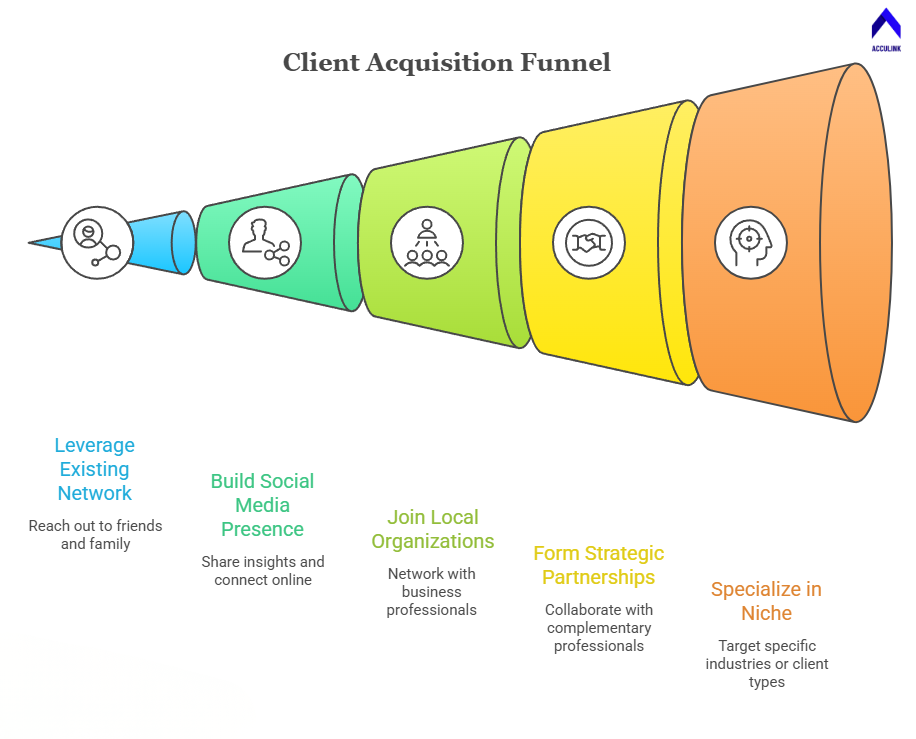
-
Your existing network: Tell everyone you know that you’ve started a firm. Friends, family, former colleagues, and professional contacts are your first referral pipeline.
-
LinkedIn and social media: Establish your firm’s presence. Share insights, publish articles, and connect with business owners in your target market.
-
Local business organisations: Join your local chamber of commerce, BNI group, or industry association. These provide structured networking opportunities.
-
Strategic partnerships: Build referral relationships with attorneys, financial advisors, bankers, and insurance agents who serve the same client base.
-
Niche specialisation: Specialising in a specific industry or client type (real estate investors, ecommerce businesses, medical practices) makes your marketing more targeted and your expertise more compelling.
Building Your Team with Offshore Support
The progression for most successful new firms follows a predictable pattern. In months 1–3, the founder plus one offshore professional from Acculink CPA handles the initial client base. The offshore team member prepares returns, manages bookkeeping, and handles administrative tasks while the founder does everything client-facing.
In months 4–8, as the client base grows, a second offshore professional is added. The founder begins to specialise in review, advisory, and business development. Preparation work is almost entirely handled offshore.
By months 9–12, with 40–80 clients and 2–3 offshore staff, the founder considers the first domestic hire — typically a client-facing manager or senior accountant who can handle advisory conversations and complex client situations. The offshore team continues to scale as the client base grows.
This progression gives the new firm owner the capacity to grow without the financial risk of premature domestic hiring. If client growth is slower than expected, the offshore commitment is flexible — no long-term contracts, no severance, no overhead. If growth is faster than expected, additional offshore staff are available within 5–7 days.
12-Month Startup Timeline
Pre-Launch (Month 0)
Obtain firm registration, E&O insurance, and a business license. Set up bank accounts and accounting. Choose and configure your technology stack. Build your website and LinkedIn presence. Begin networking and telling your network about the new firm.
Months 1–3: Launch
Onboard your first offshore team member from Acculink CPA. Take on your first 5–15 clients. Establish workflows and SOPs. Focus on delivering exceptional quality to build referrals. Track time carefully to calibrate pricing.
Months 4–6: Growth
Expand to 15–30 clients. Add a second offshore professional if volume warrants. Refine your service offerings based on client demand. Begin building advisory capabilities. Attend 1–2 industry conferences.
Months 7–12: Scale
Reach 30–80 clients. 2–3 offshore staff handling preparation and compliance. Evaluate the first domestic hire for a client-facing role. Implement advisory tools and begin offering CAS services. Set revenue and profitability targets for year two.
Common Mistakes New CPA Firm Owners Make
-
Underpricing: Fear of losing prospects leads to fees that don’t cover costs. Price for value from day one.
-
Over-investing in office space: A home office or co-working space is sufficient at launch. Don’t sign a lease until revenue justifies it.
-
Trying to do everything yourself: This creates a capacity ceiling that limits growth. Build offshore capacity early.
-
Neglecting business development: The technical work feels safer than selling, but client acquisition is your job. Block time for it weekly.
-
Not building systems early: SOPs and workflows are easier to build with 10 clients than 50. Start standardising immediately.
Frequently Asked Questions
How much does it cost to start a CPA firm?
$5,000–$15,000 for initial setup, including firm registration, E&O insurance, technology subscriptions, and website. Monthly operating costs start at $1,500–$3,000, including offshore staffing. Many firms are cash-flow positive within 3–6 months.
Do I need an office to start a CPA firm?
No. Most new firms start from a home office. Cloud technology and remote work make physical office space unnecessary at launch. Co-working spaces provide meeting rooms for occasional in-person client meetings.
How long until a new CPA firm is profitable?
Most new firms reach profitability within 6–12 months with disciplined pricing and offshore support. Firms that start with offshore capacity reach profitability faster because their per-engagement cost is dramatically lower.
Should I specialise or be a generalist?
Specialisation is a significant competitive advantage, especially for new firms. A specialist in e-commerce accounting or real estate tax is more compelling to prospects than a generalist. However, don’t turn away good clients outside your speciality in the early months — revenue is important.
Can I start a firm while still employed?
Yes, many CPAs start as a side practice and transition to full-time when revenue supports it. Check your current employer’s policies on outside employment and any non-compete agreements.
References
AICPA Resources for New Firm Owners — https://www.aicpa.org/
Small Business Administration — https://www.sba.gov/
About Acculink CPA
Acculink CPA is a premier offshore staffing and outsourcing company purpose-built for CPA firms, accounting firms, and tax firms in the United States, Canada, and the UAE. With a team of 300+ qualified professionals — including CPAs, Chartered Accountants, Enrolled Agents, and Big 4-trained staff — Acculink provides dedicated offshore accountants, bookkeepers, tax preparers, auditors, virtual CFOs, and virtual assistants at $8–$35/hr, delivering up to 75% cost savings compared to domestic hiring. The company is ISO 27001 certified, SOC 2 Type II aligned, IRS §7216 compliant, and GDPR compliant, with zero security breaches in 5+ years of operations. Acculink offers a 40-hour free trial with no setup fees, no recruitment charges, and no long-term contracts. Over 80 CPA firms across the United States trust Acculink to deliver quality, security, and scalability.
Website: Acculink CPA | Schedule a Call: book a 45-minute call | Email: Info@acculinkcpa.com | Phone: +1 (203) 997-0224
Tags:
About the Author

Related Posts

Hire Offshore Bookkeepers for CPA & Accounting Firms – Blueprint for Outsourced Bookkeeping
How to hire an offshore bookkeeper for your CPA firm — what they do, how vetting and onboarding work, cost (up…

Hire Offshore Accountants for CPA & Accounting Firms – Why Outsourced Accounting Works
How to hire an offshore accountant for your CPA firm — month-end close, GL, GAAP reporting, in your software —…
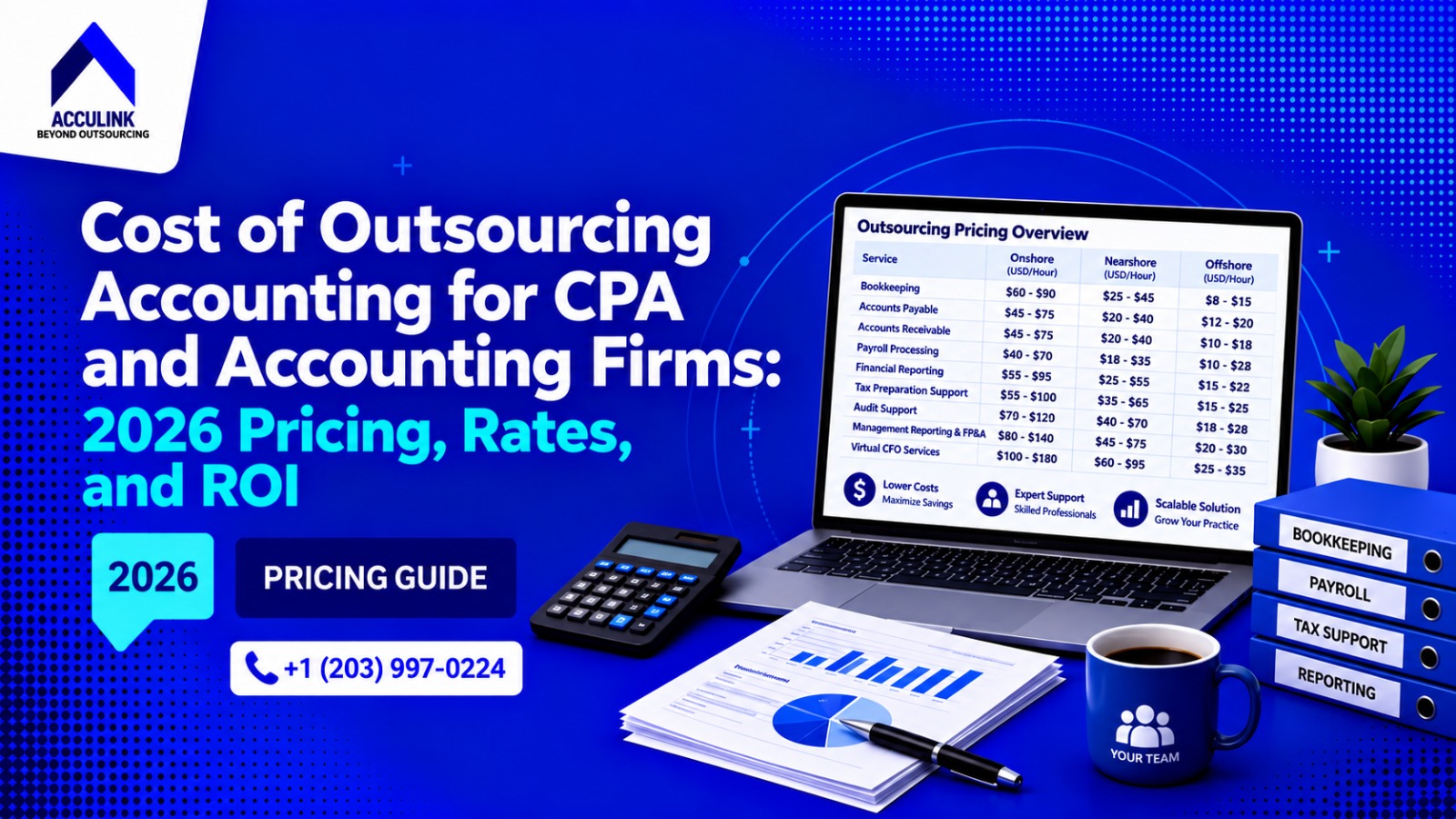
Cost of Outsourcing Accounting for CPA and Accounting Firms: 2026 Pricing, Rates, and ROI
The cost to outsource accounting typically ranges from $8 to $35 per hour, depending on the service, experienc…