How Private Equity Is Reshaping the Accounting Profession in 2026


Summary
The PE wave in accounting is not a temporary trend. Institutional capital will continue flowing into the profession because the fundamental investment thesis remains strong: recurring revenue, high retention, a fragmented market, and growing demand. Independent firms that ignore this reality will find
The PE wave in accounting is not a temporary trend. Institutional capital will continue flowing into the profession because the fundamental investment thesis remains strong: recurring revenue, high retention, a fragmented market, and growing demand. Independent firms that ignore this reality will find themselves competing against well-capitalised platforms with national scale. But the firms that respond strategically, combining offshore staffing for capacity and cost efficiency, technology for productivity, and advisory for revenue diversification, will not just survive the PE era. They will thrive in it, on their own terms, with their independence intact and their client relationships stronger than ever. The choice between PE and independence is ultimately a choice about what kind of firm you want to build and what kind of professional life you want to lead. Both paths can lead to financial success. Only one preserves the autonomy and culture that most firm owners entered the profession to enjoy.
Understanding PE Deal Structures in Accounting
For firm owners evaluating PE interest, understanding the deal structure is critical. Most PE transactions in accounting involve a combination of upfront cash payment for a majority stake in the non-attest entity, rollover equity where partners retain 20 to 40 per cent ownership in the platform, earn-out provisions tied to post-acquisition revenue and EBITDA targets over 2 to 4 years, and employment agreements requiring key partners to remain for 3 to 5 years post-closing.
The headline valuation multiple of 2x to 4x revenue sounds attractive, but the effective value depends heavily on the earn-out terms and rollover equity structure. A partner might receive only 50 to 60 per cent of the total deal value upfront, with the remainder contingent on hitting growth targets under PE ownership. If those targets require aggressive acquisition activity, technology migration, and cultural integration that the partner did not anticipate, the earn-out may not materialise.
Partners should also understand the second-bite economics. PE firms often pitch the idea that partners will profit again when the platform is sold to the next buyer, typically at a higher valuation. While this second bite can be lucrative, it is not guaranteed. Market conditions, integration challenges, and competitive dynamics can all affect the second exit valuation. Partners should evaluate the first-bite economics independently and treat any second-bite upside as a bonus rather than a certainty.
For many firm owners, the analysis reveals that organic growth with offshore staffing delivers comparable financial outcomes over a 5 to 10 year horizon without the loss of control, cultural disruption, and earn-out risk that PE deals entail. A firm that grows revenue by 15 to 20 per cent annually through offshore-enabled capacity expansion, while maintaining 35 to 40 per cent margins, creates significant equity value that partners capture entirely. This is the math that keeps many successful firm owners independent despite active PE interest.
What PE Means for the Talent Market
PE-backed firms are reshaping the talent market in ways that affect every CPA firm. These platforms offer compensation packages that independent firms struggle to match: higher base salaries, structured bonus programs, equity participation, and national mobility. For senior talent, PE-backed firms are increasingly the employer of choice on financial terms alone.
However, PE-backed firms also create talent that independent firms can recruit. Not everyone thrives in a PE environment. Professionals who joined for the compensation often discover that cultural trade-offs, including aggressive targets, frequent reorganisation, and loss of community, are not worth the premium. These disillusioned professionals represent a recruiting opportunity for independent firms offering stability and meaningful work.
For firms using offshore staffing, the talent equation changes entirely. When 50 to 60 per cent of production work is handled by offshore professionals at 8 to 35 dollars per hour, you need fewer domestic hires. The domestic roles you fill can be higher-level positions focused on client relationships and advisory, letting you compete with PE-backed firms on compensation for the roles that matter most.
The Long-Term Case for Independence
The PE model operates on a 5 to7-yearr investment horizon. PE firms buy a platform, grow it, and sell it. This creates real tension with the long-term nature of CPA firm client relationships. Independent firms operate on an infinite time horizon. Your clients know you will be there next year and the year after. This permanence builds trust that PE-backed platforms with revolving ownership structures struggle to replicate.
Independent firms also have the freedom to make decisions based on client value rather than investor returns. You can invest in a relationship that will not pay off for two years. You can build a culture that prioritises well-being over quarterly metrics. These choices, compounded over decades, create firms that clients trust deeply and staff are proud to work for. Acculink CPA enables this model by providing the capacity and cost structure of a much larger firm while preserving independence.
Practical Steps for Independent Firms Facing PE Competition
Beyond the strategic considerations, independent firms should take concrete steps to strengthen their competitive position. First, invest in technology that PE-backed firms use, but that is available to any firm at subscription prices: practice management platforms, AI-powered document processing, and cloud accounting tools. Second, build your advisory capabilities, since advisory revenue commands higher margins and deeper client loyalty than compliance alone.
Third, formalise your offshore staffing strategy. Start with one or two dedicated professionals from Acculink CPA and scale based on results. The firms that started offshore staffing two or three years ago are now years ahead in capacity, cost efficiency, and partner work-life balance. Fourth, strengthen your brand in your local market. PE-backed platforms compete nationally, but clients still prefer advisors who understand their community, their industry, and their specific circumstances.
Key Takeaways
-
Private equity investment in accounting has exploded since 2020, with PE-backed firms now dominating the Accounting Today Top 100 and fundamentally changing the competitive landscape for small and mid-size CPA firms.
-
PE firms are attracted to accounting because of its recurring revenue, high client retention rates, fragmented market ripe for consolidation, and predictable cash flows — making CPA firms ideal platform investments.
-
For firm partners considering PE, the decision involves trade-offs: immediate liquidity and growth capital versus loss of autonomy, cultural disruption, and pressure to hit aggressive financial targets.
-
Small and mid-size firms have a viable alternative to PE: organic growth powered by offshore staffing, which delivers scalability, cost efficiency, and capacity expansion without giving up equity or control.
-
Acculink CPA enables firms to scale from 5 to 50+ staff without PE capital, maintaining independence while achieving the growth metrics that PE-backed competitors pursue.
Private equity has arrived in accounting, and it’s not leaving. What started as a niche strategy by a handful of investors has become a defining force in the profession. PE-backed firms are acquiring practices at a record pace, consolidating regional firms into national platforms, and fundamentally changing the economics of public accounting.
For small and mid-size CPA firm owners, the PE wave raises urgent questions: Should I take PE money? Can I compete with PE-backed firms that have deeper pockets and more aggressive growth strategies? Is there an alternative growth path that doesn’t require giving up control of the firm I’ve spent decades building?
This guide examines the PE phenomenon in accounting from every angle: what’s happening, why it’s happening, how it changes firm operations, the pros and cons for partners, and — for firms that choose independence — how to compete and grow without PE capital through strategic offshore staffing.
What Is Private Equity in Accounting?
Private equity in accounting refers to PE firms investing capital in CPA firms, typically through platform acquisitions (buying a large firm as a base) and tuck-in acquisitions (adding smaller firms to the platform). The PE firm provides growth capital, operational expertise, and M&A infrastructure. The accounting firm provides recurring revenue, client relationships, and professional expertise.
These investments are facilitated by Alternative Practice Structures (APS), which separate the attest (audit) functions — which must remain under CPA ownership per state licensing laws — from the non-attest functions (tax, advisory, bookkeeping, consulting) that can be owned by non-CPA entities, including PE firms. This legal structure has enabled PE investment to flow into the profession on an unprecedented scale.
The Numbers: How Many Firms Have Taken PE
The scale of PE investment in accounting has grown dramatically. Multiple firms in the Accounting Today Top 100 are now PE-backed, and the pace of acquisitions continues to accelerate. Major PE players in the accounting space include New Mountain Capital (which backed a leading platform), Hellman & Friedman, TowerBrook Capital, Bain Capital, and several other institutional investors.
The deals are substantial. Platform acquisitions have been valued at multiples of 2x–4x revenue, with the largest transactions exceeding $1 billion in enterprise value. For partners in acquired firms, these deals offer immediate liquidity — often delivering payouts that would have taken 10–15 years to accumulate through traditional partnership draws.
The consolidation is reshaping the competitive landscape. PE-backed platforms can offer services across multiple geographies, invest in technology at scale, and recruit talent with compensation packages that independent firms struggle to match. For small and mid-size firms, this creates both competitive pressure and potential acquisition opportunities.
Why PE Is Entering Accounting
Private equity investors are attracted to accounting for several structural reasons that make CPA firms ideal investment targets:
-
Recurring revenue: CPA firms have exceptionally sticky client relationships. Annual tax returns, monthly bookkeeping, and quarterly advisory engagements create predictable, recurring revenue streams that PE firms value highly.
-
High retention rates: Client retention in public accounting typically exceeds 90–95%. Once a client trusts their CPA firm, switching costs (both real and perceived) are significant.
-
Fragmented market: The U.S. has roughly 45,000 CPA firms, the vast majority of which are small or mid-size. This fragmentation creates a massive consolidation opportunity for PE-backed platforms.
-
Predictable cash flows: Accounting firms generate consistent cash flows with relatively low capital expenditure requirements. This cash flow profile is ideal for leveraged buyout structures.
-
Pricing power: The accountant shortage and growing demand for advisory services give CPA firms increasing pricing power — a trend that PE investors expect to continue.
How PE Changes Firm Operations
When a PE firm invests in a CPA practice, operational changes typically follow. Understanding these changes is important for partners evaluating whether PE is right for their firm.
Accelerated Growth Targets
PE investors expect returns of 20–30%+ annually. This means aggressive growth targets: revenue growth through organic expansion and tuck-in acquisitions, margin improvement through operational efficiency and technology investment, and geographic expansion into new markets. Partners accustomed to steady, conservative growth may find the pace and pressure significantly different.
Centralized Operations
PE-backed platforms typically centralise administrative functions: HR, IT, marketing, billing, and practice management. This can improve efficiency but also reduce individual firm autonomy. Partners who valued running their own practice may feel constrained by platform-level policies and processes.
Technology Investment
PE capital enables significant technology investment: new practice management platforms, AI tools, data analytics, and client portals. This is often cited as a primary benefit of PE investment — access to technology that individual firms couldn’t afford independently.
Talent Strategy
PE-backed firms can offer more competitive compensation packages, structured career paths, and national mobility. However, the cultural integration of acquired firms can be disruptive, and some staff leave during transitions.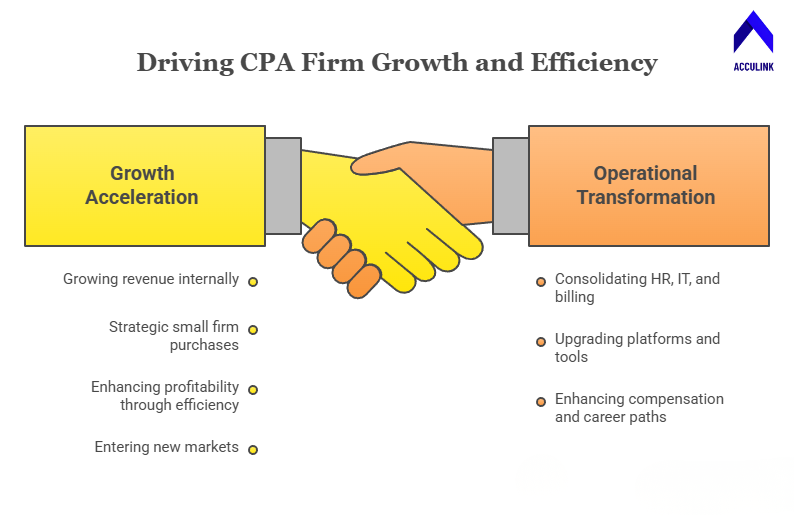
Pros and Cons of PE for CPA Firm Partners
Potential Benefits
-
Immediate liquidity — partners receive cash payouts for their equity, often at premium valuations.
-
Growth capital — access to investment funds for technology, talent, and geographic expansion.
-
Operational support — centralised HR, IT, marketing, and practice management resources.
-
Exit strategy — PE provides a defined path for partners looking to transition out of the firm.
Potential Drawbacks
-
Loss of autonomy — partners become employees of a larger organisation with platform-level governance.
-
Cultural disruption — the firm’s culture may change significantly under PE ownership, affecting staff retention and client relationships.
-
Performance pressure — aggressive growth and margin targets can create stress that contradicts the work-life balance many partners seek.
-
Earn-out risk — a significant portion of the partner payout may be contingent on post-acquisition performance targets.
-
Second bite uncertainty — the PE firm’s exit strategy (selling the platform to another PE firm or taking it public) may create disruption and uncertainty for remaining partners.
The Alternative: Organic Growth with Offshore Teams
For firm owners who value independence, autonomy, and control, there’s a compelling alternative to PE: organic growth powered by offshore staffing. This approach delivers many of the same benefits PE promises — capacity expansion, cost efficiency, and the ability to scale — without the trade-offs.
Here’s how independent firms are competing with PE-backed platforms using offshore teams from Acculink CPA:
-
Capacity expansion without capital: Add 2, 5, or 20 professionals at $8–$35/hr without PE investment. Scale up during tax season, maintain lean operations off-season.
-
Margin improvement: Offshore staffing reduces your fully-loaded cost per engagement by 60–75%, improving margins to levels that PE-backed firms achieve through consolidation.
-
Advisory enablement: Offshore teams handle compliance work, freeing partners to build advisory services that command premium fees. Virtual CFOs and FP&A analysts from Acculink can directly deliver advisory deliverables.
-
Technology access: The technology PE-backed firms invest in — cloud accounting, AI tools, practice management platforms — is available to independent firms at the same subscription prices. You don’t need PE capital to buy software.
-
Full ownership retention: Every dollar of profit stays with the partners. No investor takes a cut. No board approves your decisions. No exit timeline pressures your strategy.
The firms that combine offshore staffing with smart technology investment and advisory development are achieving growth rates that rival PE-backed competitors — while retaining the independence, culture, and client relationships that made their firms successful in the first place.
What Small and Mid-Size Firms Should Do Now
Whether or not PE is right for your firm, the competitive landscape demands action. Here’s a practical roadmap:
-
Assess your firm’s value: Understand what your firm would be worth to a PE acquirer. This benchmarks your growth opportunity and clarifies your alternatives.
-
Build capacity with offshore teams: Start with 1–2 dedicated offshore professionals and scale based on results. Capacity is the foundation for growth.
-
Invest in advisory: Build CAS capabilities that differentiate your firm and command premium fees. Offshore vCFOs and FP&A analysts make this economically viable.
-
Strengthen client relationships: Your deepest competitive moat is client trust. PE-backed firms struggle to replicate the personal relationships that independent firms build over decades.
-
Decide on your terms: If PE comes knocking, evaluate from a position of strength — not desperation. A growing, profitable, well-staffed firm has leverage in any conversation.
Frequently Asked Questions
What is private equity doing in accounting?
PE firms are investing in CPA firms through platform and tuck-in acquisitions, providing growth capital in exchange for equity ownership. They’re attracted by recurring revenue, high retention rates, and a fragmented market ripe for consolidation.
Should my CPA firm take a PE investment?
It depends on your goals. PE offers immediate liquidity and growth capital but requires giving up autonomy and accepting aggressive performance targets. Firms that value independence have viable alternatives through organic growth with offshore staffing.
Can small firms compete with PE-backed firms?
Yes. Small firms compete on client relationships, personalised service, and community trust — advantages PE-backed platforms struggle to replicate. Offshore staffing provides the capacity and cost efficiency to compete on operational metrics.
How does offshore staffing help compete with PE-backed firms?
Offshore staffing provides the same capacity expansion, cost efficiency, and margin improvement that PE capital delivers — without giving up equity or control. Firms can scale from 5 to 50+ staff at $8–$35/hr.
References
Accounting Today Top 100 Firms — https://www.accountingtoday.com/
AICPA — https://www.aicpa.org/
About Acculink CPA
Acculink CPA is a premier offshore staffing and outsourcing company purpose-built for CPA firms, accounting firms, and tax firms in the United States, Canada, and the UAE. With a team of 300+ qualified professionals — including CPAs, Chartered Accountants, Enrolled Agents, and Big 4-trained staff — Acculink provides dedicated offshore accountants, bookkeepers, tax preparers, auditors, virtual CFOs, and virtual assistants at $8–$35/hr, delivering up to 75% cost savings compared to domestic hiring. The company is ISO 27001 certified, SOC 2 Type II aligned, IRS §7216 compliant, and GDPR compliant, with zero security breaches in 5+ years of operations. Acculink offers a 40-hour free trial with no setup fees, no recruitment charges, and no long-term contracts. Over 80 CPA firms across the United States trust Acculink to deliver quality, security, and scalability.
Website: Acculink CPA | Schedule a Call: book a 45-minute call | Email: Info@acculinkcpa.com | Phone: +1 (203) 997-0224
Tags:
About the Author

Related Posts

Hire Offshore Bookkeepers for CPA & Accounting Firms – Blueprint for Outsourced Bookkeeping
How to hire an offshore bookkeeper for your CPA firm — what they do, how vetting and onboarding work, cost (up…

Hire Offshore Accountants for CPA & Accounting Firms – Why Outsourced Accounting Works
How to hire an offshore accountant for your CPA firm — month-end close, GL, GAAP reporting, in your software —…
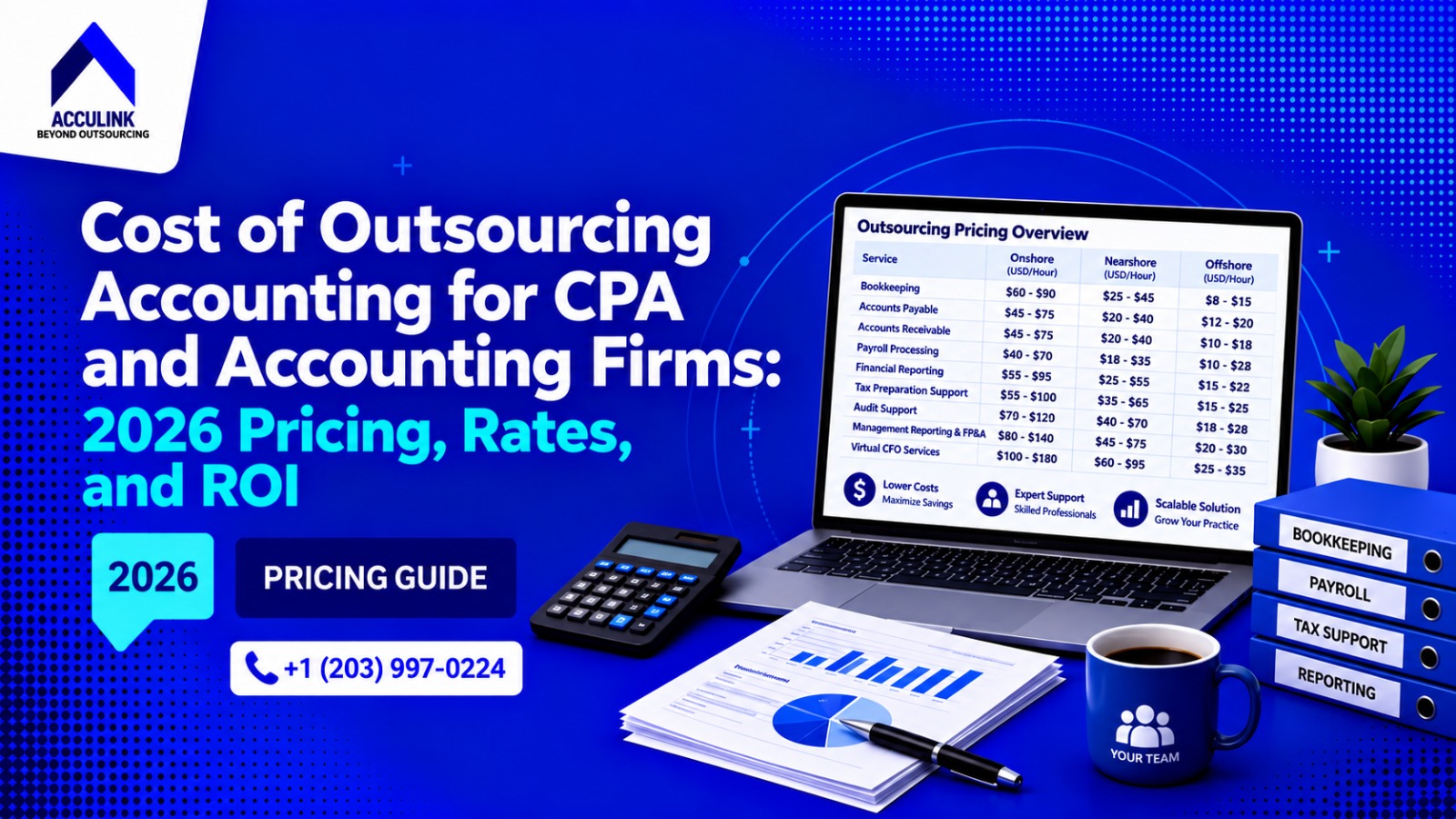
Cost of Outsourcing Accounting for CPA and Accounting Firms: 2026 Pricing, Rates, and ROI
The cost to outsource accounting typically ranges from $8 to $35 per hour, depending on the service, experienc…