Hire Offshore Payroll Experts for CPA & Accounting Firms – Your Guide to Payroll Outsourcing


Summary
Hire an offshore payroll expert for your CPA firm — multi-state filings (941/940), W-2/1099, year-end — at up to 70–75% less. What they do, software, and how to start.
CPA firms that offer payroll services face a structural tension: payroll is a high-frequency, time-sensitive service that clients depend on — weekly or biweekly, every cycle, without failure. Adding payroll clients is good for revenue. Adding payroll clients without adding production capacity is a recipe for service failures, compliance exposure, and staff burnout.
Outsourced payroll support for CPA firms — specifically, offshore accounting teams that handle the payroll production work under the CPA firm's supervision — is one way to resolve that tension. This guide explains how the model works, what the offshore team handles versus what the firm retains, and what to look for in a provider.
What "Payroll Services" Means for a CPA Firm
When a CPA firm offers payroll as a service, the scope typically includes:
- Payroll processing: Calculating gross wages, withholding (federal, state, local), and net pay for each employee each pay period. Processing via a payroll platform (ADP, Gusto, Paychex, QuickBooks Payroll, or similar).
- Payroll tax compliance: Filing 941s quarterly, 940s annually, state unemployment returns, and any local tax filings. Ensuring deposits are made on the correct schedule.
- Year-end payroll compliance: Preparing W-2s and 1099s, transmitting to the SSA, and distributing to employees/contractors.
- Payroll accounting: Journal entries to record payroll expense and the associated liabilities. Reconciling payroll tax liability accounts to deposits made.
- Employee change management: Adding new hires, processing terminations, updating withholding elections, handling garnishments and child support orders.
This is a service that repeats on a fixed cycle, with compliance deadlines attached to every cycle. Errors have direct financial consequences for clients (penalties, underpaid employees) and reputational consequences for the firm.
The Capacity Problem in CPA Firm Payroll
Payroll is capacity-constrained in a different way from tax season work. Tax preparation peaks sharply in Q1 and then declines. Payroll is constant — the weekly and biweekly payroll cycle never stops, regardless of how busy the firm is with tax preparation.
A CPA firm with 30 payroll clients running biweekly payroll processes approximately 780 payroll cycles per year. Add quarterly 941s (120 filings across 30 clients), annual 940s, W-2 preparation, and change management — the annual production load is substantial.
At US staff hourly rates, the internal cost of payroll production for 30 clients runs $40,000–$75,000 per year in labor alone, depending on how complex the clients are. The revenue from a 30-client payroll book at typical CPA firm pricing runs $60,000–$120,000 — leaving thin margins when domestic production staff carry the load.
Offshore payroll support typically costs $8–$15/hour, compared to $25–$45/hour for US accounting staff. Moving the production work offshore while keeping review, client communication, and compliance sign-off in-house improves the margin substantially — and creates capacity to take on additional payroll clients without a corresponding headcount increase.
What the Offshore Team Handles
Payroll cycle processing Running each payroll cycle in the client's payroll platform: entering hours (for hourly employees), processing salary payments, applying withholding, confirming direct deposit totals. The offshore team runs the cycle; the CPA firm or designated manager approves before submission.
Payroll journal entries Recording payroll expense and liabilities in the client's accounting system after each cycle. Reconciling the payroll tax liability accounts to the deposits made. This is a mechanical, recurring task that offshore teams handle well.
New hire and change processing Setting up new employees in the payroll system: direct deposit, withholding elections, state withholding setup. Processing terminations. Updating withholding changes (W-4 updates, state equivalents). Processing garnishments and child support order withholding.
Quarterly payroll tax compliance support Preparing draft 941s from payroll platform data. Reconciling quarterly wages and tax deposits to the payroll platform's quarterly summary. Flagging discrepancies for CPA review. Some firms also have offshore teams prepare state unemployment return data.
W-2 and 1099 preparation support Pulling year-end data from the payroll platform. Reconciling W-2 Box 1 wages to the 941 annual totals. Preparing the W-2 filing package for CPA review and SSA submission.
Exception reporting Identifying anomalies in each payroll cycle — employees with unusually high or low wages compared to normal, withholding that looks incorrect, garnishment balances approaching satisfaction — and flagging them for the CPA before the cycle is submitted.
What the CPA Firm Retains
Payroll tax compliance sign-off The CPA firm is responsible for the accuracy of the 941, 940, and state filings. The offshore team prepares drafts; the CPA reviews and authorizes.
Client advisory When a client asks whether to classify a worker as W-2 or 1099, whether to implement a retirement plan, or how to handle an unusual compensation arrangement, that's a CPA advisory conversation — not something the offshore team handles.
Complex situations Garnishments with complicated priority rules, termination pay calculations in states with final paycheck requirements, equity compensation (stock options, RSUs), multi-state payroll for employees working across multiple states — these require CPA oversight.
Client communication The CPA firm communicates directly with the client about payroll issues. The offshore team communicates only with the CPA firm's internal staff.
Payroll Software Requirements
CPA firms use a range of payroll platforms. The offshore team needs to work in whatever the client uses:
Full-service payroll platforms: - ADP Run, Workforce Now - Gusto (cloud-native, increasingly common with younger clients) - Paychex Flex - QuickBooks Payroll (Online or Desktop) - Rippling (combined HR/payroll)
Accounting system integration: Payroll journal entries flow into QuickBooks, Xero, or Sage Intacct depending on the client. The offshore team needs to know both the payroll platform and the accounting system.
When vetting an offshore provider, ask specifically which payroll platforms their team has operated — not just which ones they claim familiarity with.
Security and Compliance in Payroll Outsourcing
Payroll data is sensitive: Social Security numbers, bank account information for direct deposit, compensation data, and health benefit deductions. The offshore team will have access to this data in order to process payroll.
Requirements to confirm: - Data transmission via encrypted, secure channels (not email attachments) - Access controls that limit the offshore team to the specific clients they serve - SOC 2 Type II certification and ISO 27001 certification at the provider level - Payroll platform access provisioned through the CPA firm's own account (not a separate provider account) - A documented offboarding process that revokes access immediately when the engagement ends
These are baseline requirements, not nice-to-haves, for payroll work.
Getting Started
The typical ramp-up for outsourced payroll support:
Month 1: The offshore team is provisioned with access to 2–3 pilot clients' payroll platforms. They observe the first 1–2 payroll cycles, then run the cycle themselves with the CPA firm reviewing every step.
Month 2: Offshore team runs payroll cycles with a pre-submission review by a US manager (typically 15–20 minutes per cycle). The manager approves before the firm submits.
Month 3+: Process is stable. Review time drops as the offshore team becomes familiar with each client's patterns. Anomaly reporting reduces exceptions that reach the review stage.
Most CPA firms reach a stable offshore payroll arrangement in 60–90 days. For the broader scope of what we offer, see our accounting outsourcing services for CPA firms. The per-cycle review time at that stage is typically 10–15 minutes for standard clients — compared to 45–60 minutes of total production + review time in an in-house model.
Acculink provides payroll outsourcing support for CPA firms: cycle processing, journal entries, quarterly tax compliance data, and W-2 preparation. We operate within your payroll platform under your firm's supervision and access controls. Contact us.
Tags:
About the Author

Related Posts
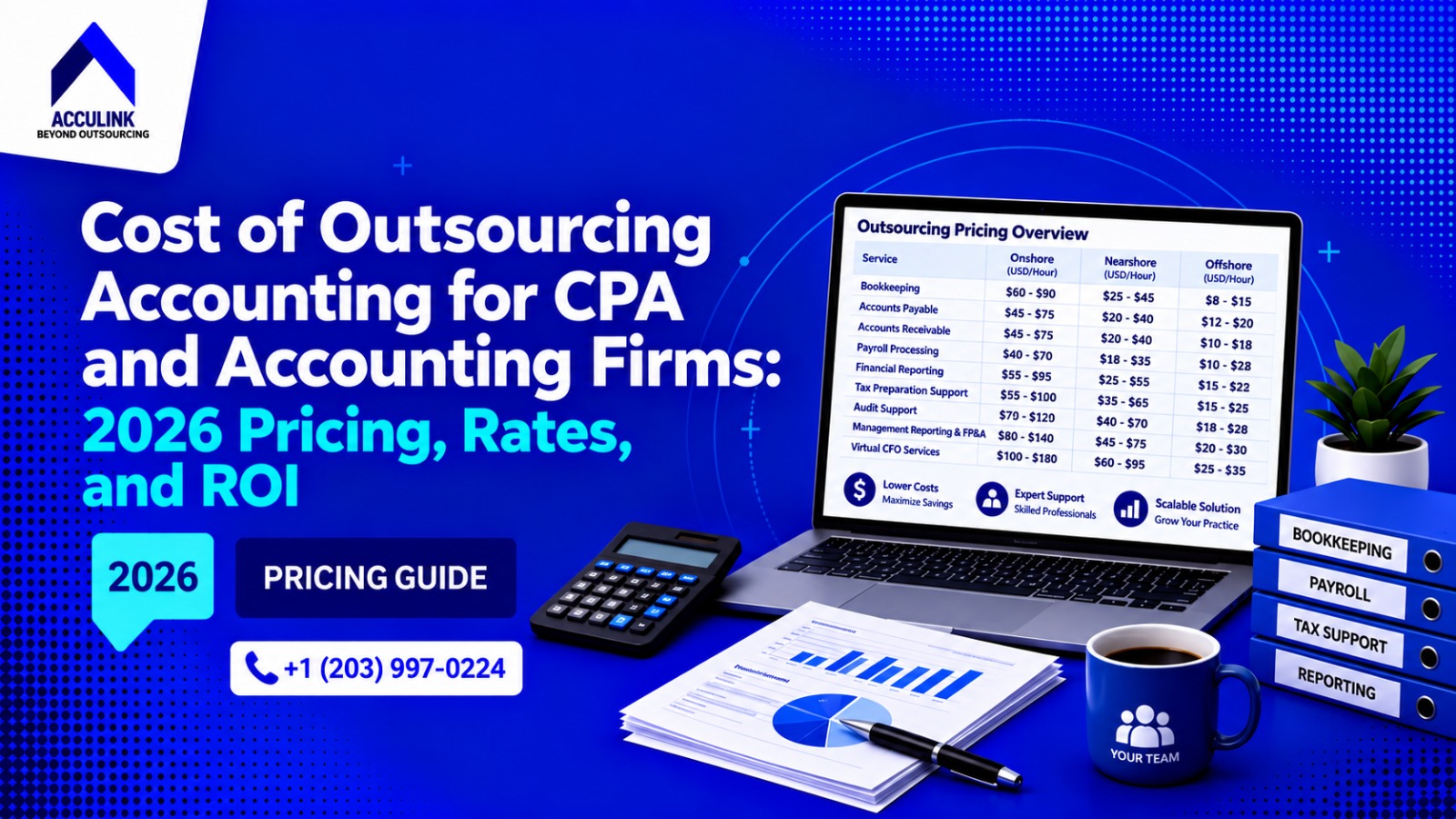
Cost of Outsourcing Accounting for CPA and Accounting Firms: 2026 Pricing, Rates, and ROI
The cost to outsource accounting typically ranges from $8 to $35 per hour, depending on the service, experienc…
15 Profitable Add-On Services CPA and Accounting Firms Can Offer Without Hiring In-House
CPA and accounting firms do not need to build every new service with another in-house hire. This guide compare…
Top 10 Payroll Outsourcing Companies for CPA and Accounting Firms (2026)
This guide compares ten payroll outsourcing companies for U.S. CPA and accounting firms. It separates processi…