Hire Offshore Bookkeepers for CPA & Accounting Firms – Blueprint for Outsourced Bookkeeping


Summary
How to hire an offshore bookkeeper for your CPA firm — what they do, how vetting and onboarding work, cost (up to 70–75% less), and how to start with a free trial.
CPA firms don't hire bookkeepers the way their clients do. A bookkeeper on a client's payroll does one company's accounts. A bookkeeper embedded in a CPA firm serves 15–25 clients simultaneously — and needs to switch contexts, software platforms, and chart-of-accounts conventions fluidly across all of them.
That difference explains why outsourced bookkeeping for CPA firms is a fundamentally different product from outsourced bookkeeping for small businesses. The right offshore partner isn't just competent in bookkeeping — they're set up to serve a CPA firm's multi-client, multi-platform production model.
This guide covers how CPA-firm bookkeeping outsourcing works, what to expect from the engagement, and what it actually costs.
Why CPA Firms Outsource Bookkeeping (The Real Reasons)
The standard answer is "cost savings." The more accurate answer is a combination of three pressures.
Capacity without headcount risk Bookkeeping demand in a CPA firm isn't flat — it peaks in Q1, dips in summer, and resurges in Q4. Hiring a full-time US bookkeeper to handle a seasonal peak means carrying that cost through the slow periods. Offshore bookkeeping arrangements scale up and down with client load.
The talent pipeline is broken The pool of entry-level accounting staff is contracting. US accounting graduates are increasingly targeting advisory roles, not bookkeeping. Offshore teams provide a reliable supply of skilled bookkeepers without competing in a tight domestic talent market.
Utilization math A partner billing at $250–400/hour who spends 20% of their time reviewing bookkeeping production is costing the firm $50–80/hour of partner time for work that should cost $10–20/hour. Moving production to offshore staff restores utilization to where it belongs.
What Outsourced Bookkeeping for CPA Firms Actually Covers
The scope varies by firm, but the core tasks that outsource well in a CPA firm context are:
Transaction processing Bank imports, categorization, and coding — the foundation of every client engagement. Offshore teams handle this across multiple clients simultaneously, typically within agreed turnaround times.
Bank and credit card reconciliation Monthly reconciliation of all accounts against statements. This is the highest-frequency recurring task in bookkeeping and the easiest to systematize offshore.
Accounts payable processing Invoice entry, coding, and payment run preparation for clients who use the CPA firm for AP management.
Payroll journal entries Posting payroll summaries from ADP, Gusto, Paychex, or other processors to the accounting system. Reconciling payroll liability accounts.
Month-end close preparation Preparing the pre-close trial balance, flagging anomalies, and producing draft financial statements for partner review.
Client-facing bookkeeping reports Profit and loss, balance sheet, and cash flow summaries formatted to client or firm standards, ready for the CPA to review and deliver.
Catch-up and cleanup bookkeeping When a client comes in with 6–18 months of unreconciled books, offshore teams can handle the reconstruction work without pulling US staff off current-client work.
Multi-Platform Fluency: What to Require
CPA firm bookkeeping runs across multiple platforms simultaneously. Your offshore team will need to work in whatever the client uses, not just one system.
The major platforms to confirm competency in:
- QuickBooks Online — used by the majority of US SMB clients
- QuickBooks Desktop (still common in established firms)
- Xero — growing share, especially in younger and tech-adjacent client bases
- Sage Intacct — mid-market clients and nonprofits
- FreshBooks / Wave — smaller client segments
- NetSuite — larger or scaling clients
Ask any offshore provider which platforms they support, and for which they have staff with 2+ years of hands-on experience. A team that can only do QuickBooks Online will limit your ability to serve your full client base.
How CPA Firm Bookkeeping Outsourcing Is Structured
Model 1: Dedicated Offshore Staff
The firm is assigned one or more offshore bookkeepers who work exclusively on that firm's clients. They learn the firm's workflows, chart of accounts conventions, and client base. They function as remote members of the firm's team.
Best for: Firms with stable, high-volume client loads; firms that want deep integration; firms with 15+ monthly bookkeeping clients.
Model 2: Shared Pool with Firm-Level Assignment
The offshore provider assigns client work from a pool of bookkeepers. Different clients may be handled by different team members within the pool. Work is managed by a coordinator at the provider.
Best for: Firms with variable client loads; firms trialing offshore bookkeeping before committing to dedicated staff.
Model 3: Project-Based (Catch-Up Only)
The firm sends specific catch-up or cleanup projects — a client with 12 months of unreconciled books, for example — and the offshore team handles the project work only, not ongoing monthly bookkeeping.
Best for: Firms that need to clear a catch-up backlog without ongoing offshore commitment.
Pricing: What Outsourced Bookkeeping for CPA Firms Costs
Offshore bookkeeping support is typically priced per full-time equivalent (FTE) or per hour, depending on the arrangement.
FTE pricing (dedicated model): $1,200–$2,500/month per FTE, depending on experience level and provider. A dedicated bookkeeper at $1,500/month gives the firm approximately 160 hours of production time monthly — equivalent to roughly $18,000–$20,000/year in offshore staff cost, versus a $45,000–$60,000/year US hire.
Hourly pricing (shared or project model): $8–$18/hour depending on task complexity and provider.
The economics improve further when you account for what's not included in offshore pricing: no benefits, no payroll taxes, no PTO, no recruiting costs, no equipment.
For a CPA firm carrying 20 monthly bookkeeping clients and paying a US bookkeeper $50,000/year all-in, an offshore arrangement at $24,000/year creates capacity for 8–10 additional clients without adding headcount — doubling the revenue from the bookkeeping practice line at approximately the same cost.
Quality Control: How CPA Firms Maintain Standards
Offshore bookkeeping introduces a review layer that many CPA firms find is an improvement over in-house arrangements, not a degradation.
The recommended structure:
- Offshore team produces the monthly work product (trial balance, reconciliations, draft statements)
- A US-based senior accountant or manager reviews the work product before it goes to the partner
- Partner reviews and delivers to the client
In firms that previously had a single bookkeeper with no intermediate review, the offshore model adds a structural review step that catches errors before they reach the partner. The review layer is lighter because the offshore team's work product is explicit and documented — not scattered across email threads and sticky notes.
Recommended quality controls: - Standardized monthly checklist the offshore team completes for every client - Clear escalation path for unusual transactions - Monthly review calls between firm manager and offshore team lead - Quarterly accuracy audits on a sample of clients
Getting Started
The typical onboarding process for outsourced bookkeeping in a CPA firm:
Week 1: Offshore team provisioned with software access for 1–2 pilot clients. Firm provides chart of accounts, existing workpapers, and any client-specific conventions.
Weeks 2–4: Pilot clients' bookkeeping handled by offshore team under close review. Firm identifies any gaps or workflow issues.
Month 2+: Process refined, additional clients onboarded. Dedicated team members (in the dedicated model) become familiar with the firm's entire client base.
Most CPA firms reach a stable, fully-functioning offshore bookkeeping arrangement within 60–90 days. If you're ready to hire a dedicated bookkeeper, our hire page outlines the engagement model.
Acculink provides outsourced bookkeeping for CPA firms through dedicated offshore team arrangements. Our bookkeepers are trained across QuickBooks Online, Xero, and Sage Intacct, and operate as production extensions of your firm — not as a black-box service. Contact us.
About the Author

Related Posts
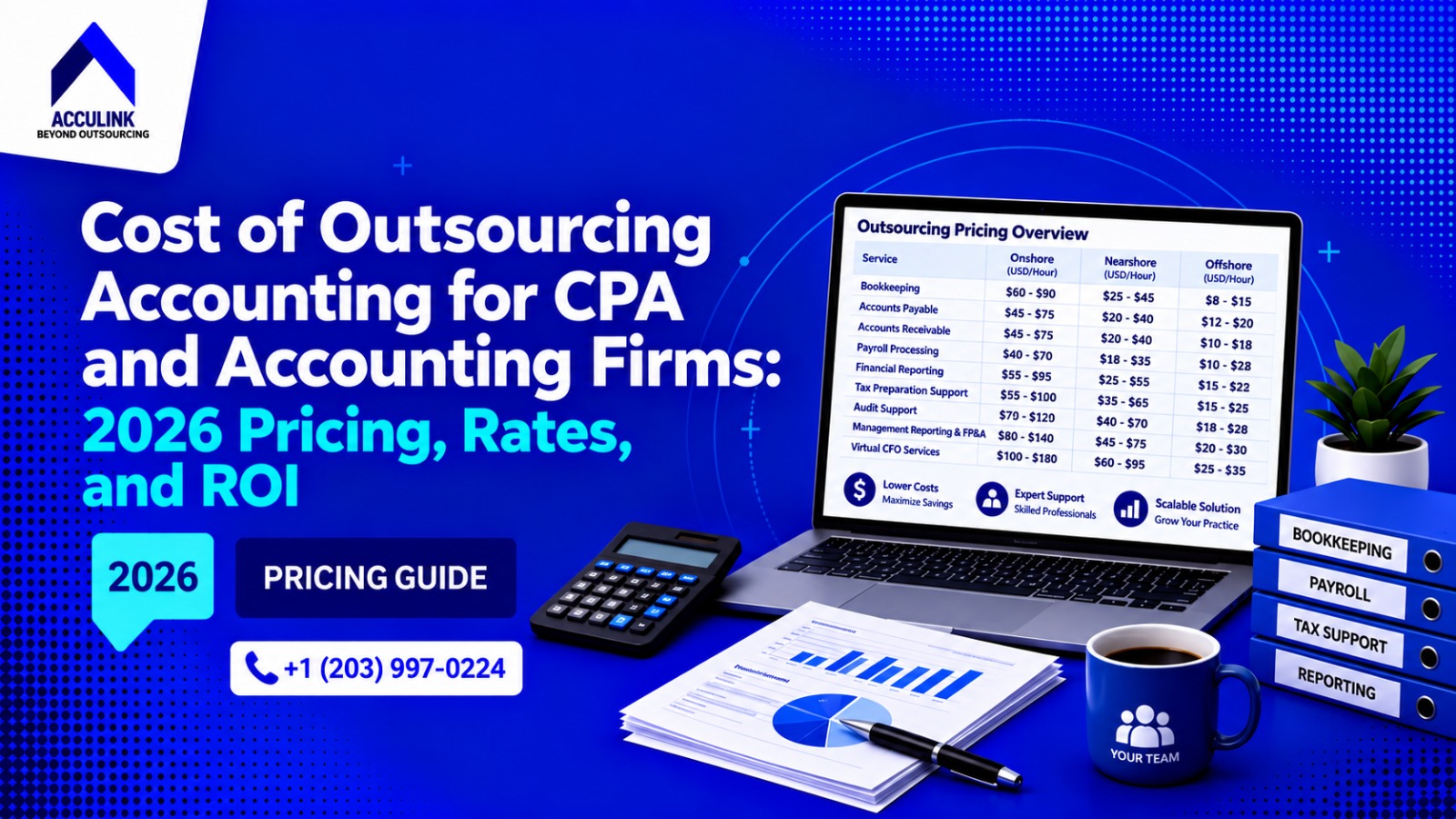
Cost of Outsourcing Accounting for CPA and Accounting Firms: 2026 Pricing, Rates, and ROI
The cost to outsource accounting typically ranges from $8 to $35 per hour, depending on the service, experienc…
15 Profitable Add-On Services CPA and Accounting Firms Can Offer Without Hiring In-House
CPA and accounting firms do not need to build every new service with another in-house hire. This guide compare…
Top 10 Payroll Outsourcing Companies for CPA and Accounting Firms (2026)
This guide compares ten payroll outsourcing companies for U.S. CPA and accounting firms. It separates processi…