Hire Offshore Billing Assistants for CPA & Accounting Firms - Blueprint for Accurate Outsourced Billing


Summary
Hire an offshore billing assistant for your CPA firm — invoicing, time entry, WIP, retainer billing — at offshore cost. What they do, software, and how to start.
Billing is a function that CPA firms often handle internally despite the fact that it shares almost no overlap with professional accounting judgment. Preparing invoices, tracking outstanding balances, following up on overdue accounts, and reconciling payments received are administrative and bookkeeping tasks — not CPA-level work. Yet in many firms, partners and senior accountants spend meaningful time on billing management because no one else in the firm owns it cleanly.
Outsourced billing support for CPA firms moves the production and follow-up work offshore, while the firm retains control over billing decisions: what to charge, when to adjust, and how to handle billing disputes with clients.
The Two Types of Billing Work in a CPA Firm
It helps to distinguish between the two components of billing in a professional services context:
Billing production (mechanical) Creating invoices from time records or flat-fee schedules, applying any discounts or adjustments the partner has approved, formatting the invoice to the firm's standards, sending the invoice to the client through the appropriate channel (email, portal, mail).
AR management (administrative) Tracking which invoices are paid and which are outstanding, sending payment reminders at defined intervals, flagging overdue accounts to the partner for decision, recording payments received and reconciling to the client's account.
Both categories transfer cleanly to offshore billing support. Neither requires professional accounting judgment.
What doesn't transfer: - Deciding what to charge for a given engagement - Approving write-downs or write-offs - Communicating with clients about billing disputes - Collections decisions (whether to pursue, when to write off, whether to engage a collection agency)
The CPA firm owns these decisions. The offshore team handles the execution.
The Production Cost of Billing in a Typical CPA Firm
Billing administration is often invisible in a CPA firm's cost structure because it's embedded in partner or staff time rather than tracked as a separate function. But the time adds up.
In a firm billing 30 clients: - Invoice preparation: 30–45 minutes per billing cycle per client (assuming monthly or project-based billing) = 15–22 hours/month of staff time - Payment tracking: reviewing the AR aging report, flagging overdue accounts, sending reminders = 3–5 hours/month - Payment recording: posting receipts, reconciling to client accounts = 2–4 hours/month - Partner billing review and approval = 3–5 hours/month
Total: 23–36 hours per month of billing-related time in a 30-client firm — roughly half a week of a staff accountant's time. At US staff rates, that's $800–$1,500/month in billing administration cost, before adding partner review time.
Offshore billing support at $8–$12/hour handles the production and AR management work for $200–$400/month for the same volume. Partner review time is unchanged (the firm still needs to review invoices before they go out), but production cost drops by 70–80%.
What Offshore Billing Support Handles
Invoice preparation Creating invoices in the firm's practice management software (Karbon, Canopy, Jetpack Workflow, Thomson Reuters Practice CS, or simple QuickBooks invoicing) from approved time entries or flat-fee schedules. Formatting to the firm's template. Flagging any entries that require partner review before invoicing (unusual time, write-down candidates, incomplete engagements).
Invoice delivery Sending invoices to the appropriate contact at each client via the firm's preferred channel. Managing the client portal if the firm uses one (creating access, uploading invoices, tracking opens).
AR aging maintenance Maintaining the accounts receivable aging report: updating payment status as receipts are recorded, identifying invoices that have crossed the 30-day, 60-day, or 90-day thresholds.
Payment reminders Sending follow-up emails at defined intervals (typically 30, 60, and 90 days past due), using the firm's template language. Escalating to the partner for decision at the 90-day mark.
Payment recording Recording payments received in the practice management system and/or the accounting system. Reconciling check deposits or ACH receipts to outstanding invoices. Applying payments to the correct invoice and client account.
Monthly AR reporting Preparing the monthly AR aging summary for the partner: total outstanding, by age bucket, by client. Identifying clients with consistently slow payment patterns.
Trust account / retainer management (for firms that use retainers) Tracking retainer balances, recording deposits and draws, preparing the monthly retainer statement for the client.
Practice Management Software: What the Offshore Team Needs to Know
Billing support requires access to the firm's practice management software. The offshore team needs to be proficient in whatever the firm uses:
Common practice management platforms: - Karbon (cloud-native, growing market share) - Canopy (US-focused, good billing module) - Jetpack Workflow - Thomson Reuters Practice CS (on-premise, common in established firms) - CCH Axcess Practice - QuickBooks (for firms that bill directly from QB rather than a dedicated practice management tool)
If the firm uses a practice management system with a time entry to billing workflow (Karbon, Canopy, Practice CS), the offshore team works within that workflow. If the firm bills ad-hoc from QuickBooks, the offshore team prepares invoices there.
Security Considerations
Billing management involves client payment information: bank account details for ACH, credit card data if the firm accepts card payments, payment history. The offshore team should not have access to actual payment processing — they should record that payments were received, not initiate or approve payments.
Access control structure: - Offshore team: read access to time records, create access for invoices, update access to AR records - No access to payment processing or firm bank accounts - No access to the firm's full client list beyond the clients they service
Getting Started
Billing outsourcing is one of the easier outsourcing arrangements for a CPA firm to start because:
- The output (invoices, AR reports) is easy to review quickly
- Mistakes are caught immediately (client calls about a wrong invoice)
- The scope is well-defined and doesn't expand into judgment work
A typical ramp-up: - Week 1: Offshore team given read access to practice management software; observes the current billing cycle - Week 2: Offshore team prepares invoices for the next billing cycle; partner reviews all before sending - Weeks 3–4: Billing cycle handled with partner reviewing before invoices go out - Month 2+: Partner spot-checks invoices rather than reviewing all; offshore team handles routine AR follow-up independently
The review load drops as the offshore team becomes familiar with the firm's billing conventions, fee structures, and client-specific preferences.
Acculink provides billing and AR management support for CPA firms: invoice preparation, AR aging maintenance, payment reminders, payment recording, and monthly AR reporting — operating within your practice management software under your firm's approval workflow. See our full accounting outsourcing services. Contact us.
Tags:
About the Author

Related Posts
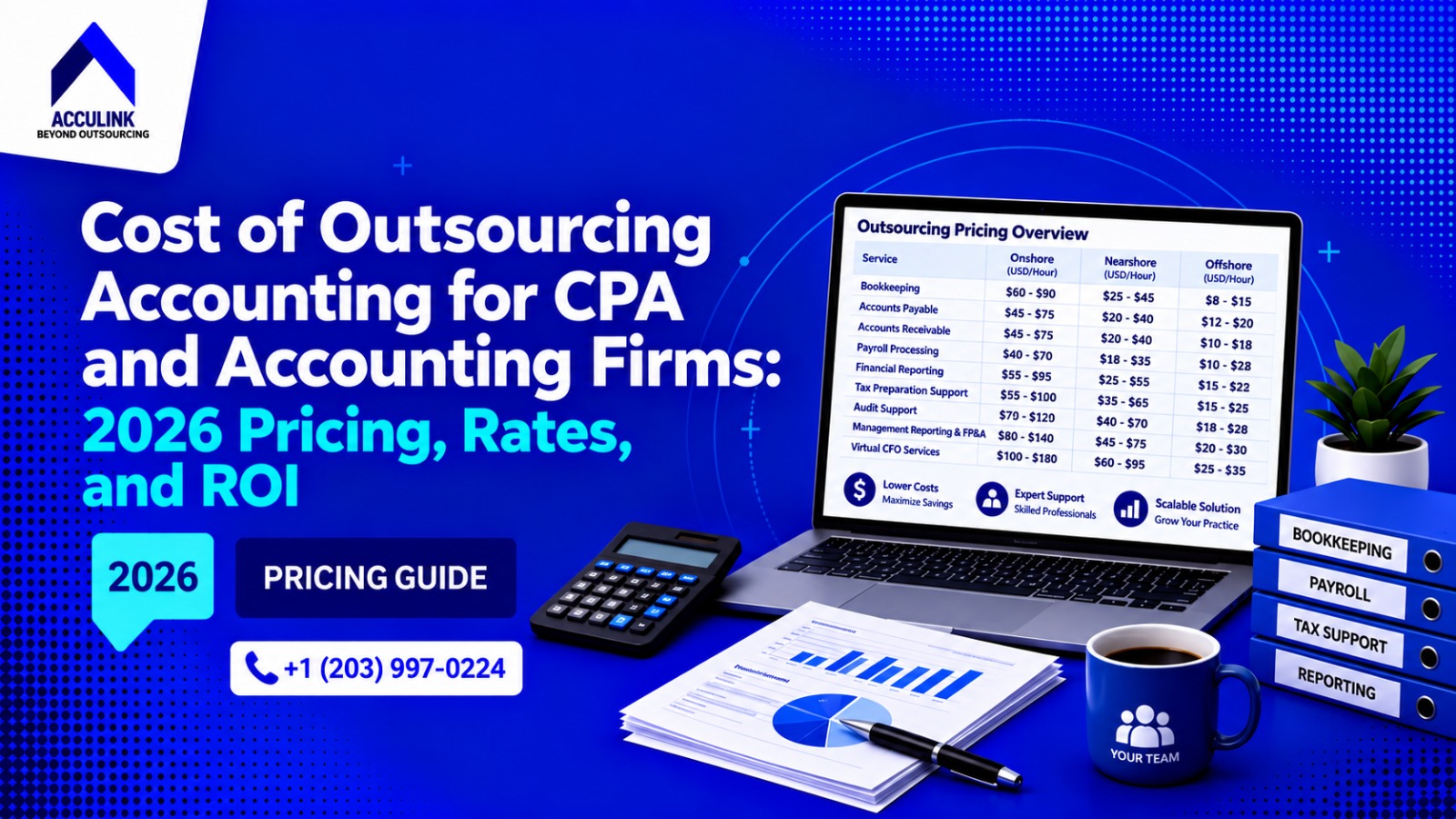
Cost of Outsourcing Accounting for CPA and Accounting Firms: 2026 Pricing, Rates, and ROI
The cost to outsource accounting typically ranges from $8 to $35 per hour, depending on the service, experienc…
15 Profitable Add-On Services CPA and Accounting Firms Can Offer Without Hiring In-House
CPA and accounting firms do not need to build every new service with another in-house hire. This guide compare…
Top 10 Payroll Outsourcing Companies for CPA and Accounting Firms (2026)
This guide compares ten payroll outsourcing companies for U.S. CPA and accounting firms. It separates processi…