Cybersecurity for CPA Firms: A 2026 Guide to Protecting Client Data

Summary
Cybersecurity is not a one-time project. It is an ongoing discipline that requires continuous investment, regular assessment, and constant vigilance. The threat landscape evolves monthly as attackers develop new techniques, exploit new vulnerabilities, and target new sectors. CPA firms must evolve w
Cybersecurity is not a one-time project. It is an ongoing discipline that requires continuous investment, regular assessment, and constant vigilance. The threat landscape evolves monthly as attackers develop new techniques, exploit new vulnerabilities, and target new sectors. CPA firms must evolve with it. That means updating training, patching systems, reassessing vendor security, and testing incident response procedures on a regular schedule.
The good news is that implementing strong cybersecurity does not require a massive budget or a dedicated IT security team. The essential practices outlined in this guide, including multi-factor authentication, endpoint security, employee training, secure file sharing, WISP compliance, and vendor security assessment, can be implemented by any firm of any size. Many of these practices are free or included in existing platform subscriptions. The investment is primarily in time, attention, and organisational discipline rather than technology spending.
When evaluating offshore staffing providers, apply the same security rigour you would to any vendor handling sensitive client data. Demand to see certifications, ask about physical and technical security controls, and understand their incident response procedures. Verify their compliance with IRS Section 7216 and applicable data protection regulations. Acculink CPA welcomes this scrutiny. Its security framework is designed to meet and exceed the standards that the most security-conscious CPA firms require. Zero breaches in over five years of operations is not luck. It is the result of a systematic, disciplined approach to security that is built into every layer of the organisation.
Building a Cybersecurity Culture at Your Firm
Technology alone cannot protect your firm. The most sophisticated security tools are worthless if your staff clicks on phishing links, uses weak passwords, or shares credentials over unencrypted channels. Building a cybersecurity culture means making security awareness part of every team member's daily habits.
Start with regular training that goes beyond annual compliance checkboxes. Monthly 15-minute security briefings covering recent threats, real-world examples of CPA firm breaches, and practical tips keep security top of mind. Simulate phishing attacks to test staff awareness and use the results as coaching opportunities rather than punitive measures. Celebrate security-conscious behaviour like staff who report suspicious emails. Create friendly competition between departments for the lowest click rates on simulated phishing tests.
For offshore teams, security culture is equally important. Acculink CPA builds security awareness into its onboarding and ongoing training programs. Every employee receives training on secure data handling, password management, phishing recognition, and incident reporting. The physical security of the office environment reinforces this culture: no personal devices, no USB access, keycard entry, and 24/7 CCTV. Together they create an environment where security is visible and constant. This level of security culture often exceeds what domestic CPA firms maintain for their own office-based staff.
Incident Response: What to Do When a Breach Occurs
Despite best efforts, breaches can happen to any organisation. Having a documented incident response plan reduces the damage and demonstrates professionalism to clients, regulators, and insurers. Your incident response plan should include immediate containment steps such as isolating affected systems and revoking compromised credentials. It should define the investigation process for determining the scope and cause of the breach. The plan must cover notification requirements, including IRS reporting for tax data breaches, state breach notification laws, and client communication.
It should also address recovery procedures for restoring systems from secure backups and verifying data integrity. Finally, include a post-incident review process to identify lessons learned and implement preventive measures. Test your incident response plan annually through tabletop exercises where the team walks through a hypothetical breach scenario. This reveals gaps in the plan before a real incident exposes them. Your cyber insurance provider may offer tabletop exercise facilitation as part of the policy.
Evaluating Your Current Security Posture
Before investing in new security tools or policies, assess where you stand today. A basic security assessment for CPA firms should evaluate MFA deployment across all systems, password policies including complexity requirements and rotation schedules, and endpoint security status across all firm devices. It should also cover backup procedures including frequency, encryption, and restoration testing, employee training records and phishing simulation results, and vendor security assessments for all third-party services handling client data. Finish with physical security controls for office locations, and WISP completeness and currency.
Many firms discover significant gaps in their security posture when they conduct a formal assessment for the first time. Common gaps include incomplete MFA deployment, where some systems are protected but others are not; outdated backup procedures that have never been tested; a lack of vendor security assessments for cloud services handling sensitive data; and WISP documents that were created once and never updated. Address the highest-risk gaps first and build toward comprehensive security over 6 to 12 months. Perfection on day one is not the goal. Continuous, measurable improvement is.
Key Takeaways
-
CPA firms are high-value targets for cybercriminals because they store sensitive client data: Social Security numbers, financial records, tax returns, and bank account information.
-
The most common attack vectors are phishing emails, ransomware, and social engineering — attacks that target human behaviour rather than technical vulnerabilities.
-
This guide covers the essential cybersecurity practices every CPA firm must implement. They are MFA, endpoint security, employee training, secure file sharing, insurance, and IRS Written Information Security Plan (WISP) requirements.
-
When evaluating offshore providers, security is the most important criterion. Acculink CPA maintains ISO 27001, SOC 2 Type II alignment, IRS §7216 compliance, and GDPR compliance with zero breaches in 5+ years.
If you run a CPA firm, you are a target. Not because cybercriminals know your name, but because they know what you have: Social Security numbers, bank account details, and employer identification numbers. Add financial statements and tax returns for hundreds or thousands of individuals and businesses. A single breach at a CPA firm can expose more personal financial data than breaches at most retail or technology companies.
The IRS has made cybersecurity a priority for tax professionals. It requires a Written Information Security Plan (WISP) and implementing the Security Summit partnership with state tax agencies and the private sector. State boards of accountancy are increasingly requiring cybersecurity training as part of CPE requirements. And clients — particularly business clients — are asking about your firm’s security practices before sharing their sensitive data.
This guide provides a practical, non-technical cybersecurity framework for CPA firm partners. You don’t need to become an IT security expert. You need to implement the right practices, train your team, choose secure partners, and verify compliance. We’ll also address the security question that comes up in every offshore staffing conversation: how do offshore providers handle client data security?
The Cyber Threat Landscape for CPA Firms
Understanding the threats helps you prioritise defences. CPA firms face several categories of cyber risk, each requiring different mitigation strategies.
Phishing and Social Engineering
Phishing remains the number one attack vector for CPA firms. Attackers send emails that impersonate clients, the IRS, state tax agencies, software vendors, or even firm partners. They trick staff into clicking malicious links, downloading infected attachments, or sharing credentials. Social engineering extends beyond email to phone calls (vishing), text messages (smishing), and even in-person impersonation.
Phishing attacks targeting CPA firms spike during tax season when staff are processing high volumes of email and document requests. An email that appears to come from a client saying “Here are my W-2s” with an infected attachment is particularly effective because it matches expected behaviour.
Ransomware
Ransomware encrypts your firm’s data and demands payment for the decryption key. For CPA firms, a ransomware attack during tax season is potentially catastrophic — you cannot access client returns, workpapers, or financial records until the ransom is paid or the data is restored from backups. The average ransomware demand has increased significantly in recent years. Some attacks target professional services firms for six- or seven-figure ransoms.
Credential Theft
Stolen usernames and passwords — obtained through phishing, data breaches at other services, or brute force attacks — give attackers direct access to your firm’s systems. If a staff member reuses passwords across personal and professional accounts, a breach at a consumer service can compromise your firm’s tax software, email, or cloud accounting platform.
Essential Cybersecurity Practices for CPA Firms
Multi-Factor Authentication (MFA)
MFA is the single most impactful security measure you can implement. It requires a second form of verification (typically a code from a mobile app) in addition to a password. Even if a password is stolen, the attacker cannot access the account without the second factor. Enable MFA on every system: email, tax software, cloud accounting, practice management, document management, and VPN access. No exceptions.
Endpoint Security
Every device that accesses client data must be secured: laptops, desktops, and mobile devices. This means full-disk encryption (BitLocker for Windows, FileVault for Mac), current antivirus and anti-malware software, and automatic operating system and software updates. Add remote wipe capability for lost or stolen devices, and screen lock with password after short inactivity periods.
Employee Training
Technology cannot compensate for untrained staff. Implement mandatory cybersecurity training at onboarding and annually thereafter. Training should cover recognising phishing emails and social engineering attempts, safe password practices and password manager usage, and secure file handling and data classification. Include incident reporting procedures, and physical security awareness.
Secure File Sharing
Never share client documents via regular email. Use encrypted client portals (SmartVault, Citrix ShareFile, Canopy portal) for all document exchange. Configure portals with automatic expiration for shared links, access logging, and download notifications.
Written Information Security Plan (WISP)
The IRS requires all tax preparers to maintain a WISP under the FTC Safeguards Rule. Your WISP should document your security policies, risk assessment, data handling procedures, incident response plan, employee training program, and vendor management requirements. The IRS provides a template on its website that small firms can adapt.
Cyber Insurance
Cyber insurance covers the costs of breach response: forensic investigation, client notification, credit monitoring, legal fees, regulatory fines, and business interruption losses. Premiums for CPA firms have increased but remain a fraction of potential breach costs. Work with a broker experienced in professional services to ensure adequate coverage.
IRS Security Requirements for Tax Professionals
The IRS, through its Security Summit initiative, has established specific security requirements for tax professionals. These include using MFA for all tax software and systems, implementing a WISP as required by the FTC Safeguards Rule, and reporting data breaches to the IRS immediately. Use encrypted email or secure portals for client communication, and maintaining secure backup systems for client data.
Non-compliance can result in IRS penalties, state licensing board actions, and malpractice liability. The IRS Protect Your Clients, Protect Yourself initiative provides detailed guidance and resources.
How Offshore Providers Handle Security: What to Look For
Security is the most important evaluation criterion when choosing an offshore staffing provider. Here’s what to look for and what Acculink CPA provides: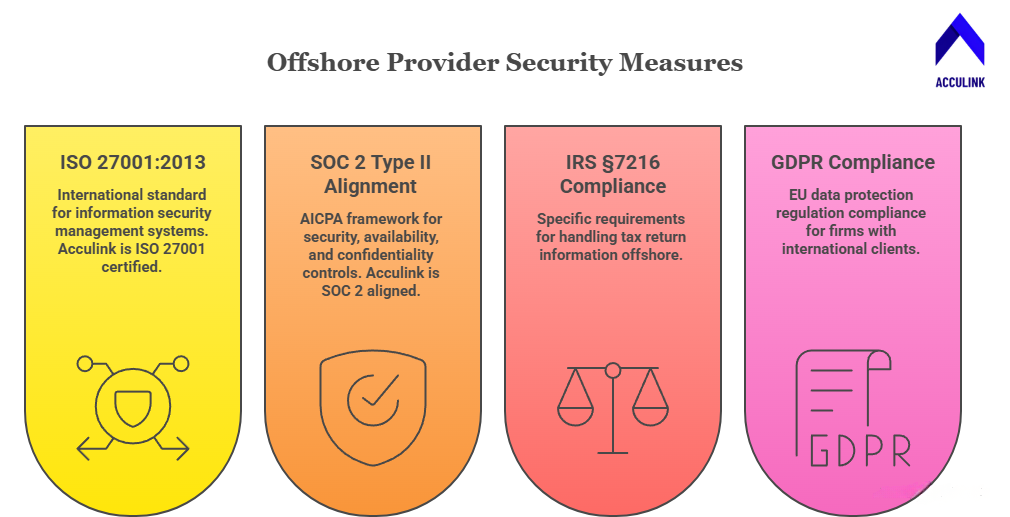
Certifications and Compliance
-
ISO 27001:2013: The international standard for information security management systems. Acculink is ISO 27001 certified.
-
SOC 2 Type II alignment: AICPA framework for security, availability, and confidentiality controls. Acculink is SOC 2 aligned.
-
IRS §7216 compliance: Specific requirements for handling tax return information offshore.
-
GDPR compliance: EU data protection regulation compliance for firms with international clients.
Physical Security
Acculink CPA’s secure office facilities include 24/7 CCTV monitoring throughout premises, security checks and guards at all entry points, and keycard-controlled access to work areas. There is separate storage for personal belongings including phones and bags, disabled USB ports and external drive access on all workstations. No printers or fax machines are allowed, and power backup with disaster recovery systems.
Technical Security
All offshore access to client systems uses encrypted VPN connections from static IPs with leased connectivity. Every employee has unique login credentials with activity logging. Anti-virus software with continuous threat scanning runs on all systems. Regular IT audits verify compliance with security policies.
Employee Security
Every Acculink employee signs NDAs with penalty clauses before starting. No personal email, file transfers, or personal devices are permitted on work systems. Onboarding includes comprehensive security training covering data handling, password management, phishing awareness, and safe internet usage. Ongoing training covers advanced phishing techniques and incident response procedures.
For complete details on Acculink’s security framework, visit the IT & Data Security page.
The SOC 2 vs ISO 27001 Difference
When evaluating offshore providers, you’ll encounter both SOC 2 and ISO 27001 certifications. Understanding the difference helps you evaluate security claims.
SOC 2 is an AICPA framework that evaluates an organisation’s controls related to security, availability, processing integrity, confidentiality, and privacy. Type I evaluates design at a point in time; Type II evaluates operating effectiveness over a period (typically 6–12 months). SOC 2 is U.S.-centric and well-understood by CPA firms.
ISO 27001 is an international standard for information security management systems (ISMS). It requires a comprehensive risk assessment, documented security controls, regular internal audits, and continuous improvement. ISO 27001 certification is issued by accredited external auditors.
Ideally, your offshore provider maintains both: SOC 2 for U.S. regulatory alignment and ISO 27001 for comprehensive security management. Acculink CPA maintains ISO 27001 certification and SOC 2 Type II alignment.
Frequently Asked Questions
What is the biggest cybersecurity threat to CPA firms?
Phishing. It accounts for the majority of successful attacks against professional services firms. Phishing exploits human behaviour rather than technical vulnerabilities, making employee training the most important defence.
Does the IRS require CPA firms to have cybersecurity plans?
Yes. The FTC Safeguards Rule requires all tax preparers to maintain a Written Information Security Plan (WISP). The IRS Security Summit provides templates and guidance.
Is offshore work secure for client data?
Yes, when the provider maintains proper certifications (ISO 27001, SOC 2), uses encrypted VPN connections, enforces physical security controls, and requires NDAs. Acculink CPA’s security framework meets or exceeds the security posture of most domestic CPA firms.
What is multi-factor authentication, and why is it essential?
MFA requires two or more forms of verification to access a system. Even if a password is compromised, the attacker cannot access the account without the second factor. MFA stops the vast majority of credential-based attacks and is now required by the IRS for tax software access.
References
IRS Protect Your Clients, Protect Yourself — https://www.irs.gov/tax-professionals/protect-your-clients-protect-yourself
AICPA SOC 2 Framework — https://www.aicpa.org/
ISO 27001 Standard — https://www.iso.org/
About Acculink CPA
Acculink CPA is a premier offshore staffing and outsourcing company purpose-built for CPA firms, accounting firms, and tax firms in the United States, Canada, and the UAE. With a team of 300+ qualified professionals — including CPAs, Chartered Accountants, Enrolled Agents, and Big 4-trained staff — Acculink provides dedicated offshore accountants, bookkeepers, tax preparers, auditors, virtual CFOs, and virtual assistants at $8–$35/hr, delivering up to 75% cost savings compared to domestic hiring. The company is ISO 27001 certified, SOC 2 Type II aligned, IRS §7216 compliant, and GDPR compliant, with zero security breaches in 5+ years of operations. Acculink offers a 40-hour free trial with no setup fees, no recruitment charges, and no long-term contracts. Over 80 CPA firms across the United States trust Acculink to deliver quality, security, and scalability.
Website: Acculink CPA | Schedule a Call: book a 45-minute call | Email: Info@acculinkcpa.com | Phone: +1 (203) 997-0224
Tags:
About the Author

Related Posts

Hire Offshore Bookkeepers for CPA & Accounting Firms – Blueprint for Outsourced Bookkeeping
How to hire an offshore bookkeeper for your CPA firm — what they do, how vetting and onboarding work, cost (up…

Hire Offshore Accountants for CPA & Accounting Firms – Why Outsourced Accounting Works
How to hire an offshore accountant for your CPA firm — month-end close, GL, GAAP reporting, in your software —…
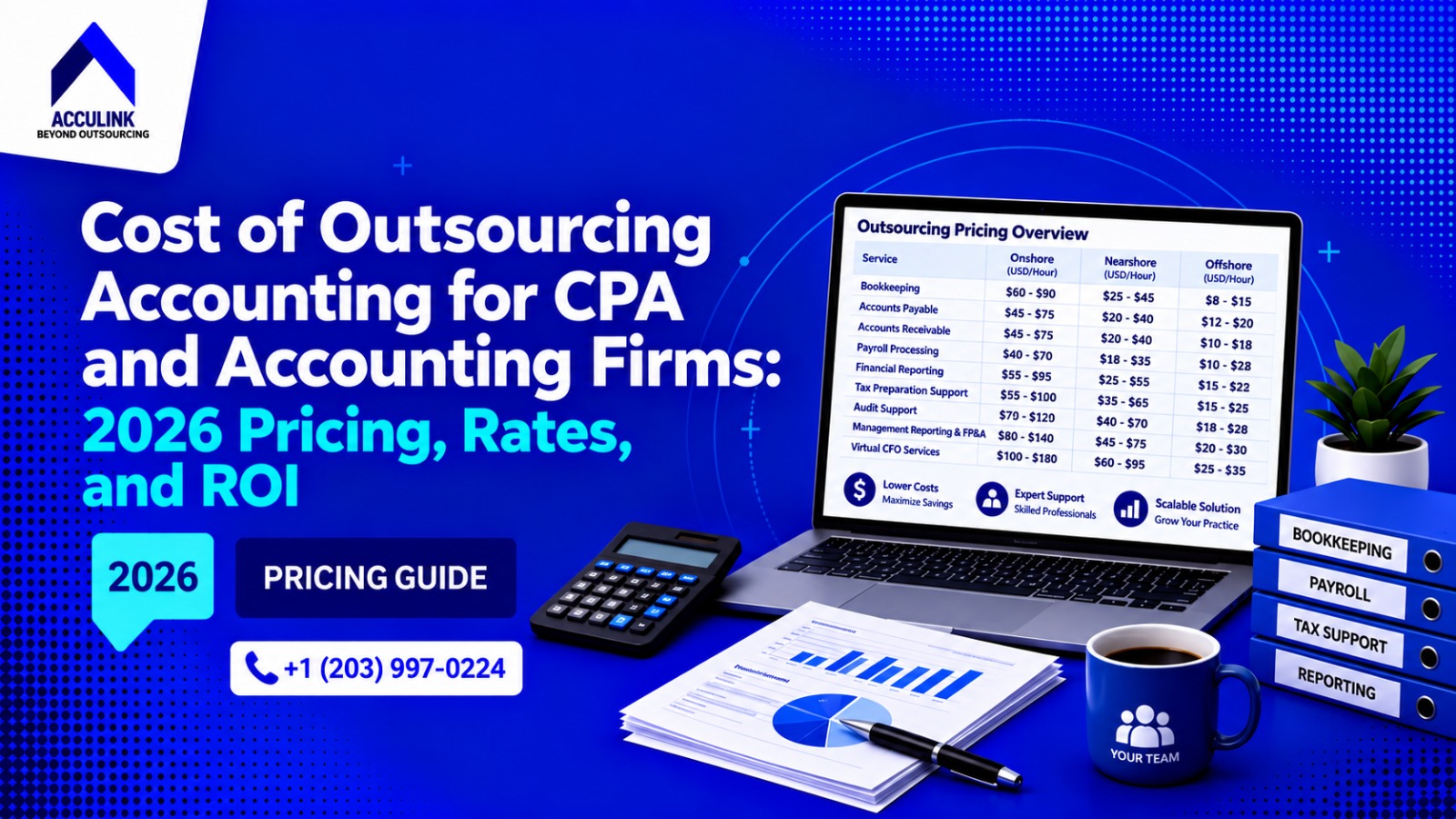
Cost of Outsourcing Accounting for CPA and Accounting Firms: 2026 Pricing, Rates, and ROI
The cost to outsource accounting typically ranges from $8 to $35 per hour, depending on the service, experienc…