Business Formation Outsourcing for CPA & Accounting Firms – Why Outsource Entity Setup

Summary
How outsourcing business-formation support helps CPA firms — entity selection, EIN, S-election (2553), Delaware/Wyoming filings, post-formation setup — at up to 70–75% less.
CPA firms that handle entity formation for clients sit in an interesting position: the legal work (filing the articles, drafting the operating agreement) belongs to an attorney, but the accounting, tax elections, and EIN setup work that comes immediately after entity formation is squarely in the CPA's domain. That post-formation work — setting up the entity's accounting structure, making the right tax elections, and establishing the chart of accounts — is repetitive, time-sensitive, and often handled by staff who could be spending that time on higher-value work.
Business formation outsourcing lets CPA firms handle this setup work more efficiently. This guide covers exactly what the outsourcing covers (and what it doesn't), how the engagement flows, and what to look for in a provider.
The CPA Firm's Role in Business Formation
CPA firms aren't attorneys and shouldn't practice law. The work that falls clearly in the CPA's domain when a client forms a new entity:
Tax election decisions The S election (Form 2553), the sole proprietor vs. partnership vs. corporation question, and the entity classification election (Form 8832) are tax decisions that have long-term consequences. These are advisory conversations the partner has with the client — not work that gets outsourced.
EIN application Obtaining the Employer Identification Number from the IRS is a ministerial task: completing the SS-4, submitting online or by fax, and recording the EIN. This is a common task for offshore accounting support.
Initial accounting system setup Setting up QuickBooks, Xero, or whatever accounting platform the client will use: creating the entity, configuring fiscal year, setting up the initial chart of accounts appropriate for the entity type and industry.
Chart of accounts design Designing the chart of accounts — which accounts to include, how to segment revenue and expenses, which tracking categories to create — requires some understanding of the client's business, but the implementation is mechanical.
Opening balances Entering the opening equity (owner contribution, initial capitalization), any initial asset purchases, and any startup cost entries (capitalized startup costs under Section 195, organizational costs under Section 248).
State registrations For clients operating in multiple states, the foreign qualification filings and state account registrations are administrative tasks. The determination of where to qualify is a legal and tax question; the filing mechanics can be supported by the offshore team.
Sales tax registration Where the client has sales tax nexus, applying for seller's permits or sales tax registrations in the appropriate states. The nexus analysis is the CPA's advisory work; the registration itself is administrative.
Initial payroll setup For clients who will have employees from the start: registering for federal and state employer accounts, setting up the initial payroll system.
What Gets Outsourced in This Workflow
The full list of entity setup tasks that transfer well to offshore accounting support:
- EIN application and tracking
- Accounting system account creation and configuration
- Chart of accounts setup from the CPA-provided template
- Opening balance entries
- State employer account registrations (after the CPA determines which states apply)
- Sales tax registration applications (after nexus analysis)
- Initial payroll system setup in ADP, Gusto, or QuickBooks Payroll
- Organization of the entity's initial document package (filing confirmations, EIN letter, account credentials) in the firm's client file
None of these tasks require professional judgment — they're ministerial work. But they require accuracy, attention to detail, and timely completion. A new client whose initial accounting setup is wrong (wrong accounts, wrong fiscal year, wrong tax classification in the system) creates downstream problems that take considerably more time to fix.
What Stays With the CPA Firm
- The tax election conversation — which entity type, which elections, what the long-term implications are
- Nexus analysis for state registration
- Operating agreement or partnership agreement review (which is really the attorney's domain, with the CPA reviewing the tax implications)
- Multi-state compliance strategy
- All client communication around formation decisions
- Review and approval of everything the offshore team completes
How the Engagement Flows
A typical entity formation workflow with offshore support:
Step 1 (CPA firm): Tax election decision made with client. Entity type and structure confirmed. Client retains attorney for legal formation work.
Step 2 (offshore team, triggered by CPA): EIN application submitted to IRS. Accounting system account created per CPA's specifications. Chart of accounts set up using the firm's standard template for that entity type (S Corp, LLC, C Corp, etc.).
Step 3 (CPA firm): Review accounting setup. Confirm chart of accounts is correct for the client's industry and the firm's expected service scope.
Step 4 (offshore team): Enter opening balances per CPA's instructions. Set up payroll system if applicable. Complete any state registration applications the CPA has identified.
Step 5 (CPA firm): Final review of entire setup. Sign off on the entity's initial accounting package.
The offshore team's involvement ends at Step 4. The CPA firm owns the advisory decisions (Step 1) and the final review (Step 5). Total offshore time per new entity: 3–6 hours depending on complexity.
The Time Savings Case
New client onboarding — the entity setup work that follows a formation engagement — often falls to a mid-level staff accountant who spends 4–8 hours setting up accounting systems, applying for EINs, configuring payroll, and building the initial chart of accounts.
At $30–$45/hour (US staff cost), that's $120–$360 of production cost per new client setup, at billing rates that rarely exceed $150–$250 for this kind of work. Margins on entity setup are often negative once overhead is considered.
Offshore entity setup support costs $8–$15/hour — $24–$90 for the same 3–6 hours. The CPA firm partner still spends 1–2 hours in review (the unavoidable judgment layer), but the production cost drops substantially.
For a firm onboarding 25–40 new clients per year, the aggregate savings are modest but real: $2,000–$8,000 in production cost reduction, plus the staff time freed for higher-value client work.
The more significant benefit is often workflow quality: when a dedicated offshore team becomes expert at the firm's entity setup protocols, the quality and consistency of new client setups improves over the variable quality of in-house staff handling it alongside other work.
What to Look for in an Offshore Provider for Entity Setup Work
Entity setup isn't the most complex accounting task, but accuracy matters because mistakes in initial setup propagate forward. Look for:
Clear process documentation The provider should have (or agree to build) a documented checklist for each entity type's setup tasks. This ensures nothing gets missed.
Experience with multiple accounting platforms New clients may use QuickBooks Online, QuickBooks Desktop, Xero, or Sage Intacct depending on the firm's recommendation. The offshore team should be fluent in multiple platforms.
EIN application experience The SS-4 process is straightforward but has specific rules (fax vs. online depending on entity type, processing times for different submission methods). Experience here matters.
Turnaround time agreement Entity setup is often time-sensitive — a new client who wants to start operating needs their accounting setup complete. Define turnaround expectations upfront (typically 3–5 business days for a complete new entity setup).
Acculink supports CPA firms with business formation and entity setup: EIN applications, accounting system setup, chart of accounts configuration, opening balance entries, and state registration support. We handle the administrative and setup work; you handle the advisory decisions and final review. See our full accounting outsourcing services for CPA firms. Contact us.
About the Author

Related Posts
15 Profitable Add-On Services CPA and Accounting Firms Can Offer Without Hiring In-House
CPA and accounting firms do not need to build every new service with another in-house hire. This guide compare…
Top 10 Payroll Outsourcing Companies for CPA and Accounting Firms (2026)
This guide compares ten payroll outsourcing companies for U.S. CPA and accounting firms. It separates processi…
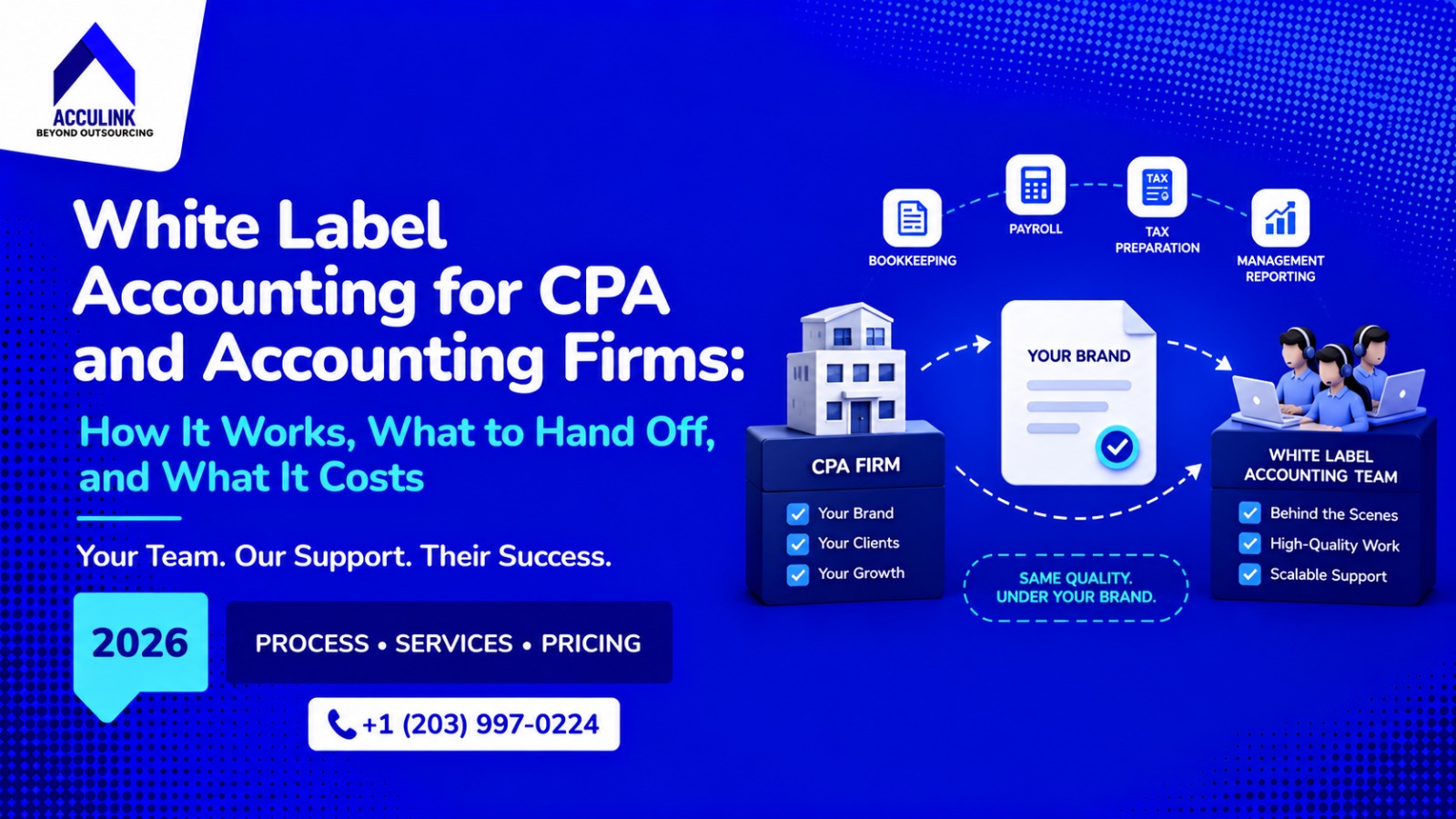
White Label Accounting for CPA and Accounting Firms: How It Works, What to Hand Off, and What It Costs
White label accounting helps CPA firms expand capacity while keeping control of their brand, client relationsh…