8 Best Financial Reporting and FP&A Tools for CPA and Accounting Firms (2027)
Summary
Compare automated financial reporting software and FP&A tools for CPA and accounting firms, including Fathom, Jirav, Reach Reporting, Spotlight, Syft, LivePlan, Datarails and Planful. Review pricing, forecasting, consolidation and integrations, then see how Acculink's published role-based reporting and FP&A support at $8 to $35 per hour can add capacity around your chosen platform.
Quick answer: Start with Fathom for reporting-led advisory, Jirav for driver-based forecasting, Reach Reporting for customized reports and portals, or Spotlight Reporting for an accounting-firm suite. Syft suits broad analysis, LivePlan fits business-plan engagements, Datarails supports Excel-centered finance teams, and Planful serves enterprise planning. Choose for the deliverable, data, client portfolio, forecast complexity, and review workflow.
This guide compares eight financial reporting, forecasting, and client advisory services (CAS) software options for U.S. CPA and accounting firms. Features and prices were checked against first-party vendor pages on November 4, 2026. Treat pricing as a dated planning snapshot for 2027, then confirm the package available when your firm buys.
Key takeaways
- Choose the deliverable before the tool. A management pack, rolling forecast, consolidated board pack, and lender-ready plan require different capabilities.
- Do not confuse a dashboard with an advisory process. Clean books, mapped accounts, defined KPIs, useful commentary, review, and a client conversation still have to happen.
- Compare the same client book. Vendors bill by company, organization, entity, user, integration, or module, so headline prices are rarely comparable.
- Test the difficult case. A multi-entity client with mapping differences and a forecast revision reveals more than a polished demo.
- Software and delivery capacity are separate decisions. The platform can automate collection and presentation, but people still reconcile data, investigate variances, prepare commentary, and resolve review notes.
Need more reporting and FP&A capacity? Acculink provides role-based support at $8 to $35 per hour. Use management reporting support for a defined workload or build a dedicated team for recurring capacity while your firm retains final review and client advice.
What is automated financial reporting software?
Automated financial reporting software connects to accounting or operational data and turns it into repeatable reports, dashboards, KPIs, forecasts, and consolidations. It reduces manual exporting and formatting, but it does not remove the need to close the books, validate mappings, review exceptions, or interpret results.
For accounting firms, CAS software supports client accounting and advisory services such as management reporting, budget versus actual analysis, cash-flow forecasting, scenarios, KPI monitoring, and virtual CFO work. The AICPA & CIMA client advisory services resource emphasizes turning financial information into actionable insights and delivering recurring advisory work consistently.
If the service package is still being defined, compare profitable add-on services for CPA and accounting firms, then select software around the deliverables the firm will actually sell and review.
For buyers comparing management reporting software for accounting firms, the useful dividing line is whether the platform only visualizes historical results or also supports budgets, scenarios, consolidation, and rolling forecasts. A tool marketed as rolling forecast software should be demonstrated using the firm's actual forecast frequency, horizon, and assumption changes.
Financial reporting software vs FP&A software
Financial reporting software primarily explains actual results through statements, KPIs, dashboards, consolidations, and management packs. FP&A software combines actuals with budgets, operational drivers, staffing plans, forecasts, and scenarios to model what may happen next.
Many products do both. For FP&A, prioritize assumption control, scenarios, forecast horizons, and budget-owner workflows. For reporting-led work, prioritize refreshes, account mapping, commentary, templates, and review efficiency. Define the metrics first with the CPA firm KPI guide, rather than expecting software to decide what matters.
Best financial reporting software for each use case
These are use-case starting points, not a universal ranking.
| Firm need | Strong starting point | Why it belongs on the shortlist |
|---|---|---|
| Recurring management reports and client advisory | Fathom | Branded reports, KPIs, three-way forecasts, benchmarking, and an accounting-firm portfolio option |
| Driver-based budgets and long-range FP&A | Jirav | Three-way financials, scenario comparisons, and higher-tier driver, staffing, and bottom-up models |
| Highly customized reports, live dashboards, and client portals | Reach Reporting | Flexible reports, multi-year three-way planning, consolidation, unlimited deliverables, and portal access |
| A packaged advisory suite for an accounting practice | Spotlight Reporting | Reporting, three-way forecasting, dashboards, consolidation, training, and organization-based firm plans |
| Analysis, broad integrations, consolidation, and flexible forecast periods | Syft Analytics | Reporting, dashboards, multi-level consolidation, and weekly, monthly, or annual four-way forecasts |
| Startup, lender, and business-plan engagements | LivePlan | Guided plans, full financial forecasts, scenarios, plan versus actuals, and QuickBooks/Xero connections |
| Excel-centered reporting and planning for mid-market finance | Datarails | Governed Excel workflows, custom reports, planning, multiple charts of accounts, and eliminations |
| Enterprise planning, close, reporting, and consolidation | Planful | A broad financial performance management platform for complex organizations and source systems |
See a complete client reporting pack.
Get a worked example with KPIs, variance commentary and a client-meeting agenda.
Pricing at a glance
Prices below were published in U.S. dollars and checked November 5, 2026. Taxes, promotions, implementation, add-ons, and partner terms can change the total. A company, connection, organization, and entity are not always the same billing unit.
| Software | Published price or pricing basis | Important pricing check |
|---|---|---|
| Fathom | Pro example: $450/month for 25 companies, plus $17 per extra company; Portfolio: $67/month for 100 companies; 51+ Pro companies use custom Enterprise pricing | Portfolio is for whole-book oversight and does not include Pro reporting, forecasting, or consolidation |
| Jirav | Accounting-firm wholesale rates: Controller Essentials from $50/month; CFO Enterprise from $150/month | Confirm partner eligibility and billing units. Driver-based planning, staffing, custom bottom-up models, longer horizons, and more scenarios are Enterprise capabilities |
| Reach Reporting | $149/month for 1 connection, $290 for 10, or $550 for 25; annual plans also published | Confirm how many company files and separate integrations count as connections, plus the white-label scope |
| Spotlight Reporting | Advisor Starter $349/month for up to 10 organizations; Growth $549 for 25; Scale $995 for 75; Enterprise by quote | Confirm the organization count, consolidation setup, and whether Spotlight Multi is required |
| Syft Analytics | Plan, entity, currency, and billing-commitment based; current total is calculated in the account | Request the exact Standard, Plus, or Advanced mix and confirm premium integration charges |
| LivePlan | Standard $20 monthly or $15/month paid annually; Premium $40 monthly or $30/month paid annually | Price the number of client workspaces and verify whether the workflow scales across your portfolio |
| Datarails | Custom quote for Professional, Premium, or Expert | Plans begin with 2, 5, or 15 users and 1, 2, or 3 integrations, respectively |
| Planful | Subscription tailored to company size, users, and selected modules | Request implementation, integration, support, and module costs, not only a platform fee |
Reporting, forecasting, and consolidation compared
| Software | Reporting and dashboards | Forecasting and planning | Consolidation | Data sources to verify |
|---|---|---|---|---|
| Fathom | Branded management reports, analysis, KPIs, benchmarking | Three-way cash-flow forecasts, budgets, scenarios, and what-if analysis on Pro | Multi-currency consolidation with eliminations, up to 300 entities | QuickBooks, Xero, MYOB, Sage, FreeAgent, Excel, Google Sheets |
| Jirav | Reports, executive summaries, KPI library, and real-time dashboards | One-year auto-generated planning on Essentials; drivers, staffing, bottom-up models, and up to seven years on Enterprise | Confirm the required entity and elimination workflow in the demo | QuickBooks, Xero, Sage Intacct, NetSuite, Excel, Google Sheets, workforce data |
| Reach Reporting | Custom live reports, dashboards, storytelling, and client portal | Three-way FP&A, multi-year plans, and AR, AP, inventory, and cash projections | Multi-currency consolidations | QuickBooks Online/Desktop, Xero, MYOB, Digits, Gusto, Google Sheets, CSV trial balance |
| Spotlight Reporting | Management reporting, dashboards, and AI-assisted executive summaries | Three-way forecasts, budgets, and scenarios | Consolidation is included; Spotlight Multi is a separate aggregation and benchmarking tool | Xero, QuickBooks Online/Desktop, MYOB, Sage 50cloud, Google Sheets, Excel |
| Syft Analytics | Financial reports, dashboards, scorecards, analysis, and AI-assisted insights | Four-way monthly and annual forecasts; weekly forecasting requires Advanced | Multi-level and multi-currency consolidation with plan-dependent elimination features | Xero, QuickBooks, Sage, Sage Intacct, MYOB, other ERPs, ecommerce, payroll, file uploads |
| LivePlan | Plan versus actual dashboards and lender-ready plan outputs | Integrated profit and loss, balance sheet, and cash-flow forecasts with scenarios | Not positioned as a multi-entity consolidation platform | QuickBooks Online and Xero |
| Datarails | Custom Excel-connected reports, live dashboards, and AI storyboards | Budgets, forecasts, rolling models, workflows, and version control | Multiple charts of accounts, currency translation, and intercompany eliminations | One to three integrations by plan, plus governed Excel-based workflows |
| Planful | Enterprise reporting, analysis, and dashboards | Financial, workforce, and operational planning | Financial close, currency translation, and consolidation | ERP, HRIS, CRM, data warehouse, and BI systems, including NetSuite, Workday, Salesforce, Snowflake, and Power BI |
How this comparison was built
We compared client deliverables, reporting and forecast depth, consolidation, integrations, pricing units, and plan restrictions. Capabilities and prices were checked against first-party product pages, pricing pages, and help documentation on November 5, 2026.
The products are not identical. Fathom, Reach, Spotlight, and Syft are reporting-led; Jirav, Datarails, and Planful are broader planning platforms; LivePlan centers on business planning. Use representative client data to test imports, refreshes, forecast revisions, review, and total portfolio cost.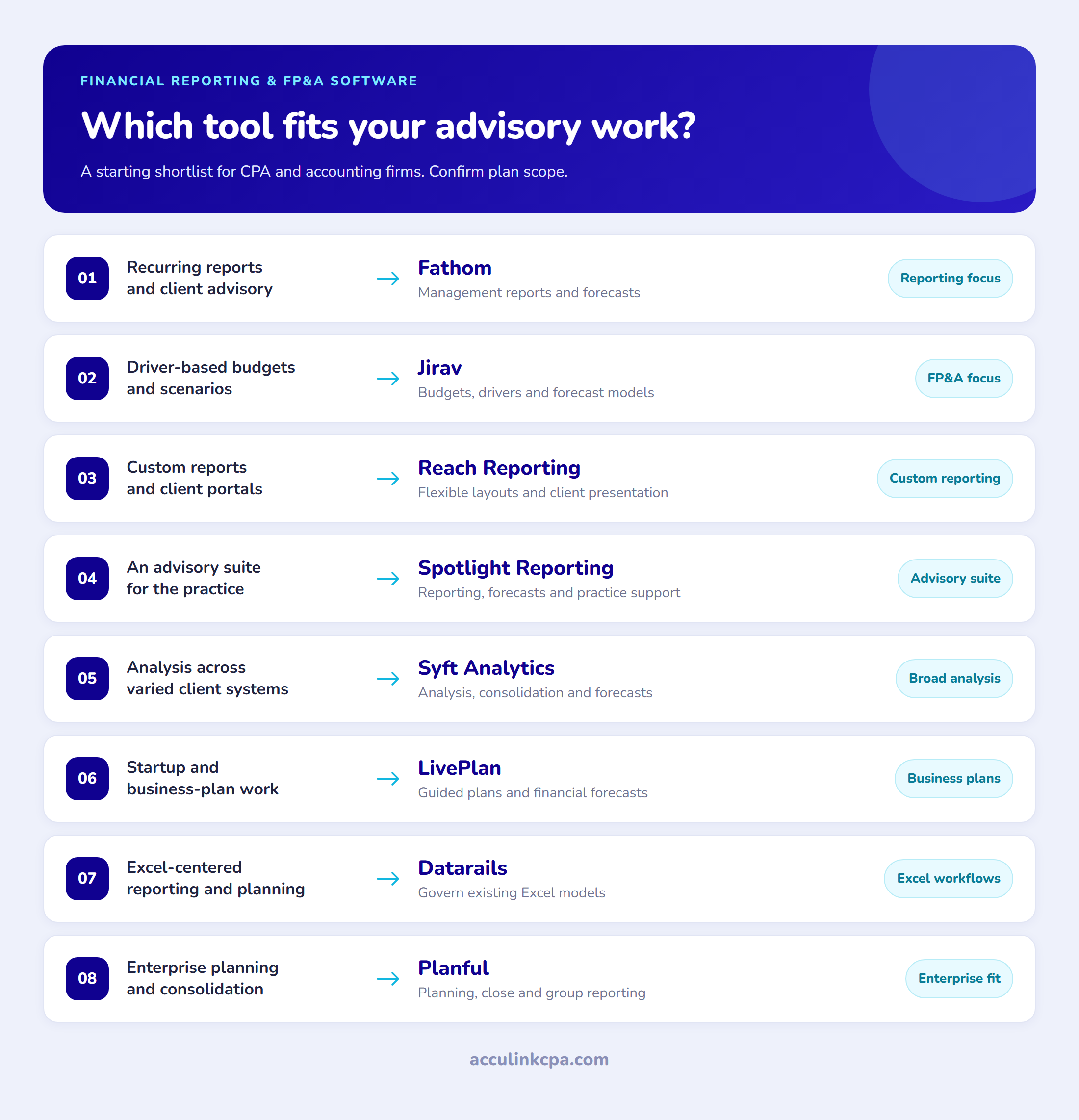
1. Fathom: best starting point for reporting-led advisory
Fathom combines management reports, KPI analysis, benchmarking, forecasting, and consolidation, with separate options for full advisory work and portfolio monitoring.
Why firms shortlist it: Pro includes branded reports, custom KPIs, three-way forecasts, budgets, scenarios, and multi-currency consolidation with eliminations. It connects to QuickBooks Online and Desktop, Xero, other accounting sources, Excel, and Google Sheets.
Best for: recurring monthly or quarterly management packs, KPI reviews, advisory meetings, and multi-entity clients.
Watch-outs: Portfolio provides whole-book oversight, trends, and summaries, but a company needs Pro for advanced analysis, custom reports, forecasts, and consolidation. Demonstrate any required 13-week cash model or transaction-level drill-down.
Pricing: $450 per month for 25 Pro companies, plus $17 per extra company; $67 per month for 100 Portfolio companies. More than 50 Pro companies use Enterprise pricing.
2. Jirav: best for forecast-led and FP&A advisory
Jirav emphasizes planning, drivers, staffing, and long-range scenarios. It fits engagements that begin with a budget or operating model.
Why firms shortlist it: current products include three-way financials, budget versus actual analysis, dashboards, KPI templates, scenario comparisons, white labeling, and permissions. The higher tier adds drivers, workforce planning, custom bottom-up models, five active scenarios, and a seven-year horizon.
Best for: firms building repeatable FP&A services, headcount plans, departmental budgets, and longer-range scenarios.
Watch-outs: Controller Essentials has auto-generated planning, two plans, and a one-year horizon; advanced drivers and staffing models require CFO Enterprise. If consolidation matters, request a demonstration using the real entity structure.
Pricing: accounting-firm wholesale rates start at $50 per month for Controller Essentials and $150 for CFO Enterprise. Confirm partner eligibility, billing units, users, departments, and integrations.
3. Reach Reporting: best for report customization and client presentation
Reach Reporting combines flexible report design, live dashboards, a client portal, data storytelling, three-way planning, and consolidation.
Why firms shortlist it: published plans include unlimited users and deliverables, templates, branding, multi-currency consolidation, three-way FP&A, multi-year planning, dashboards, and portal access. Connections include QuickBooks Online and Desktop, Xero, and other sources.
Best for: firms that want to standardize branded reports while retaining flexibility for special client layouts and board packs.
Watch-outs: Reach says monthly data is its lowest tracking period. Validate another workflow for daily, weekly, or transaction-level needs. Confirm which screens, emails, domains, and deliverables can be white-labeled.
Pricing: monthly pricing is $149 for one connection, $290 for 10, and $550 for 25. Published annual totals are $1,548, $2,436, and $4,620, respectively.
4. Spotlight Reporting: best packaged suite for an accounting practice
Spotlight Reporting packages reporting, three-way forecasting, dashboards, consolidation, training, and practice support into organization-based plans.
Why firms shortlist it: plans include management reporting, budgets, cash-flow forecasts, KPI dashboards, multi-currency consolidation, certification, onboarding, and training. Connections include Xero, QuickBooks Online and Desktop, MYOB, Sage 50cloud, Google Sheets, and Excel.
Best for: firms that want one suite and a structured practice enablement program across a defined number of client organizations.
Watch-outs: Spotlight Multi, its aggregation and benchmarking product, is separate. Confirm whether the use case requires it and how consolidated entities count for billing.
Pricing: Advisor Starter is $349 per month for up to 10 organizations, Advisor Growth is $549 for 25, and Advisor Scale is $995 for 75. Enterprise pricing is by quote for more than 75 organizations.
5. Syft Analytics: best for broad analysis and flexible forecast periods
Syft Analytics covers reports, dashboards, scorecards, forecasts, and consolidation across varied data sources. Its four-way forecast adds financial ratios and operational connections to the profit and loss, balance sheet, and cash flow model.
Why firms shortlist it: forecasts can be monthly or annual for up to ten years, or weekly for up to 52 weeks. Weekly forecasting requires Advanced. Syft can consolidate data from accounting systems, trial balances, transaction lists, and ERPs.
Best for: firms that need analysis and consolidation across varied client systems or want both longer-range and short-horizon forecast options.
Watch-outs: plan limits apply to cash-flow forecast tables, multi-currency consolidation, transaction-level eliminations, consolidation-of-consolidations, and some controls. Quote the required features, not the lowest plan.
Pricing: Syft calculates the current subscription from the selected entities, plans, currency, and billing commitment. Request a written quote for the exact mix of Standard, Plus, and Advanced entities, including premium integrations.
6. LivePlan: best for startup and business-plan advisory
LivePlan centers on creating and presenting a business plan, with guided planning, lender-ready outputs, forecasts, scenarios, plan versus actual dashboards, and QuickBooks Online and Xero connections.
Why firms shortlist it: clients can move from narrative assumptions to projected profit and loss, balance sheet, and cash flow statements in one workflow. Premium adds deeper research, scenarios, and analysis.
Best for: startup plans, funding applications, business-plan engagements, and owner-friendly scenario discussions.
Watch-outs: LivePlan is not a broad multi-client reporting or multi-entity consolidation platform. For recurring monthly packs, compare Fathom, Reach, Spotlight, or Syft.
Pricing: Standard is $20 monthly or $15 per month paid annually. Premium is $40 monthly or $30 per month paid annually.
7. Datarails: best for Excel-centered mid-market finance
Datarails preserves Excel models while adding centralized data, dashboards, workflows, permissions, version control, and AI-assisted analysis.
Why firms shortlist it: FinanceOS includes reporting, planning, dashboards, data mapping, review workflows, custom reports, multiple charts of accounts, currency translation, allocations, and eliminations. It can govern existing Excel models instead of forcing an immediate rebuild.
Best for: mid-market client finance teams, complex report structures, multi-entity groups, and advisory work that depends on existing Excel models.
Watch-outs: this is usually a larger implementation than client-reporting software. Professional includes two users and one integration, Premium five users and two integrations, and Expert 15 users, 50 viewers, and three integrations. Map contributors, viewers, sources, and modules first.
Pricing: Datarails uses custom quotes for Professional, Premium, and Expert. Do not substitute an unverified third-party range for the vendor's proposal.
8. Planful: best for enterprise financial performance management
Planful combines financial and operational planning, reporting, workforce planning, close, and consolidation in an enterprise platform.
Why firms shortlist it: Planful connects ERP, HRIS, CRM, warehouse, and BI environments and supports eliminations, currency translation, enterprise reporting, and multiple planning processes.
Best for: larger organizations with several systems, formal close and consolidation needs, cross-functional planning, and a finance transformation budget.
Watch-outs: Planful can be excessive for small-business reporting. Compare implementation, integration, administration, training, support, and modules. Enterprise breadth does not automatically improve a ten-client pilot.
Pricing: Planful uses a subscription tailored to company size, user count, and selected modules. Request an itemized proposal covering software, implementation, integrations, support, and expansion costs.
The direct comparisons firms ask most often
Jirav vs Fathom
Choose Fathom for polished management reports, KPI packs, benchmarks, and recurring reviews. Choose Jirav for driver-based budgets, staffing plans, and long-range scenarios. Both support three-way financial work, but their workflows differ.
Fathom vs Reach Reporting
Choose Fathom for structured reporting and a separate portfolio-monitoring tier. Choose Reach for deeper report customization, dashboards, portal access, and three-way planning across published plans. Test the same client pack in both.
Fathom vs Spotlight Reporting
Fathom separates full Pro work from Portfolio monitoring. Spotlight bundles reporting, forecasting, dashboards, consolidation, training, and practice support into organization tiers. Compare advisory-client volume, training, consolidation, and benchmarking needs.
LivePlan vs Fathom
Use LivePlan for guided business plans, funding narratives, startup forecasts, and owner-facing scenarios. Use Fathom for recurring management reporting, KPI analysis, benchmarking, and portfolio advisory.
Datarails vs Planful
Choose Datarails to preserve and govern Excel-centered workflows. Choose Planful for enterprise planning, workforce, close, consolidation, reporting, and multiple source systems. Compare implementation and administration, not just features.
What the software costs across a 25-client book
Convert every proposal to the same billing unit before comparing it. For example, the public 25-company tiers reviewed for this article produce the following simple monthly arithmetic:
- Fathom Pro: $450 / 25 companies = $18.00 per company.
- Reach Reporting: $550 / 25 connections = $22.00 per connection.
- Spotlight Advisor Growth: $549 / 25 organizations = $21.96 per organization.
These figures are not a cheapest-software ranking. The three packages differ in features, training, branding, data handling, and billing definitions. They also exclude taxes, implementation, optional services, and the labor required to close the books, build the report, review commentary, and lead the client meeting.
Fathom Portfolio illustrates why scope matters. Its published 100-company price works out to $0.67 per company, but those companies do not receive Fathom Pro's custom reports, forecasts, or consolidations. Use Portfolio for its stated oversight purpose, not as a full-advisory price comparison.
How to choose software for an accounting firm
1. Define the client deliverable
Write down the exact output: board pack, KPI dashboard, budget versus actual report, 13-week cash forecast, annual budget, scenario model, consolidated report, or business plan. A vague requirement for “better insights” produces a poor demonstration. If the real need is internal deadlines, billing, or task coordination, this is the wrong software category.
2. Segment the client book
Group clients by accounting system, entities, reporting frequency, close quality, forecast complexity, KPIs, and meeting cadence. Choose a preferred platform for the common pattern and define justified exceptions.
3. Verify the data path
Ask what imports automatically, refresh frequency, editable periods, and how mappings are maintained. Confirm classes, locations, departments, tracking categories, eliminations, currencies, budgets, and non-financial data. “Integrates with QuickBooks” is not enough.
4. Test review and permissions
Give the preparer, reviewer, partner, and client realistic roles. Check whether reviewers can identify changed assumptions, mapping edits, stale data, and revised commentary. Test offboarding without losing required records.
5. Compare total operating cost
Add subscriptions, implementation, training, integrations, template build, preparation, review, and client-meeting time. Include exceptions across multiple tools. Cheap software that creates partner rework is not a lower-cost model.
6. Pilot representative clients
Use a clean single-entity client, one with departments or classes, and a multi-entity or forecast-heavy client. Run a complete close-to-meeting cycle before expanding.
A practical reporting workflow after the software is chosen
- Close and reconcile the books. Resolve uncategorized activity, missing entries, balance-sheet reconciliations, and unusual movements.
- Maintain the reporting map. Standardize account groups, departments, eliminations, KPIs, and forecast assumptions, with named owners for changes.
- Refresh and validate. Confirm the period, tie totals to the ledger, review failed imports, and investigate variances.
- Prepare the deliverable. Update the report, variance explanations, action items, and required scenarios.
- Apply maker-checker review. A second person checks material balances, mappings, calculations, narrative, and open questions.
- Lead the client conversation. The responsible firm interprets results, applies judgment, agrees actions, and records decisions.
- Improve the next cycle. Turn repeated questions into better KPI definitions, data requests, mapping rules, or templates.
The accounting outsourcing process guide provides a fuller framework for intake, secure access, preparation, review, sign-off, and feedback when work is shared with an external team.
Spend more time on the client conversation.
Add support for report packs, variance analysis and forecast updates in your firm's workflow.
Where an outsourced reporting or FP&A team fits
Automated reporting software reduces manual collection and formatting. It does not prepare every reconciliation, investigate every variance, maintain every forecast assumption, or write client-specific commentary without review.
Acculink's management reporting support can help U.S. CPA and accounting firms prepare recurring report packs, dashboards, and variance analysis in the firm's chosen stack. For budgets, rolling forecasts, scenario models, and financial analysis, scope the work through FP&A outsourcing support. CFO-level interpretation and client leadership can remain with the firm's partner or be scoped separately through virtual CFO services.
Define who closes the books, refreshes data, maintains mappings, prepares drafts, reviews exceptions, approves commentary, and leads meetings. Use named accounts, least-privilege permissions, and a separate reviewer. Compare Acculink's data security controls with the firm's requirements and each vendor's controls.
Acculink offers role-based support from $8 to $35 per hour, depending on experience and scope, and a 40-hour free trial with no setup fee or long-term lock-in. Use the trial on one defined reporting cycle, not an undefined list of tasks. The engagement model and dedicated-team option explain how recurring capacity can fit around the software your firm already uses.
The fractional CFO services guide explains where higher-level interpretation, forecasting, and client meetings fit.
Frequently asked questions
What is automated financial reporting software?
Automated financial reporting software connects accounting and operational data to repeatable reports, dashboards, KPIs, forecasts, or consolidations. It can reduce exporting and formatting, but the firm still needs clean source data, controlled mappings, review, and interpretation.
What is CAS software for accounting firms?
CAS software supports client accounting and advisory services such as management reporting, KPI analysis, budgeting, forecasting, scenarios, consolidation, and virtual CFO work. The best product depends on the service package the firm intends to deliver.
What is the best financial reporting software for accounting firms?
Fathom is a strong general starting point for reporting-led advisory, Jirav for driver-based FP&A, Reach Reporting for customized reports and portals, and Spotlight for a packaged accounting-firm suite. Syft, LivePlan, Datarails, and Planful fit more specific integration, business-planning, Excel-centered, or enterprise needs.
Is Jirav or Fathom better for advisory work?
Fathom is usually the better starting point when the main deliverable is a management report, KPI pack, benchmark, or recurring client review. Jirav is usually the better starting point when the engagement centers on drivers, staffing plans, departmental budgets, and longer-range scenarios.
Is Fathom or Reach Reporting better?
Fathom suits firms wanting structured reporting, analysis, benchmarking, and a separate portfolio-monitoring tier. Reach Reporting suits firms prioritizing flexible report design, live dashboards, portal access, and three-way planning on all published plans. Test the same client workflow in both.
Which financial reporting tools connect to QuickBooks Online and Xero?
Fathom, Jirav, Reach Reporting, Spotlight Reporting, Syft Analytics, and LivePlan publish connections to QuickBooks Online and Xero. Support for Desktop, classes, locations, tracking categories, budgets, transaction detail, and refresh frequency varies, so verify the exact data path.
Which tools support multi-entity consolidation?
Fathom, Reach Reporting, Spotlight Reporting, Syft Analytics, Datarails, and Planful publish consolidation capabilities. Currency translation, eliminations, transaction detail, entity limits, and plan availability differ. Demonstrate the firm's real entity structure before buying.
How much does financial reporting software cost for an accounting firm?
Published examples include LivePlan at $20 monthly and Jirav Controller Essentials at an accounting-firm wholesale starting rate of $50 monthly. Multi-client firm plans can cost several hundred dollars per month. Datarails and Planful use custom quotes. Compare the same number of clients, entities, users, integrations, and required features.
Can financial reporting software replace Excel?
It can replace many manual exports, recurring formatting steps, and disconnected report files. Excel may still be useful for specialized models, data preparation, and ad hoc analysis. Datarails is specifically designed to govern Excel-centered workflows rather than eliminate them.
Can an offshore financial analyst work in our reporting software?
Yes, when the vendor permits the required access and the analyst has suitable platform and accounting experience. Assign individual accounts and limited permissions, define the preparation and review steps, and keep final interpretation, client communication, and approval with the responsible firm. Acculink can scope management reporting or FP&A support around the selected platform and client workload.
Choose the operating model, not just the feature list
The best accounting advisory software is the platform your firm can run consistently across real clients. Define the deliverable, shortlist by use case, compare the same portfolio, and pilot a full reporting cycle. Then separate the software subscription from the people and review capacity needed to deliver the service.
Grow advisory capacity around your software.
Management reporting and FP&A support, with your firm leading the client relationship.
Tags:
About the Author

Related Posts
Top 10 Audit Support Outsourcing Companies for CPA and Accounting Firms (2026)
Compare ten audit support outsourcing companies for U.S. CPA and accounting firms. This guide separates manage…
Top Tax Outsourcing Companies for CPA and Accounting Firms (2026 Rankings)
The top tax outsourcing companies for CPA firms in 2026 are Acculink CPA, QX Accounting Services, CapActix, Da…
Top 10 Offshore Staffing Companies for Accounting Firms (2026)
Hiring an offshore team is one of the highest-leverage moves a short-staffed CPA firm can make, but the partne…
Top Outsourced Accounting Firms for CPA Practices (2026)
Choosing an outsourced accounting partner is a high-stakes call because the team touches your clients' data. T…